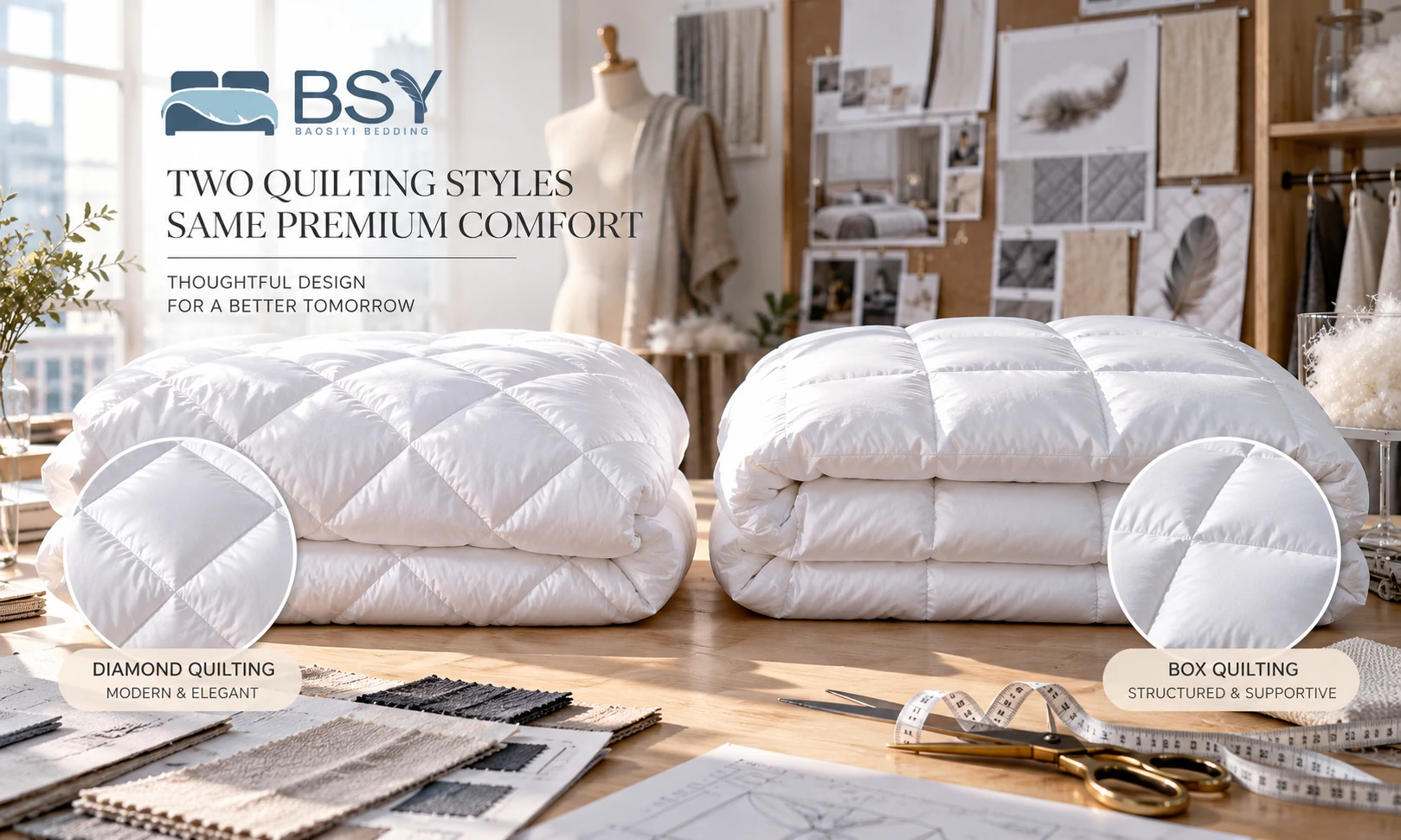
Diamond Quilting vs. Box Quilting: Aesthetics and Fiber Shift Control in Bedding
October 20, 2026When browsing luxury retail catalogs or inspecting hotel guest rooms, comforter stitching patterns catch the eye immediately. Consumers notice crisp diamond grids, clean minimalist squares, or elegant flowing waves.
However, for home textile product developers, retail buyers, and hospitality procurement directors, quilting is far more than a visual styling decision. It is an essential mechanical engineering solution.
In commercial bedding, the exterior shell fabric and interior filling material naturally want to pull apart under the dynamic friction of human sleep and the violent shear forces of commercial laundering. Without an engineered quilting matrix, fillings drift toward the perimeter, leaving cold, uninsulated voids across the center of the bed.
Choosing between the two industry standards—Square Box Quilting and Diamond (Rhombus) Quilting—involves critical trade-offs between body-contouring drape, filling containment, thermal bridge management, and automated factory production costs.
This engineering manual breaks down the mechanical physics, aesthetic identities, and manufacturing economics of both quilting geometries to help commercial sourcing teams specify the ideal pattern for their product portfolios.
1. The Physics of Quilting Geometry: Fiber Migration and Thermal Dynamics
To evaluate quilting patterns objectively, sourcing teams must examine the physical forces acting upon a comforter during real-world sleep.
Gravity, Restless Sleep, and Lateral Migration Pressures
During a standard eight-hour sleep cycle, an adult moves, shifts, and turns between 20 and 40 times.
Each bodily movement exerts a lateral shearing force on the comforter:
- The sleeper’s weight pulls the central fabric down while tossing forces push the internal fibers outward toward the bed edges.
- Over weeks of continuous use, gravity and friction pull loose down clusters and synthetic microfibers downward and outward, resulting in the dreaded “empty comforter” defect where the center is flat while the outer edges are swollen with displaced filling.
Pocket Volume vs. Perimeter Seam Tension
Quilting counters this displacement by dividing a massive two-dimensional expanse into dozens of isolated, self-contained micro-compartments.
Each compartment acts as a physical containment cell:
- The smaller the pocket, the less internal distance fibers can travel.
- However, excessive stitch lines introduce more needle punctures, flatten surface loft, and create conductive cold bridges where heat escapes.
Impact of Stitch Geometry on Comforter Drape (Bending Modulus)
A flat sheet of fabric resists bending along random axes. Quilted seam lines act as flexible mechanical hinges:
- Where a needle stitches through the shell, the fabric can easily fold and articulate.
- How those stitch lines intersect—whether orthogonal at 90 degrees or diagonal at 45 degrees—fundamentally dictates how the finished comforter contours around a sleeper’s shoulders, chest, and hips.
2. Square Box Quilting: The Classic Symmetrical Workhorse
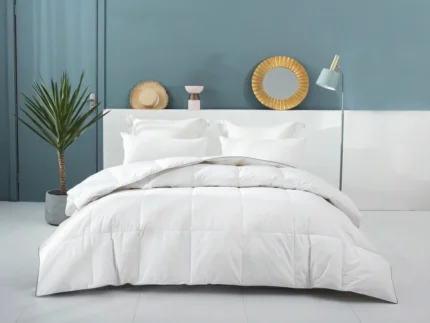
Square box quilting (often called grid quilting) represents the historical standard of commercial duvet production, serving as the default specification for five-star hotels and volume retail programs worldwide.
Symmetrical Load Distribution Across Horizontal and Vertical Axes
The primary mechanical advantage of square box quilting is orthogonal symmetry:
- Square compartments maintain identical dimensions along both the X-axis (width) and Y-axis (length).
- Mechanical tension, down expansion pressure, and laundering pull forces are distributed with complete uniformity across the bed.
- Regardless of whether a comforter is turned horizontally or vertically, the structural load on individual seams remains identical.
Standard Commercial Grid Dimensions
In commercial manufacturing, square grid sizing is tightly standardized:
- 25 x 25 cm (Small Grid): Maximum fiber containment. Ideal for lightweight summer comforters, high-turnover institutional bedding, and feather-rich blends where quill movement must be strictly restricted.
- 30 x 30 cm to 35 x 35 cm (The Commercial Golden Ratio): The global standard for luxury hospitality and department store all-season duvets. Delivers optimal volumetric loft expansion without permitting noticeable down migration.
- 40 x 40 cm to 45 x 45 cm (Oversized Box): Reserved strictly for high-fill-power white goose down (750+ FP), giving expansive down plumes the uninhibited cubic volume required to achieve deep, cloud-like loft.
Natural Compatibility with 3D Baffle Walls
Square box geometry is the natural engineering foundation for 3D Baffle-Box Construction:
- Sewing vertical mesh walls in perpendicular straight lines is structurally efficient and easily automated.
- It creates clean cubic chambers that hold down clusters directly over seam intersections, eliminating thermal cold spots across winter-weight bedding.
Primary Sourcing Applications
- 4-star and 5-star commercial hotel chains and luxury resort portfolios.
- Heavyweight winter comforters (9.0 Tog to 15.0 Tog) filled with natural goose or duck down.
- Classic, high-street department store private-label bedding collections.
3. Diamond (Rhombus) Quilting: Dynamic Aesthetics and Directional Drape
While square boxes dominate traditional hospitality, diamond quilting (stitching rotated at a 45-degree angle to create rhombus patterns) has emerged as the premier choice for modern, lifestyle-focused bedding brands.
The Diagonal Bias Advantage (Enhanced Fluidity)
Woven fabrics (like cotton percale or sateen) possess structural warp and weft yarns intersecting at 90 degrees. Fabric has virtually zero stretch along the straight grain, but exhibits natural elasticity along the 45-degree diagonal bias:
- Diamond quilting lines run parallel to the fabric’s diagonal bias.
- As a result, the stitched comforter gains remarkable fluidity. When a sleeper pulls the comforter, the diamond pattern flexes effortlessly, draping tightly around the neck and shoulders to eliminate cold air gaps.
Acute Angle Fiber Containment (The Wedge Friction Effect)
A subtle engineering advantage of diamond quilting is its corner geometry:
- In a square box, all four corners meet at open 90-degree right angles.
- In a diamond pattern, two corners are acute (typically 60 degrees) and two are obtuse (typically 120 degrees).
- The narrow, acute corner angles create a natural wedge friction trap. Loose synthetic microfibers that shift toward the upper and lower corners become physically pinched by the converging seam lines, naturally arresting lateral migration.
Contemporary Retail Merchandising and Lifestyle Branding
Aesthetically, square box quilting can look utilitarian and institutional.
Diamond stitching breaks visual monotony:
- It introduces dynamic diagonal energy that makes beds look tailored, modern, and high-end.
- It is widely specified by direct-to-consumer (DTC) brands, Scandinavian-inspired home furnishing retailers, and boutique urban lifestyle hotels seeking an upscale, designer presentation.
Primary Sourcing Applications
- Lightweight summer quilts, air-conditioned coverlets, and all-season bed blankets.
- Ultra-fine blown microfiber and down-alternative comforters where fluid drape is prioritized.
- Top-of-bed decorative bedding designed to be displayed without an exterior duvet cover.
4. Alternative Quilting Geometries: Channel, Wave, and Ultrasonic Patterns
While square and diamond patterns command over 80% of global wholesale volume, specialized comforter lines deploy alternative geometries.
Linear Channel Quilting (Vertical Stripes)
- The Architecture: Continuous, unbroken straight lines running from the top of the bed to the bottom, without horizontal cross-stitches.
- The Sourcing Reality: Channel quilting allows ultra-fast automated production at the lowest factory labor cost. However, because there are no horizontal barriers, down clusters slide directly down to the foot of the bed within days.
- Engineering Rule: Channel quilting should never be used with loose down or blown micro-clusters. It is suitable only for resin-bonded or needle-punched continuous polyester batting that is mechanically anchored at the outer perimeter seams.
Ergonomic Contour & Wave Quilting
- The Architecture: Flowing, continuous S-curve wave stitching designed to mirror human anatomical contours.
- The Application: Highly popular in technical cooling bedding and orthopedic sleep lines. The wave lines prevent the flat, rigid feeling of straight seams, creating an ultra-modern aesthetic for functional sleep collections.
Ultrasonic (Threadless) Embossed Patterns
- The Architecture: High-frequency acoustic energy melts synthetic polyester fibers and shell fabrics together in intricate floral, geometric, or mini-diamond patterns without needles or threads.
- The Commercial Trade-Off: 100% leak-proof with zero needle puncture holes, and exceptionally inexpensive in mass volume. However, it creates a relatively flat, stiff comforter with minimal vertical loft, restricting its use to budget bedspreads and lightweight summer coverlets.
5. Manufacturing Complexity and Factory Cost Impacts
Quilting pattern selection directly influences machinery programming, factory throughput speed, and wholesale FOB pricing.
Computerized Multi-Needle Quilting vs. Single-Needle CNC Frame Quilting
- Continuous Multi-Needle Quilting: A wide automated machine operating dozens of synchronized needle heads stitches continuous rolls of fabric and batting simultaneously. Ideal for continuous diamond and small square patterns on synthetic batting. Delivers ultra-high production speed (hundreds of units per hour) at minimal unit labor cost.
- Single-Needle CNC Frame Quilting: An individual comforter shell is clamped into an expansive mechanical frame, and a single high-speed computerized sewing head travels across the fabric following digital CAD coordinates. Mandatory for high-fill natural down duvets and individual 3D baffle-box assemblies. Labor-intensive with lower hourly output, generating higher manufacturing overhead.
Thread Consumption and Cycle Times
Diamond patterns require longer continuous thread lines per square meter than square grids of equivalent spacing:
- An average Queen-size duvet with a 20 x 20 cm diamond pattern consumes approximately 35% more sewing thread than a 30 x 30 cm square box.
- The increased thread consumption and directional machine changes add 15% to 25% to total machine cycle time, resulting in a modest factory price premium.
Comprehensive Geometric Comparison Matrix
| Engineering Metric | Square Box Quilting | Diamond (Rhombus) Quilting | Linear Channel Quilting | Ultrasonic Wave Quilting |
| Fiber Migration Control | Excellent (Isolated cells) | Very Good (Wedge friction) | Very Poor (Unchecked drift) | Complete (Thermo-welded) |
| Body Contouring Drape | Balanced, structured | Superior (45° bias drape) | Poor (Folds only on 1 axis) | Moderate to Rigid |
| 3D Baffle-Box Compatibility | Native (Industry standard) | Extremely Complex / Rare | Incompatible | Incompatible |
| Thermal Cold Bridge Risk | Low (if paired with baffles) | Moderate (Higher seam ratio) | Severe along channels | High (Flattened welds) |
| Thread Consumption | Baseline | + 25% to 35% | – 40% (Lowest) | Zero (Threadless) |
| Factory Throughput Speed | High (Standard CNC/Multi) | Moderate to High | Ultra-High | Maximum Volume |
| FOB Price Impact | Baseline | + $0.80 – $1.50 per unit | – $1.20 – $2.00 per unit | – $2.50 – $3.50 per unit |
| Optimal Filling Partner | Goose & Duck Down | Blown Microfiber & Batting | Continuous Poly Wadding | Synthetic Sheet Batting |
6. Matching Quilting Patterns to Fillings and Shell Fabrics
To avoid product failure, commercial buyers must pair quilting geometry with the physical behavior of the internal filling and outer casing.
Natural Down & Feathers: The Absolute Primacy of Square Baffle Boxes
Natural down plumes are fluid, three-dimensional spheres that expand radially.
- Attempting to construct a 10.5 Tog or 13.5 Tog down duvet with a sewn-through diamond pattern compresses the plumage, creating an excessive density of flattened seam lines that destroy thermal insulation.
- Best Practice: Natural waterfowl down comforters should always utilize Square Box Quilting with internal 3D vertical baffle mesh walls (30 x 30 cm or 35 x 35 cm).
Synthetic Microfiber Batting and Blown Clusters: Thriving Under Diamond Grids
Synthetic fibers behave differently than down:
- Carded microfiber webs and loose 0.8D/1.2D blown clusters lack rigid quills and are highly compliant.
- Diamond quilting complements synthetic fibers by breaking up the artificial springiness of polyester, creating an organic, fluid drape that makes synthetic comforters feel significantly softer and more down-like to the touch.
Shell Fabric Tension and Seam Puckering
When sewing diamond patterns across high-thread-count woven cotton (such as 300T or 400T sateen), sewing across the fabric bias can pull warp and weft yarns unevenly, creating unsightly diagonal fabric puckering (creasing).
Quality-certified export factories must deploy:
- Differential Feed Tension Controls on computerized quilting carriages.
- Pre-Shrunk Casings to ensure that stitch lines lay completely flat without puckering along diagonal seam intersections.
7. Purchase Order Sourcing Guidelines & Quality Tolerances
When drafting a commercial Purchase Order (PO) for custom-quilted bedding, enforce these technical quality parameters:
- Mandate Grid Dimensional Tolerances: Specify: Quilting grid dimensions shall maintain a maximum variance of ±5 mm across all boxes throughout the finished duvet.
- Require Seam Intersection Reinforcement: State: All four-way stitch intersections must be tightly locked with zero skipped stitches, loose thread loops, or needle cut-throughs on the shell fabric.
- Control Stitch Density: Require: Quilting lockstitching must maintain a consistent stitch density of 10 to 12 stitches per inch (SPI) using high-tenacity core-spun polyester thread.
- Enforce Back-Tacking on Perimeter Borders: Ensure: Every continuous quilting line must be secured at the perimeter seam with a minimum 3-stitch back-tack to prevent unraveling during commercial laundering.
- Mandate 100% Backlit Table Inspection: Require: Every finished quilted unit must pass illuminated inspection on a frosted glass LED table to verify uniform fill distribution and zero empty corners.
8. Frequently Asked Questions (FAQ)
Does diamond quilting prevent fiber shifting better than square box quilting?
Both patterns provide excellent fiber shift control when properly sized, but they achieve it through different mechanics. Square box quilting relies on fully enclosed, symmetrical compartments that hold equal volumes of filling across horizontal and vertical planes. Diamond quilting creates acute corner angles that wedge and trap synthetic fibers, slowing lateral drift while providing a more supple, body-contouring drape along the diagonal bias of the fabric.
Why is square box quilting the industry standard for natural down winter duvets?
Square box quilting is the universal standard for winter down duvets because it integrates seamlessly with 3D internal baffle-box walls. Sewing vertical mesh partitions in a square grid allows down clusters to expand to their full volumetric loft uniformly across the bed, eliminating thermal cold spots. Sewing internal 3D baffle walls into complex diamond or wave patterns is labor-prohibitive and increases manufacturing costs without adding thermal value.
How does quilting pattern geometry affect the factory manufacturing cost of a comforter?
Quilting geometry directly affects sewing machine cycle times and thread consumption. A dense 20 x 20 cm diamond pattern requires roughly 30% more continuous thread and 20% more machine run time than a standard 30 x 30 cm square box grid, resulting in an FOB price increase of approximately $0.80 to $1.50 per unit. Conversely, open channel quilting runs significantly faster, reducing manufacturing costs but sacrificing filling stability.
Can diamond quilting be combined with internal 3D baffle-box walls?
Technically yes, but commercially it is rarely executed. Assembling internal vertical mesh walls along 45-degree diagonal lines requires intricate manual pre-stitching and complex chamber blowing paths, which slows factory throughput and increases labor costs by over 40%. For luxury down bedding, square baffle boxes deliver superior thermal consistency at a far more viable commercial cost point.
Conclusion: Selecting the Winning Quilting Geometry for Your Brand
In commercial bedding procurement, quilting geometry is the hidden structural bridge between product design and functional performance.
- Specify Square Box Quilting (30 x 30 cm with 3D Baffle Walls) when sourcing premium, all-season, and heavy-winter down comforters for five-star hotel portfolios and traditional department stores where maximum volumetric loft and thermal consistency are paramount.
- Specify Diamond Quilting when developing lightweight summer quilts, coverlets, and down-alternative microfiber lines for modern retail and DTC lifestyle brands where superior body-contouring drape and contemporary visual styling drive purchasing decisions.
Located in the textile manufacturing capital of Xiaoshan, Hangzhou, BSY Bedding operates an advanced fleet of multi-needle computerized quilting machinery, single-needle CNC frame stitchers, and automated baffle-box injection lines. We engineer precision-quilted commercial duvets, comforters, and coverlets in custom square, diamond, wave, and bespoke geometric patterns tailored to international retail and hospitality specifications.