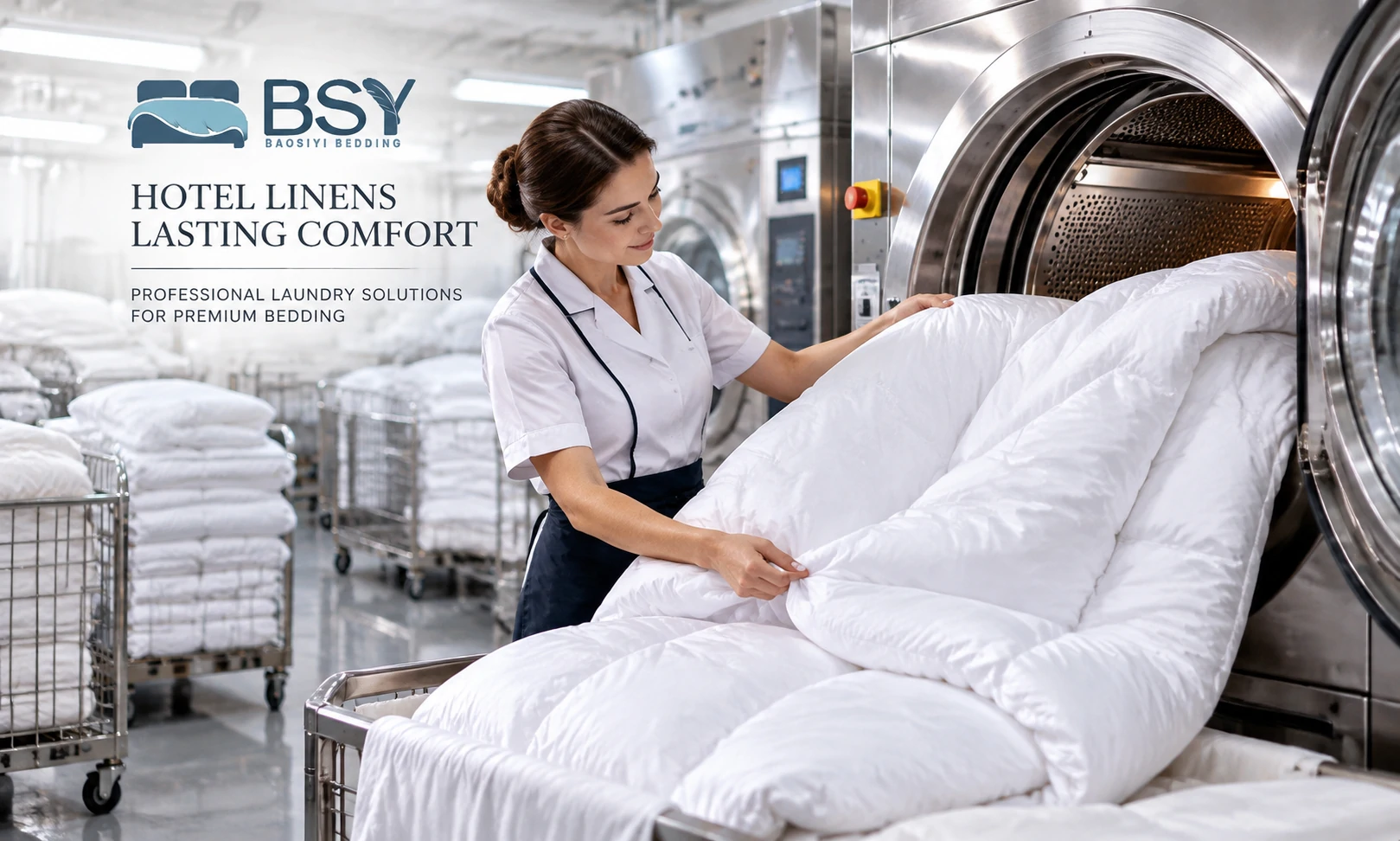
Microfiber Duvet Maintenance: How Frequent Commercial Laundering Affects Loft
October 13, 2026In commercial hospitality, extended-stay properties, and healthcare networks, microfiber comforters are widely celebrated as the ultimate low-maintenance bedding solution. Unlike natural down, which demands delicate handling and specialized laundering chemistry, synthetic micro-denier comforters are marketed as durable, hypoallergenic, and fully machine-washable workhorses.
However, operating a commercial hotel laundry or contracting a centralized laundry plant (CLP) is fundamentally different from laundering bedding at home.
In institutional facilities, linens are subjected to aggressive mechanical shear inside continuous batch tunnel washers, squeezed under hydraulic extraction presses exerting hundreds of pounds of pressure, and tumbled through high-temperature industrial gas dryers.
After 20, 30, or 40 commercial wash cycles, many properties encounter a frustrating operational defect: Premature Loft Collapse.
Comforters that began their service life thick, soft, and cloud-like develop hard, lumpy clumps, thin uninsulated zones, and a boardy, flattened drape that generates guest dissatisfaction.
Understanding how commercial laundering alters synthetic fiber geometry allows hoteliers, executive housekeepers, and procurement managers to implement standard operating procedures (SOPs) that protect linen assets, preserve duvet loft, and extend replacement cycles.
1. The Micro-Mechanics of Fiber Degradation During Commercial Washing
To prevent premature comforter retirement, laundry operators must understand what happens to micro-denier fibers under industrial laundering stress.
The Stripping of Cured Silicone Coatings (Siliconization Wear)
Virgin microfibers do not achieve their signature silky, down-like slip naturally; raw polyester has a high coefficient of surface friction. During extrusion, fiber manufacturers cure a microscopic layer of polysiloxane (silicone) oil onto the surface of every filament.
In commercial laundering:
- High-alkaline detergents (pH > 10.5) and high-temperature water chemically strip this microscopic silicone coating over time.
- As the silicone barrier thins, the raw polymer surfaces of adjacent fibers rub directly against one another, creating friction, static electricity, and drag.
Mechanical Shear and Fiber Entanglement (Friction Knots)
Inside continuous tunnel washers or large-capacity washer-extractors (e.g., 50 kg to 100 kg open-pocket machines):
- Mechanical action relies on heavy drop-and-fall tumbling to dislodge soil.
- As the comforter is thrown against the drum ribs, loose microfibers within the quilting chambers rub against each other under violent hydraulic currents.
- Deprived of their lubricating silicone coating, the microscopic filaments interlock and twist together like felt, forming dense, unyielding nodules known in textile engineering as friction knots.
High-G Centrifugal Extraction: Columnar Collapse
Following the wash cycle, industrial extractors spin at high velocities, generating forces between 300 and 400 G-force to squeeze water out of dense fabric layers:
- This extreme pressure forces the three-dimensional spiral crimp of hollow conjugated polyester fibers to compress flat against the casing.
- If the comforter is packed too tightly inside the drum, this compression breaks the elastic spring memory of the synthetic polymers, preventing the fibers from blooming back to their original volumetric loft during the drying phase.
2. Thermal Stress: The Destructive Power of High-Heat Laundering
While water and mechanical action cause physical friction, excessive heat causes molecular transformation.
The Wash Temperature Curve: Sanitization vs. Fiber Integrity
- 40°C Delicate Wash: Ideal for fiber longevity, but insufficient to eliminate biological soils, bacteria, and allergens in commercial environments.
- 60°C Thermal Sanitization: The international commercial standard. Effectively kills house dust mites and bacteria while remaining safe for high-quality siliconized polyester.
- 75°C+ Healthcare Sterilization: Required in clinical infection-control protocols, but accelerates the thermal oxidation of synthetic fiber coatings and casing shrinkage.
The Glass Transition Temperature (Tg) of Polyester
Polyester (polyethylene terephthalate) has a distinct physical property known as its Glass Transition Temperature (Tg), which occurs between 70°C and 80°C:
- Below 70°C, the polymer chains remain rigid and glassy, maintaining their structural crimp.
- Above 75°C to 80°C, the polymer transitions into a soft, rubbery state.
- If a comforter is tumbled in an industrial dryer operating above 80°C while moist, the mechanical pressure of the tumbling action permanently deforms the softened filaments. When the comforter cools down, the fibers freeze in this flattened, matted state, permanently destroying the comforter’s loft.
Filament Melting and Nodulation (0.8D vs. 1.2D Vulnerability)
Ultra-fine 0.8D microfibers are exceptionally delicate due to their microscopic diameter. If dryer air temperatures reach 90°C to 100°C—a common occurrence when commercial dryers are set to maximum heat to speed up throughput—the tips of fine 0.8D filaments soften and fuse together, forming permanent plastic-like clumps that cannot be fluffed out by hand.
3. Chemical Stress: Industrial Detergents and Fiber Embrittlement
The chemical formulations deployed in institutional laundries are designed for heavy-soil table linens and sheeting, which can be disastrous for delicate duvet fillings if unadjusted.
High-Alkaline Detergents (pH > 10.5)
Industrial wash formulas frequently utilize heavy caustic soda (sodium hydroxide) builders to saponify kitchen fats and bodily oils:
- High alkalinity damages polyester surfaces over repeated exposures, hydrolyzing the ester bonds in the polymer chain.
- Operational Rule: Comforters must be washed using pH-neutral or mild alkaline liquid detergents (target wash pH: 7.5 to 9.0) to protect the internal fiber matrix.
Chlorine Bleach vs. Oxygen-Based Destainers
- Chlorine Bleach (Sodium Hypochlorite): Highly corrosive to synthetic textiles. It strips fiber lubricants, attacks sewing thread tensile strength, and turns white polyester yellow through chemical scorching.
- Oxygen Bleach (Hydrogen Peroxide / Peracetic Acid): The mandatory standard for comforter destaining. Oxygen bleach sanitizes and brightens white linens without degrading the underlying polymer structures.
The Critical Neutralization (Sour) Phase
The final rinse of any commercial wash program must include an acidic neutralizing agent (sour):
- The sour step neutralizes residual wash chemicals, bringing the textile’s surface pH to a skin-neutral pH of 5.5 to 6.5.
- Proper neutralization neutralizes static charges, ensuring the internal microfibers repel rather than cling to one another during the drying cycle.
4. The Lifecycle Loft Decay Curve Across Commercial Laundering
To budget linen replacement funds accurately, asset managers must anticipate the natural degradation curve of microfiber comforters across their operational lifespan.
| Laundry Lifecycle Phase | Typical Cycle Range | Physical Loft Retention | Internal Fiber Condition | Housekeeping Action Required |
| Phase 1: Initial Conditioning | Cycles 1 to 15 | 95% – 100% of New | Fibers slide freely; silicone coating intact | Standard bed-making; comforter self-plumps effortlessly |
| Phase 2: Operational Stability | Cycles 16 to 30 | 85% – 92% of New | Minor surface silicone wear; slight edge shifting | Routine daily shaking; comforter retains full commercial loft |
| Phase 3: Progressive Fatigue | Cycles 31 to 45 | 75% – 82% of New | Noticeable fiber friction; small clumps form in corners | Housekeeping must manually knead clumps; rotation advised |
| Phase 4: Operational Retirement | Cycles 46 to 60+ | < 70% of New | Severe fiber felting; flat spots; thermal Tog degraded | Comforter retired to budget tiers, staff quarters, or discarded |
In high-occupancy 4-star and 5-star properties, comforters that lose more than 20% to 25% of their original volumetric loft fail visual luxury standards and should be systematically cycled out of guest rooms.
5. Engineering Comforters for Laundry Resilience at the Factory Level
A comforter’s ability to survive commercial laundering is largely determined during factory assembly.
Dual-Denier Hybrid Formulations (70% 0.8D + 30% 1.2D)
Comforters filled with 100% 0.8D microfibers feel exceptionally soft when new, but lack the structural backbone to resist commercial washer extraction.
BSY manufacturing standards mandate:
- The 70/30 Hybrid Ratio: Blending 70% ultra-soft 0.8D microfibers with 30% resilient 1.2D conjugated hollow fibers.
- The 1.2D fibers act like microscopic internal leaf springs, keeping the delicate 0.8D clusters separated and preventing the filling from compacting into felt during tumble drying.
Quilting Geometry: Small Box Grids vs. Channel Quilting
Quilting patterns dictate how far fibers can move during washing:
- Channel Quilting: Features continuous open lanes from head to foot. During washing, water currents push fibers to the extreme ends, leaving the center of the bed completely empty.
- Small Box Grids (25 x 25 cm to 30 x 30 cm): Mandatory for commercial laundry resilience. Small closed compartments physically contain the microfibers, preventing migration and ensuring that any localized clumping is restricted to a small, easily fluffed zone.
Pre-Shrunk Casing Fabrics and Reinforced Seams
If an outer cotton or microfiber shell shrinks by 5% during high-temperature washing while the interior filling does not shrink, the filling becomes choked inside a tight casing, forming hard, bulged lumps.
Export-grade comforters must use mechanically pre-shrunk fabrics (shrinkage under ±1.5%) sewn with high-tenacity core-spun polyester thread to withstand drum agitation.
6. Commercial Laundry Standard Operating Procedures (SOP)
To maximize the service life of microfiber comforters, commercial laundry operators must enforce strict operational parameters:
The 70% Drum Capacity Rule
Never overload washers when processing comforters:
- Wash wheels should be loaded to no more than 70% of their rated dry weight capacity.
- Overcrowded machines prevent duvets from tumbling freely, forcing the fabric to rub violently against itself and accelerating fiber friction knots.
Controlled Low-Temperature Drying Protocols
Dryer management is the single most critical factor in preventing synthetic comforter clumping:
- Inlet Air Temperature: Must be capped at 60°C to 65°C.
- Exhaust Temperature: Maintained between 45°C and 50°C.
- While low-heat drying extends drying cycle times by 10 to 15 minutes, it keeps the polyester well below its Glass Transition Temperature, protecting the internal loft.
The Mandatory 10-Minute Cool-Down Tumbling Phase
Never pull warm synthetic comforters directly from an industrial dryer and stack them immediately onto carts:
- When warm polyester is stacked under heavy linen weight, the soft filaments cool while compressed, setting permanent flat creases and destroying loft.
- Dryers must run a mandatory 10-minute cool-down cycle with ambient unheated air.
- This tumbling air cools the fibers while they are in motion, locking in their fluffy three-dimensional volume before folding.
7. Purchase Order Sourcing Guidelines for Laundry-Resilient Duvets
When drafting an international Purchase Order (PO) for high-turnover hospitality comforters, include these contractual clauses:
- Mandate Cured Siliconization: Specify: All synthetic filling shall consist of 100% virgin conjugated hollow polyester treated with high-temperature cured silicone oil to withstand repeated high-alkaline commercial washing.
- Require Hybrid Fiber Denier: State: Filling matrix must incorporate at least 30% 1.2D structural fibers blended with 0.8D ultra-fine microfibers to ensure post-wash compressive recovery.
- Enforce Small Box Quilting: Require: Quilting pattern shall be fully closed square boxes measuring no larger than 30 x 30 cm, with double-needle lockstitching along all perimeter borders.
- Mandate Pre-Shrunk Shells: Require: Outer casing fabric must exhibit residual laundry shrinkage not to exceed ±2.0% warp and weft under ISO 6330 at 60°C.
- Establish Wash Longevity Guarantees: State: Finished comforter shall retain at least 85% of its original uncompressed loft height following 30 commercial laundry cycles executed under standard hospitality wash formulas.
8. Frequently Asked Questions (FAQ)
How many commercial laundry cycles can a quality microfiber duvet endure before losing its loft?
A commercial-grade microfiber duvet built with a hybrid 0.8D/1.2D siliconized filling and small box quilting typically endures 35 to 45 industrial laundry cycles while retaining over 80% of its original loft. In standard hotel operations where duvets are laundered every 2 to 3 months (inside protective covers), this translates to an active service lifespan of approximately 3 to 4 years.
What causes synthetic microfiber duvets to clump and feel lumpy after laundering?
Clumping is caused by a combination of friction, high dryer heat, and aggressive detergents. When high-alkaline chemicals strip the lubricating silicone coating from the fibers, individual filaments generate friction and snag against each other. If exposed to dryer temperatures exceeding 75°C to 80°C, the polyester filaments soften and fuse into permanent hard nodules, especially if comforters are washed in open-channel quilting that allows fibers to shift.
What is the maximum recommended dryer temperature for commercial microfiber comforters?
The maximum recommended inlet dryer temperature for microfiber comforters is 60°C to 65°C (140°F to 150°F), with an exhaust temperature kept below 50°C. Exceeding these temperatures pushes the polyester past its Glass Transition Temperature, causing fiber distortion, clumping, and permanent loft loss.
Why is a cool-down tumbling cycle mandatory after industrial drying?
Synthetic polyester fibers retain thermal memory. If warm comforters are removed from a hot dryer and immediately folded and stacked on rolling linen carts, the weight of the stacked bedding crushes the softened fibers while they cool, locking in a flattened shape. Running a 10-minute cool-down tumble with ambient air allows the fibers to cool while fully expanded, preserving maximum loft.
Conclusion: Protecting Linen Capital Through Smarter Engineering and Care
Microfiber comforters remain an indispensable asset in modern commercial hospitality, delivering plush guest comfort, hypoallergenic safety, and substantial initial purchasing savings compared to natural down.
However, treating synthetic duvets as indestructible leads to premature clumping, flat guest beds, and unexpected linen replacement costs.
By pairing factory-level engineering—such as hybrid 0.8D/1.2D fiber formulations, closed-box quilting, and pre-shrunk calendered shells—with controlled laundry standard operating procedures capping dryer heat below 65°C, hotel operators can double the operational lifespan of their bedding, protect working capital, and guarantee a consistent five-star sleep experience.
Located in Xiaoshan, Hangzhou, BSY Bedding is a specialized OEM/ODM manufacturer producing commercial-laundry-durable microfiber duvets, pillows, and mattress toppers for international hotel chains and institutional buyers. Equipped with high-precision fiber carding lines, automated blowing machinery, and in-house wash testing laboratories, we engineer synthetic bedding built to withstand the demanding realities of commercial laundering.