Washing and Sterilization Standards for Raw Down in China’s Textile Hubs
October 13, 2026When international procurement managers specify down duvets and pillows, conversations usually center around fill power ratings, down percentages, and outer shell thread counts. Yet the foundational determinant of finished product safety, longevity, and consumer satisfaction occurs long before sewing machines are threaded.
It happens inside the industrial scouring basins and high-temperature steam sterilization chambers of specialized down processing mills.
Raw waterfowl plumage fresh from agricultural facilities is not a pristine, fluffy white material. It arrives packed in dense raw bales contaminated with farm soil, grit, dried blood, animal dander, residual poultry fats, and microbial bio-contaminants.
If this raw plumage is washed with inferior detergents, processed on hurried cycles, or dried at insufficient temperatures, the consequences for brands are catastrophic:
- In humid bedrooms or overseas container shipping, residual organic fats decompose, generating repulsive poultry odors that ruin customer reviews.
- Trapped biological dander and protein fragments escape into guest rooms, triggering severe respiratory and skin allergy flare-ups.
- Non-sterile shipments risk rejection, quarantine, or destruction by agricultural and customs authorities at destination ports.
To protect product lines, commercial buyers must look beyond the finished product and audit the industrial processing methods applied to raw plumage.
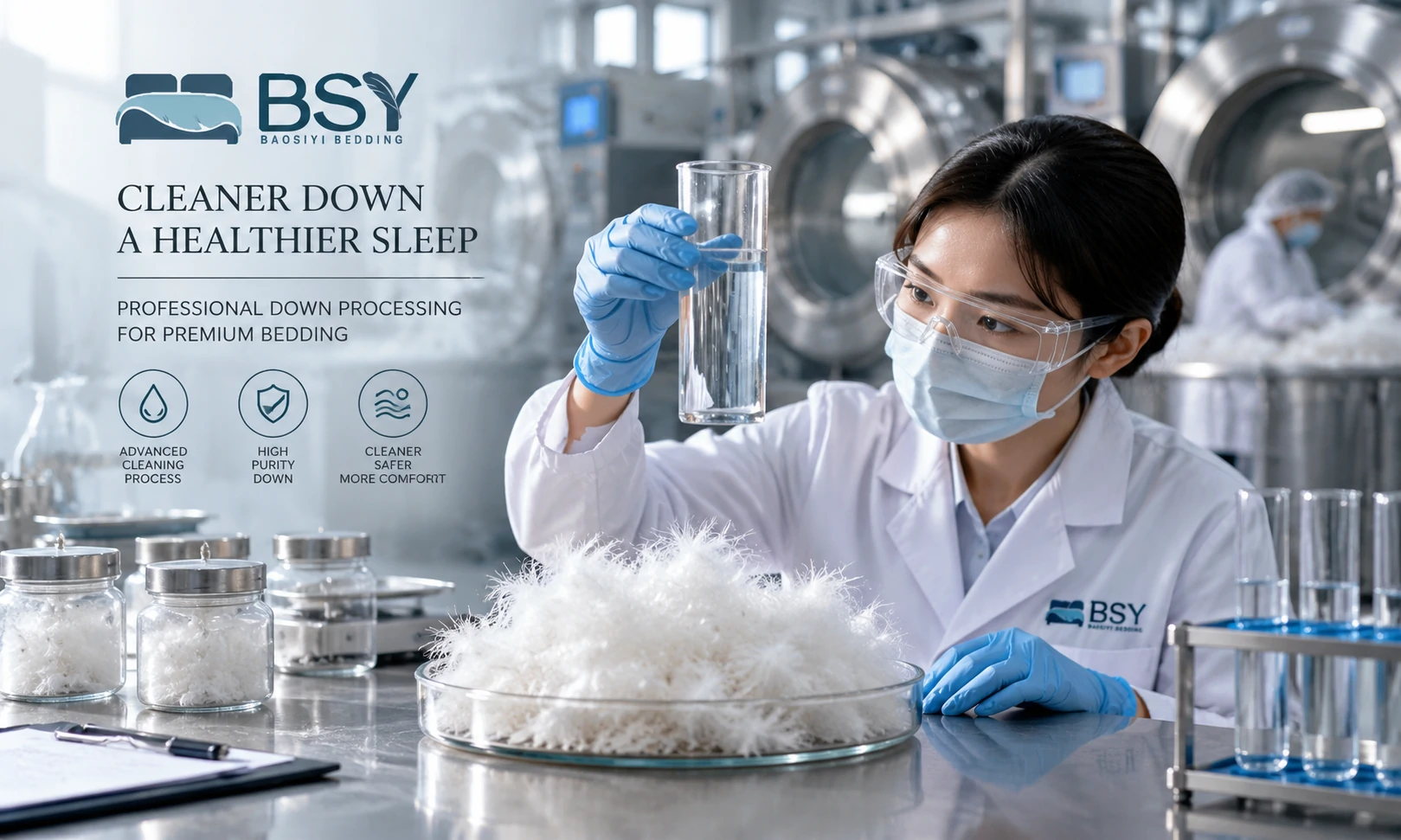
This technical report details the multi-stage scouring sequence, 120°C pressurized steam sanitization, aerodynamic sorting, and laboratory cleanliness benchmarks maintained across China’s down capital in Xiaoshan, Hangzhou.
1. The Biological and Chemical Composition of Raw Waterfowl Plumage
Developing an effective cleaning specification begins with understanding the organic chemistry of raw waterfowl plumage.
Keratin Protein vs. Natural Waterfowl Lipids
Waterfowl down and feathers are composed primarily of keratin—a fibrous structural protein that provides natural elasticity, volumetric memory, and thermal air-trapping geometry.
To protect their plumage in aquatic environments, ducks and geese produce natural oils and waxes (crude lipids) through their preen glands. In living birds, these fats coat the plumage to repel water.
In raw, harvested plumage, these lipids represent approximately 2% to 4% of total dry weight.
The fundamental challenge of industrial down scouring is delicate and dual-sided:
- If scouring leaves too much residual lipid on the down, the organic fats spoil under heat and humidity, generating volatile fatty acids that smell like rotting poultry.
- If scouring strips too much lipid using harsh, aggressive degreasers, the fragile keratin protein becomes brittle, fractures into useless dust under compression, and loses its natural fill power.
Microbial and Pathogen Bioburden
Raw plumage harbors substantial microbial populations, including environmental bacteria (such as Salmonella species and Escherichia coli), fungal molds (such as Aspergillus), and avian-borne viral pathogens.
International border health agencies strictly mandate complete thermal and chemical sterilization to prevent cross-border transmission of zoonotic pathogens.
Global Hygiene Benchmarks: EN 12935, USA-2000, and GB/T 17685
Every major international market enforces statutory minimum cleanliness standards:
- European Union: EN 12935 (Feather and Down – Hygiene and Cleanliness Requirements).
- United States: USA-2000 Standard and ABFLO (Association of Bedding and Furniture Law Officials) guidelines.
- China: GB/T 17685 and GB/T 10288 down processing standards.
While these standards set baseline legal hurdles, premier retail brands and luxury hospitality chains enforce internal testing thresholds that exceed legal minimums by more than 200%.
2. The 14-Stage Industrial Scouring Workflow: From Raw Bales to Clean Down
In advanced processing hubs like Xiaoshan, Hangzhou, raw plumage passes through a continuous, multi-stage automated washing system that balances physical de-dusting, chemical scouring, and gentle fiber preservation.
Phase 1: High-Velocity Aerodynamic Pre-Dusting (Stages 1 to 3)
Before raw down touches water, it must undergo dry mechanical pre-cleaning:
- Dense, compressed raw bales are fed into high-volume mechanical bale breakers and drum openers.
- Rotating beaters and high-velocity cyclone air extractors tumble the plumage, dislodging up to 90% of heavy soil, field dirt, sand, and dried organic matter.
- Dislodging dry particulate prior to water washing prevents washing basins from turning into muddy slurry, saving millions of liters of process water.
Phase 2: Multi-Stage Industrial Scouring (Stages 4 to 7)
Once de-dusted, the plumage enters automated continuous washing lines:
- Pre-Soak & Wetting (Stage 4): Plumage is submerged in warm water conditioned with non-ionic wetting agents to break surface tension and allow water to penetrate dense down clusters.
- Primary Detergent Scouring (Stage 5): High-efficiency wash drums inject specialized, eco-friendly textile scouring agents. These surfactants emulsify and dissolve heavy grease, animal dander, and surface contaminants.
- Secondary Precision Scouring (Stage 6): A secondary wash cycle targets microscopic lipid residues on inner barbules, dialing in the precise residual fat threshold.
- Neutralization (Stage 7): Organic, weak acid buffers neutralize residual alkalinity, bringing the bath to a skin-neutral pH of 6.0 to 7.0, which prevents keratin fiber degradation.
Chemistry Focus: Eco-Friendly Surfactants vs. Fiber Damage
Low-cost, non-compliant washing plants often rely on cheap, aggressive industrial degreasers containing Alkylphenol Ethoxylates (APEO/NPEO). While these chemicals rapidly strip grease, they are severe environmental endocrine disruptors banned in the EU under REACH, and their harsh alkalinity ruins down cluster elasticity.
Top-tier export processors use certified biodegradable, APEO-free, mild bio-surfactants that cleanly remove surface grease without stripping the interior lipid core of the down cluster.
Phase 3: Multi-Stage Deep-Well Rinsing (Stages 8 to 12)
Scouring loosens dirt; rinsing removes it.
The down passes through 6 to 8 continuous counter-current freshwater rinsing chambers:
- Fresh, filtered deep-well water continuously flushes the moving plumage.
- Effluent water is continuously monitored by automated optical sensors until discharge water matches the optical clarity of clean municipal drinking water.
Phase 4: High-Speed Centrifugal Hydro-Extraction (Stages 13 to 14)
Following the final rinse, the saturated down is pumped into high-tonnage centrifugal hydro-extractors:
- High-speed spinning extracts over 70% of free moisture within minutes.
- Rapid mechanical dewatering minimizes the energy needed in the drying phase, preventing down from stewing in warm, humid water that encourages bacterial regrowth.
3. Thermal Sterilization and De-Odorization: The 120°C Kill Chamber
Mechanical washing cleans the surface; high-pressure thermal steam sterilization guarantees absolute biological safety and activates natural loft.
Pressurized Steam Drying at 120°C to 130°C for 30+ Minutes
From hydro-extractors, damp plumage is pneumatically transferred into sealed industrial steam drying drums:
- High-pressure saturated steam is injected, raising chamber temperatures to 120°C to 130°C.
- The plumage is tumbled continuously under positive steam pressure for at least 30 to 45 minutes.
- The Biological Kill Mechanism: This extreme thermal environment denatures and eradicates all vegetative bacteria, pathogenic viruses (including Avian Influenza strains), mold spores, and dust mite organisms, ensuring sterile down.
Restoring Volumetric Cluster Bloom (Fill Power Activation)
Thermal steam drying serves an essential physical function alongside sterilization:
- During agricultural collection and transport, down clusters become compressed and clumped.
- The combination of 120°C steam heat and mechanical tumbling causes the microscopic protein barbules to bloom outward like opened umbrellas.
- This restores the three-dimensional spherical structure of each cluster, maximizing its native Fill Power (FP) capability before sorting.
Cooling, Secondary De-Dusting, and Static Neutralization
Exiting the drying chamber, down passes through fluidized cooling beds:
- Ambient, dehumidified air rapidly cools the fibers to room temperature, locking the expanded cluster structure in place.
- High-voltage ionizing bars neutralize static electricity, preventing fine down filaments from sticking to machinery walls.
- Secondary negative-pressure dust collectors draw away broken quills and micro-fibers, ensuring pure plumage.
4. Aerodynamic Fractionation: Precision Sorting of Down Clusters
Washed and dried plumage remains a raw blend of heavy waterfowl feathers, intermediate plumage, down clusters, and broken fibers. It must be aerodynamically separated into commercial grades.
Multi-Chamber Air Fractionation Towers
Down sorting relies on the physics of aerodynamic drag and terminal settling velocity:
- Plumage is blown into the base of massive, vertical, multi-chamber wooden or aluminum sorting towers (often 5 to 7 chambers tall).
- Precisely calibrated laminar air currents rise through the chambers.
- Heavy waterfowl body feathers with thick quills fall out immediately into Chamber 1.
- Medium feathers and small plumage settle into Chamber 2 and 3.
- The lightest, airiest down clusters rise to the highest chambers, where they are gently harvested.
By adjusting airflow velocities and gate openings, technicians isolate precise commercial grades: 50%, 70%, 80%, 90%, and 95% down cluster purities.
In-Line Magnetic and Optical De-Contamination
Before packaging into shipping bales or routing to sewing lines, clean down passes through multi-stage inline Rare-Earth Magnetic Filters (rated at 10,000+ Gauss) to capture any trace metallic wire fragments or farm debris, followed by optical sensors that reject off-color dark plumes from pure white batches.
5. Laboratory Cleanliness Testing: The Two Non-Negotiable Metrics
To verify that down is clean, odorless, and legally compliant, commercial contracts must mandate certified testing against two essential physical metrics: Turbidity and the Oxygen Number.
- Optical Turbidity Testing: Target
≥1000 mm≥1000 mm(100% Water Clarity→→Complete removal of particulate dust, field dirt, and allergenic micro-fragments). - Oxygen Number Titration: Target
≤10.0 mg/100g≤10.0 mg/100g(Zero Degradable Lipids→→Complete elimination of animal odor risks under humid ambient conditions).
Turbidity Testing: Measuring Water Clarity
Turbidity quantifies the amount of suspended organic dust, micro-dirt, and particulate matter remaining on the down.
- Testing Protocol: Exactly 10 grams of down are agitated in 1,000 ml of distilled water. The water is filtered and poured into a calibrated optical glass cylinder (a Turbidity Tube) with a bold black cross printed on the bottom plate.
- An analyst looks down through the liquid column until the black cross disappears from view, recording the water depth in millimeters.
- The Legal Baseline: European standard EN 12935 requires a minimum of 300 mm; US standards require 300 to 500 mm.
- The High-Standard Export Benchmark: Premium retail and five-star hospitality contracts must strictly mandate Turbidity equal to or greater than 1,000 mm. At 1,000 mm, the liquid is crystal clear, proving that the down is free from particulate dust that triggers respiratory allergies.
Oxygen Number: Measuring Residual Organic Matter
The Oxygen Number measures the chemical cleanliness of down by quantifying the mass of oxidizable organic matter—primarily residual avian fats, blood proteins, and dander—remaining on the plumes.
- Testing Protocol: Down is soaked in pure water, and the extract is titrated with potassium permanganate under acidic conditions. The volume of oxidizer consumed is calculated as milligrams of oxygen per 100 grams of down.
- The Direct Odor Link: The Oxygen Number directly predicts whether a comforter will smell. A high Oxygen Number indicates that unwashed organic matter remains on the down; when exposed to humidity or human body warmth, bacteria consume these compounds, releasing unpleasant animal odors.
- The Sourcing Standard: While international legal baselines allow up to 20 mg/100g, export purchase orders must mandate an Oxygen Number equal to or less than 10 mg per 100 grams. At or below 10, down is chemically inert and completely odorless.
Residual Fat and Oil Content Balance (0.8% to 1.5%)
Through Soxhlet solvent extraction, laboratories verify the percentage of crude fat remaining on the down:
- Above 2.0%: High risk of odor development and clumping.
- Below 0.5%: Down has been over-scoured, causing brittle fibers that crumble into dust.
- The Ideal Sourcing Target: Balanced between 0.8% and 1.5%, providing natural durability without odor.
6. The Xiaoshan Industrial Advantage: Why Hangzhou Leads Global Down Refining
When sourcing down comforters in volume, geography matters. Xiaoshan District in Hangzhou, Zhejiang Province, is recognized worldwide as the epicenter of down and feather processing.
Unmatched Scale and Sourcing Infrastructure
- Xiaoshan processes and exports more than 50% of the world’s commercial down and feather supply.
- This concentration creates deep industrial advantages: immediate access to fresh waterfowl raw stock from premier agricultural river deltas across China, paired with large-scale automated multi-drum washing lines.
Industrial-Scale Wastewater Recovery Systems
Washing raw plumage consumes large volumes of water. Because environmental regulations in Zhejiang Province are among the strictest in Asia, leading Xiaoshan facilities operate advanced closed-loop industrial wastewater treatment plants:
- Biochemical filtration, membrane bioreactors (MBR), and multi-stage sedimentation clarify washing effluent.
- Over 60% to 75% of process water is recycled back into early washing stages, shielding certified export factories from municipal water shutdowns and environmental fines.
Concentrated Testing Ecosystem
Xiaoshan houses accredited testing laboratories recognized by the International Down and Feather Bureau (IDFB). Production lots undergo double-blind testing on site, providing authentic, certified test reports before containers are sealed and dispatched to deep-water berths at Ningbo or Shanghai Port.
7. Global Standards Comparison & Purchase Order Guidelines
| Cleanliness Parameter | Chinese Standard (GB/T 17685) | European Norm (EN 12935) | US Standard (USA-2000) | Japanese Standard (JIS L 1903) | BSY Export Benchmark |
| Minimum Turbidity | ≥450 mm≥450 mm (Class I ≥1000 mm≥1000 mm) | ≥300 mm≥300 mm | ≥300 mm≥300 mm | ≥1000 mm≥1000 mm | ≥1000 mm≥1000 mm (Crystal Clear) |
| Max Oxygen Number | ≤10.0 mg/100g≤10.0 mg/100g | ≤20.0 mg/100g≤20.0 mg/100g | ≤10.0 mg/100g≤10.0 mg/100g | ≤4.8 mg/100g≤4.8 mg/100g | ≤10.0 mg/100g≤10.0 mg/100g (Odor-Free) |
| Fat & Oil Content | ≤1.5%≤1.5% | ≤2.0%≤2.0% | ≤1.5%≤1.5% | ≤1.0%≤1.0% | 0.8% – 1.3% |
| Steam Sterilization | Required (≥100≥100°C) | Required | Required | Required | 120°C – 130°C for 30+ min |
| Pathogen Presence | Zero (Negative) | Zero (Negative) | Zero (Negative) | Zero (Negative) | Zero (Certified Negative) |
5 Non-Negotiable Hygiene Clauses for Down Sourcing POs
When drafting a commercial Purchase Order (PO) for bulk down bedding, include these technical specifications:
- Mandate Turbidity Thresholds: Specify: Down filling shall achieve an optical Turbidity rating of not less than 1,000 mm when tested under IDFB Section 11 / EN 12935 protocols.
- Lock the Oxygen Number: State: The Oxygen Number shall not exceed 10.0 mg per 100 grams of down material when tested via standard titration.
- Mandate High-Temperature Steam Sanitization: Require: All down and feathers must undergo pressurized steam sterilization at a minimum of 120°C for at least 30 continuous minutes, backed by production autoclave temperature logs.
- Require Microbiological Clearance: State: Testing certificates must verify negative detection for Salmonella species, Escherichia coli, and virulent viral contaminants.
- Enforce Lot-Specific IDFB Testing: Require: Supplier must provide independent IDFB-accredited laboratory test reports matched specifically to the export container’s production lot number prior to final balance payment.
8. Frequently Asked Questions (FAQ)
Why do cheap down comforters develop a foul smell in humid weather?
Unpleasant down odor is caused by residual animal lipids and bacterial activity. Low-cost factories often rush washing cycles to save water and energy, leaving crude fats on the plumage. When a sleeper’s body heat and ambient humidity penetrate the comforter, moisture activates bacteria that feed on these residual fats, releasing offensive volatile organic acids. Specifying down with an Oxygen Number at or below 10 mg/100g and Turbidity at or above 1,000 mm guarantees an odorless product.
What is the difference between legal minimum cleanliness standards and export-grade 1,000 mm turbidity?
International legal minimums (such as EN 12935 and US customs regulations) allow turbidity down to 300 mm to 500 mm. At 300 mm, water is visibly cloudy, indicating that fine organic dust and micro-particulates remain trapped on the fibers. While legal to import, 300 mm down frequently triggers consumer dust allergies and return complaints. Export-grade 1,000 mm down has been rinsed through up to 14 stages until wash water is optically clear, ensuring a truly hypoallergenic filling.
Can raw down be sterilized without damaging the natural elasticity of down clusters?
Yes, provided thermal steam sterilization is used instead of harsh dry heat or damaging chemical bleaches. Pressurized steam at 120°C to 130°C kills 100% of biological pathogens while hydrating the keratin protein, which causes compressed down clusters to bloom and restores their natural volumetric fill power without making filaments brittle.
What is the ideal residual fat and oil content for processed waterfowl down?
The commercial sweet spot for residual fat and oil is between 0.8% and 1.5%. If fat content exceeds 1.5%, the risk of rancid odors increases dramatically; conversely, if fat content drops below 0.5% due to aggressive chemical degreasing, the down clusters become brittle, dry, and snap into powder during laundering, shortening product lifespan.
Conclusion: Engineering Total Purity in Down Bedding
In the commercial home textile industry, high fill-power ratings and luxury fabric thread counts cannot mask poorly cleaned down. True product excellence is engineered in the early washing and sterilization stages.
By mandating 14-stage automated scouring, 120°C pressurized steam sanitization, Turbidity ratings of 1,000 mm or higher, and Oxygen Numbers under 10 mg/100g, commercial buyers eliminate odor liabilities, pass stringent customs health inspections, and deliver hypoallergenic luxury down bedding that builds lasting brand trust.
Located at the center of the world’s down processing trade in Xiaoshan, Hangzhou, BSY Bedding operates advanced automated down-washing machinery, pressurized steam autoclaves, and an in-house laboratory testing facility. We provide fully certified, IDFB-tested, odorless goose and duck down comforters, duvets, and pillows engineered to the most demanding international hospitality and retail standards.