Flame Retardant Bedding: Meeting BS 7175 and Crib 5 Compliance for Hospitality
October 20, 2026In consumer retail bedding, procurement decisions are driven primarily by tactile softness, visual aesthetics, and retail price points. However, in the commercial contract sector—encompassing commercial hotel chains, Purpose-Built Student Accommodation (PBSA), healthcare facilities, and offshore cruise vessels—bedding specifications are governed by an unyielding operational priority: Life Safety and Statutory Fire Regulations.
In commercial environments, a bedding fire spreads with terrifying speed. Synthetic comforters can act as high-energy fuel sources, melting into toxic liquid flame pools and releasing dense, asphyxiating hydrogen cyanide and carbon monoxide gases within seconds.
For commercial buyers, hotel developers, and facility directors, managing fire safety is an absolute legal liability:
- Deploying non-compliant bedding can lead to immediate operational shutdown by municipal fire authorities.
- In the catastrophic event of a hotel fire, the use of uncertified linens immediately invalidates commercial building insurance policies, exposing corporate directors to severe civil and criminal penalties.
The recognized global gold standard for commercial bedding fire safety is the British Standard BS 7175, featuring the stringent Crib 5 (Ignition Source 5) test.
This technical guide deconstructs BS 7175 compliance, evaluates the critical difference between temporary chemical coatings and Inherent Flame-Retardant (IFR) polymers, and provides a procurement framework for international tender specifications.
1. Understanding BS 7175: The Statutory Standard for Contract Bedding
British Standard BS 7175—formally titled Methods of test for the ignitability of bedcovers and pillows by smouldering and flaming ignition sources—is the primary regulatory benchmark cited by contract specifiers across the UK, Europe, the Middle East, and British Commonwealth territories.
The Regulatory Framework
In the United Kingdom, commercial textile compliance is mandated under the Regulatory Reform (Fire Safety) Order 2005.
Under this legislation, the designated “Responsible Person” (such as a hotel general manager or student housing operator) is legally required to conduct formal fire risk assessments and ensure that all installed furnishings and loose contract textiles do not contribute to rapid flame spread.
The Composite Testing Principle (The Assembly Rule)
A foundational concept of BS 7175 that buyers frequently misunderstand is Composite Testing:
- The standard does not permit testing the outer fabric shell or internal filling in isolation.
- A laboratory must construct a standardized mock-up composite consisting of the exact outer fabric, internal filling (whether down, feather, or synthetic fiber), internal piping cords, and sewing threads assembled exactly as they will be manufactured.
- The test evaluates whether the entire composite assembly self-extinguishes or contributes to sustained combustion.
The Hierarchy of Ignition Sources
BS 7175 outlines a progressive scale of ignition threats, ranging from minor smoldering contact to aggressive open-flame timber fires:
- Source 0: Smoldering cigarette test.
- Source 1: Butane gas match flame simulation.
- Source 5 (Crib 5): High-energy wooden crib ignition test.
- Source 7 (Crib 7): Extreme wooden crib test reserved for maximum-security prisons and psychiatric facilities.
2. The Mechanics of Ignition Testing: Source 0, Source 1, and Crib 5
To specify contract duvets correctly, buyers must understand the physical parameters of each test level.
Source 0: The Smoldering Cigarette Test
Source 0 simulates a lit cigarette dropped accidentally onto a bed by a sleeping or intoxicated guest:
- A standardized, non-filter cigarette is placed along the surface and seam valleys of the test comforter.
- Pass/Fail Criteria: The comforter must not ignite into open flame, and progressive internal smoldering must not spread more than 50 mm from the cigarette. After 60 minutes, the sample must be completely cold with zero active embers.
Source 1: The Butane Match Flame Simulation
Source 1 evaluates resistance to small, localized open flames:
- A precision stainless steel burner tube fed with butane gas applies a standardized flame (equivalent to a lit wooden match) to the comforter surface for 20 seconds.
- Pass/Fail Criteria: After the gas burner is removed, all flaming must self-extinguish within 120 seconds, and no progressive smoldering may penetrate the interior filling.
Source 5 (Crib 5): The High-Risk Commercial Benchmark
Crib 5 represents a severe, open-flame fire scenario designed to simulate vandalized or accelerated room fires.
- The Test Apparatus: A small wooden crib constructed from 14 individual sticks of kiln-dried Scots pine, assembled in five tiers like a miniature log cabin.
- The Ignition Fluid: Exactly 1.4 milliliters of pure propan-2-ol (isopropyl alcohol) is placed into a central lint pad inside the crib.
- The Test Execution: The crib is placed on the comforter and ignited, burning with a violent, concentrated open flame that reaches temperatures between 600°C and 800°C.
The Strict Pass/Fail Criteria for Crib 5:
- All flaming from the wooden crib and comforter must completely self-extinguish within 10 minutes of ignition.
- All internal smoldering and glowing embers must completely extinguish within 60 minutes.
- The fire must not burn through the outer edges of the test specimen or exhibit uncontrolled progressive combustion.
3. Inherent Flame Retardancy (IFR) vs. Chemical Dipping: Sourcing Safeguards
When sourcing flame-retardant bedding, the most critical decision a procurement manager makes is selecting the fire-retardant delivery mechanism.
The Failure of Topical Chemical Dipping
Low-cost suppliers often cut corners by taking standard, cheap polyester or poly-cotton duvets and passing them through a chemical immersion bath containing brominated or organophosphorus flame-retardant salts:
- Temporary Lifespan: Chemical coatings are water-soluble. After 5 to 10 commercial laundry cycles, the surface chemistry washes out completely, leaving the duvet entirely flammable.
- Tactile Degradation: Topical coatings leave fabric shells feeling stiff, boardy, and abrasive against guest skin.
- Health & Off-Gassing Risks: Under body warmth or laundry tumble-drying, chemical coatings can release toxic volatile organic compounds (VOCs), failing OEKO-TEX Standard 100 chemical safety screening.
Inherent Flame Retardant (IFR) Polymers: Trevira CS and Modacrylic
High-grade contract manufacturing relies on Inherent Flame-Retardant (IFR) Fibers:
- Trevira CS (FR Polyester): Flame-retardant organophosphorus compounds are modified directly into the polyester polymer chain at the molecular synthesis stage prior to filament extrusion.
- Modacrylic Fibers: Copolymers of acrylonitrile and vinyl chloride that naturally release non-combustible gases when heated, starving the flame of oxygen.
The Essential Commercial Advantage of IFR: Because the flame retardancy is built into the molecular backbone of the fiber itself, it never washes out, never abrades away, and remains fully functional for the entire 10-year lifespan of the product.
The Self-Extinguishing Carbonization Mechanism
When an IFR comforter comes into contact with a Crib 5 fire:
- The polymers do not melt into flaming liquid droplets.
- Instead, the fibers undergo rapid catalytic dehydration, forming an expanded, cross-linked carbonaceous char layer.
- This dense black char forms an airtight thermal blanket over the filling, cutting off oxygen, dissipating thermal heat, and causing the flame to choke and self-extinguish.
Can Natural Down & Feather Meet Crib 5 Standards?
Yes, but it requires specialized textile engineering. Natural down and feather clusters are organic proteins that will char under flame, but light cotton casings can sustain combustion.
To build a Crib 5 Certified Goose Down Duvet:
- The down must be encased inside a specialized Inherent Flame-Retardant Barrier Interliner woven from fine IFR filaments, or
- The outer casing must be constructed from densely woven, inherently flame-retardant cotton-rich fabrics engineered with intumescent fire-blocking weaves.
4. Commercial Laundering Endurance of Flame-Retardant Bedding
In contract hospitality, linens are washed frequently at high temperatures. Testing must prove that fire safety survives industrial laundry processing.
Pre-Testing Cleansing Mandate: BS 5651 Water Soak
Legitimate testing under BS 7175 does not test virgin fabric straight off the loom.
Under British testing protocols:
- The comforter sample must first undergo the BS 5651 Water Soak Procedure.
- The sample is submerged in continuous running water at 40°C for at least 2 hours, or subjected to repeated industrial thermal washing cycles.
- Only after this pre-wash extraction procedure is completed can the laboratory ignite the Crib 5 wooden crib, proving that the fire retardancy is wash-durable.
High-Temperature Washing Endurance (Up to 75°C)
Inherent IFR duvets safely withstand commercial wash cycles up to 71°C to 75°C, satisfying hospital infection control standards and destroying dust mites without compromising the flame-retardant molecular matrix.
Laundry Chemical Guidelines: The Softener Hazard
Commercial laundry SOPs must include one vital rule: Never Use Conventional Fabric Softeners on Flame-Retardant Bedding.
- Fabric softeners deposit a thin, fatty wax coating across textile filaments to simulate softness.
- In a fire scenario, this dried wax layer acts as a combustion accelerant, causing even certified IFR fabrics to ignite. Contract facilities must use mechanical tumbling or specialized silicone-free laundry aids.
5. Regulatory Mapping: Which Commercial Sectors Require Crib 5?
Fire regulations vary by facility risk profile. Specifying the wrong level wastes capital; specifying below requirements creates legal exposure.
Standard Commercial Hotels & Holiday Parks
- Legal Requirement: BS 7175 Source 0 and Source 1 (Cigarette and Match Resistant).
- Industry Trend: Premium four-star and five-star hotel chains increasingly mandate Crib 5 across all duvets, pillows, and mattress encasements to secure reduced building insurance premiums and protect against room arson or accidental guest fires.
Student Accommodation (PBSA) & University Halls
- Legal Requirement: Mandatory BS 7175 Crib 5.
- Given high occupant density, unsupervised cooking, and widespread candle/smoking violations in student residences, UK and European university housing tenders enforce zero tolerance: every comforter must carry certified Crib 5 documentation.
Healthcare, Care Homes, and Assisted Living Facilities
- Legal Requirement: BS 7175 Crib 5 or Source 7.
- In facilities where patients possess reduced mobility and evacuation times are extended, bedding must resist intense, sustained ignition sources to allow staff adequate response time.
Maritime, Cruise Ships, and Offshore Accommodations
- Legal Requirement: IMO Resolution MSC 307(88) – Fire Test Procedures (FTP) Code.
- Cruise line bedding must carry the official Wheelmark (MED) certification, proving compliance with international maritime fire safety standards.
6. Sourcing Matrix & Cost Economics: Standard vs. Source 0/1 vs. Crib 5
| Technical Specification | Standard Domestic Bedding | Commercial Hospitality (Source 0 & 1) | High-Risk Contract (Crib 5 Certified) | Maritime & Cruise Line (IMO Code) |
| Ignition Test Source | None or Basic Cigarette | BS 7175 Source 0 & Source 1 | BS 7175 Ignition Source 5 (Crib 5) | IMO FTP Code Part 9 (Wheelmark) |
| Ignition Medium | N/A | Smoldering Cigarette & Match Flame | 14-Stick Pine Wood Crib with Alcohol | Standardized Pilot Flame & Radiant Panel |
| Primary Fiber Type | Standard Poly or Down | Cotton Shell + Hollowfiber | Inherent IFR Modacrylic / Trevira CS | Modacrylic / Aramid / IFR Blends |
| Wash Durability | N/A | 20 to 30 Wash Cycles | 50+ Industrial Washes (Permanent) | Permanent Chemical Resistance |
| Permissible Flame Time | N/A | < 120 seconds | < 10 minutes (Total Self-Extinction) | Immediate Self-Extinction |
| FOB Cost Premium | Baseline | + 10% to 15% | + 25% to 40% (Reflects IFR Yarn) | + 50% to 75% (Reflects MED Audit) |
| Target Sector | Retail Consumer | Standard 3/4-Star Hotels | PBSA, Care Homes, 5-Star Hotels | Cruise Liners, Ferries, Offshore Rigs |
7. The B2B Buyer’s 5-Step Fire Safety Verification Protocol
To prevent legal liability, execute this five-step verification protocol before authorizing production payments:
- Demand Accredited Third-Party Test Certificates: Reject in-house factory testing declarations. Require official test certificates issued by globally recognized, UKAS-accredited testing institutes such as SATRA Technology, FIRA International, BTTG, or Intertek.
- Verify Composite Testing Documentation: Inspect the laboratory test report description carefully. Confirm that the test was conducted on the complete finished assembly (shell fabric + internal filling + threads), not on a standalone swatch of raw fabric.
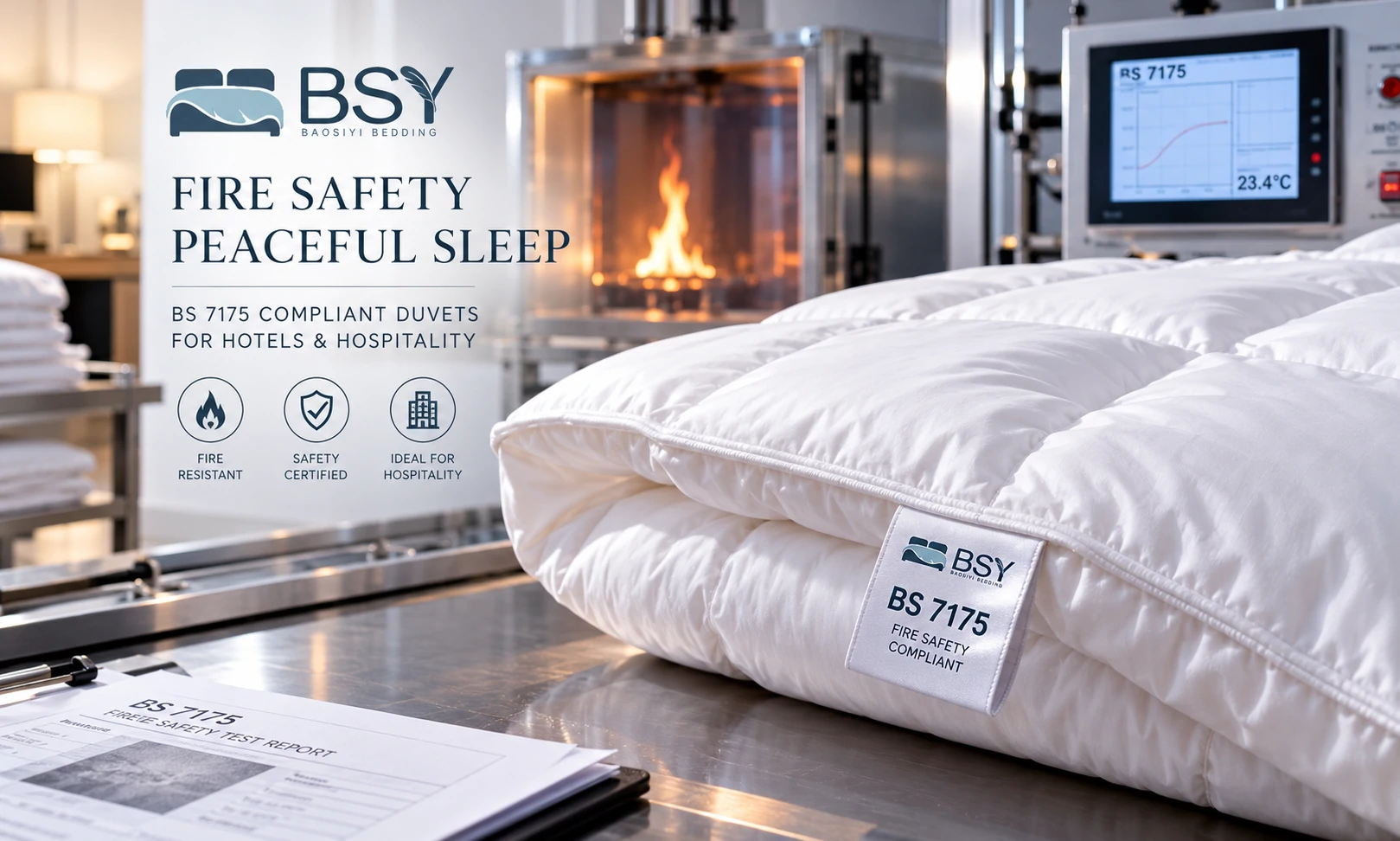
- Mandate Sewn-In Regulatory Fire Labels: Ensure every duvet carries a permanently stitched, indelible law label detailing compliance: e.g., Complies with BS 7175: 1989 for Ignition Sources 0, 1, and 5 after BS 5651 Water Soak Procedure.
- Audit Chemical Safety via OEKO-TEX Standard 100: Ensure flame-retardant performance is achieved without hazardous chemicals. Verify that the product is certified under OEKO-TEX Standard 100 Class I, proving zero carcinogenic brominated flame retardants (PBDEs), antimony trioxide, or formaldehyde residues.
- Establish Traceable Master Carton Marking: Ensure every shipping carton features unique production batch numbers traceable directly to the raw yarn extrusion lot.
8. Frequently Asked Questions (FAQ)
What is the fundamental difference between BS 7175 Source 0/1 and Crib 5 (Source 5)?
Source 0 and Source 1 evaluate resistance to low-energy ignition sources: a smoldering cigarette (Source 0) and a small 20-second match-like butane flame (Source 1). In contrast, Crib 5 (Source 5) is a high-intensity open-flame test using a 14-stick wooden crib soaked in isopropyl alcohol that burns with intense heat (600°C to 800°C) for several minutes. Bedding that passes Source 0/1 will often combust completely under a Crib 5 wooden crib fire.
Can a topically treated chemically dipped flame-retardant duvet survive commercial laundering?
No. Topically applied flame-retardant chemical baths deposit water-soluble salts onto the fiber surface. In commercial hotel laundering, continuous exposure to water, alkaline detergents, and mechanical agitation washes these chemicals away within 5 to 10 wash cycles, leaving the comforter fully flammable. Contract tenders must strictly mandate Inherent Flame Retardant (IFR) fibers where fire resistance is permanent at the molecular level.
Which commercial sectors legally mandate Crib 5 compliance for duvets and pillows?
Crib 5 compliance is legally or contractually mandated across high-risk, high-occupancy commercial environments. This includes Purpose-Built Student Accommodation (PBSA), university halls of residence, hospitals, nursing homes, residential care facilities, and offshore oil platforms. Furthermore, luxury four-star and five-star hotel brands frequently specify Crib 5 to satisfy corporate risk audits and lower commercial building insurance premiums.
Can luxury natural down and feather duvets achieve certified Crib 5 fire retardancy?
Yes. While natural down is an organic protein that chars rather than melts, high-thread-count cotton shells can ignite under a Crib 5 wooden crib. To achieve certification, manufacturers encase the natural down inside a specialized, ultra-lightweight Inherent Flame-Retardant Barrier Interliner (a sub-casing), or utilize specialized high-density cotton shells woven with intumescent fire-blocking yarns that self-extinguish when exposed to open flame.
Conclusion: Protecting Life Safety and Commercial Balance Sheets
In commercial contract bedding, fire safety is not an area for cost-cutting or ambiguity. Specifying uncertified or chemically dipped comforters creates catastrophic operational vulnerabilities that can close a property overnight.
By mandating Inherent Flame-Retardant (IFR) fibers, specifying certified BS 7175 Crib 5 composite testing, and partnering with verified manufacturers, procurement directors protect guest safety, pass regulatory audits, and ensure decades of reliable commercial performance.
Located in Xiaoshan, Hangzhou, BSY Bedding is a specialized OEM/ODM manufacturer producing certified contract-grade, flame-retardant duvets, pillows, and mattress encasements. Our contract collections comply fully with BS 7175 (Source 0, 1, and Crib 5), EN ISO 12952, and IMO FTP Code maritime standards, backed by third-party UKAS laboratory testing and OEKO-TEX Standard 100 Class I chemical safety certification.