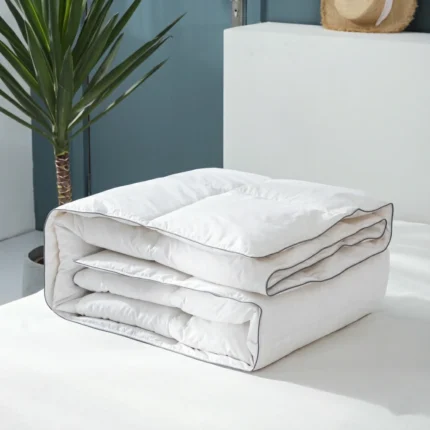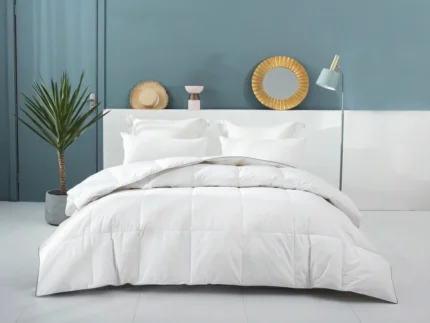
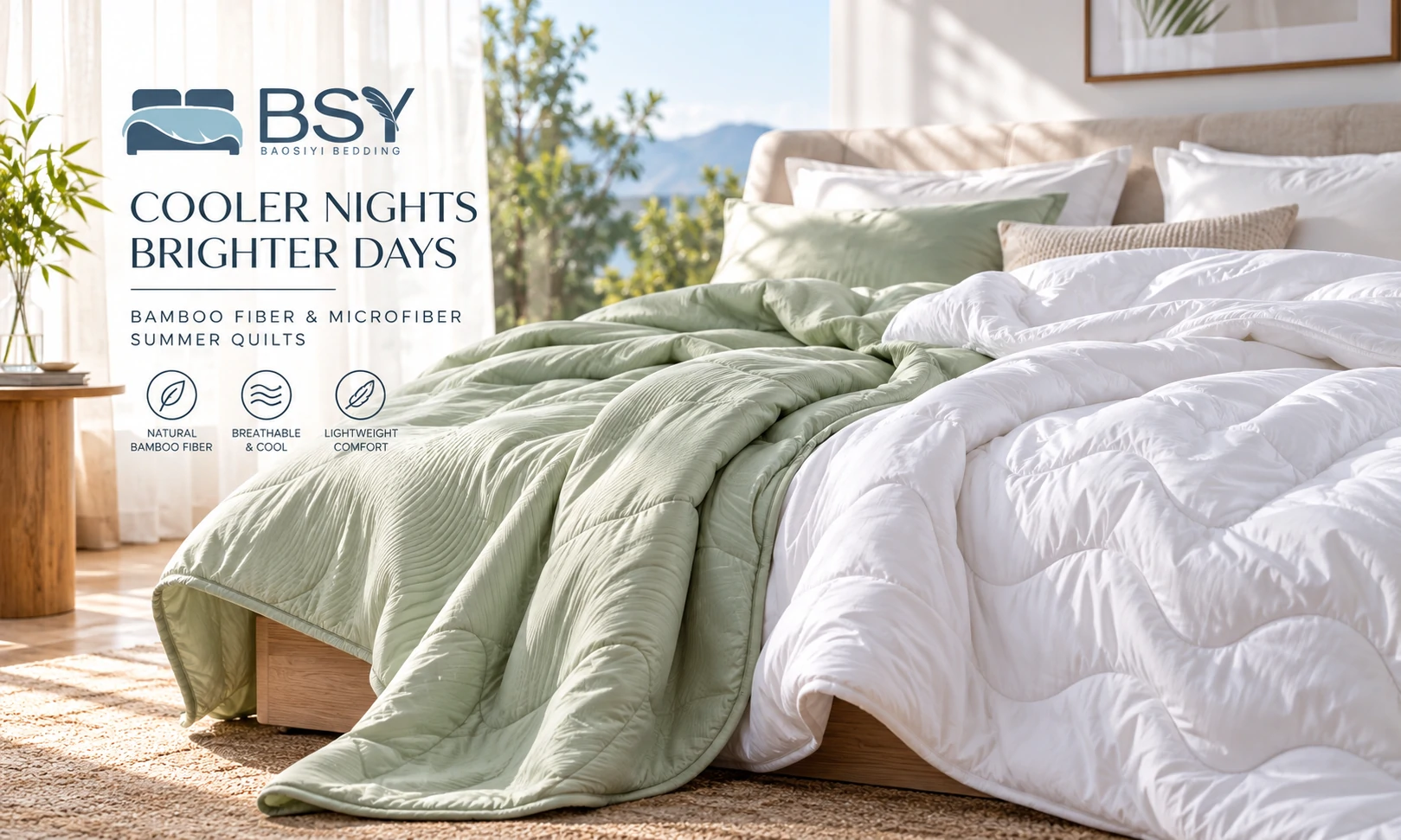
Sourcing Summer Quilts: Lightweight Microfiber vs. Breathable Bamboo Fibers
October 20, 2026For decades, the home textile calendar was dominated by the autumn-winter rush. Retailers and commercial hospitality operators focused their capital on heavy, high-Tog comforters designed to battle winter chills.
Today, climate dynamics and global lifestyle habits have triggered a structural shift. The widespread adoption of residential air conditioning and hotel climate-control systems has created a massive, high-margin category: The Summer Air-Conditioning Quilt (Summer Duvet).
During warm summer months, sleeping with no cover leaves occupants vulnerable to draft chills, muscle stiffness, and joint discomfort caused by continuous air-conditioning airflow. Conversely, sleeping under a traditional comforter leads to overheating, night sweats, and interrupted sleep cycles.
Modern consumers demand a specialized thermal envelope: a lightweight, breathable quilt weighing between 100 and 180 grams per square meter (GSM) that provides a reassuring, comforting hug while actively venting excess heat.
For retail merchandisers, private-label brand founders, and hotel procurement directors, sourcing summer quilts centers on two primary material choices: Engineered Synthetic Microfiber and Natural Cellulose Bamboo Fiber.
This sourcing guide evaluates the thermodynamics of moisture absorption, tactile skin acoustics, commercial laundry durability, and FOB factory pricing to help commercial buyers build an optimized warm-weather bedding collection.
1. The Thermodynamics of Summer Sleep: Latent Heat and Moisture Regain
To evaluate summer bedding performance, sourcing teams must examine the biophysics of nocturnal human thermoregulation.
Latent Heat of Evaporation: How Sweat Removal Keeps Sleepers Cool
The human body regulates core internal temperature during sleep through evaporative cooling. Every night, an adult sleeper expels approximately 200 to 500 milliliters of moisture vapor through insensible perspiration.
- When a comforter allows this vapor to escape freely, evaporation draws latent heat away from the skin, cooling the sleeper naturally.
- If a comforter traps humidity, relative humidity beneath the covers spikes above 80%, inhibiting further sweat evaporation. The sleeper feels clammy, tosses restlessly, and eventually kicks the covers off.
Moisture Regain (MR%): The Critical Scientific Metric
Textile moisture management is governed by Moisture Regain (MR%)—the percentage of water moisture that dry textile fibers naturally absorb from humid ambient air:
- Standard Polyester Microfiber: Possesses an exceptionally low moisture regain of less than 0.4%. It is inherently hydrophobic; moisture does not penetrate the polymer core and must be transported mechanically along exterior fiber channels.
- Pure Cotton: Features an average moisture regain of 8.5%.
- Bamboo Viscose / Lyocell: Achieves an extraordinary moisture regain of 11.5% to 13.0%. It acts like a natural organic sponge, absorbing large volumes of perspiration vapor without feeling damp to the touch.
The Air-Conditioned Room Paradox
The ideal summer quilt must balance contradictory thermodynamic demands:
- It must provide enough physical boundary insulation to protect the sleeper from localized 21°C to 24°C air-conditioning drafts.
- It must keep total thermal resistance low (calibrated strictly between 3.0 and 4.5 Tog), preventing metabolic heat accumulation.
2. Bamboo Fiber Summer Quilts: Nature’s High-Performance Cellulose
Derived from natural bamboo culms regenerated into viscose or lyocell filaments, bamboo fiber has emerged as a premier luxury material in warm-weather home textiles.
Micro-Porous Fiber Cross-Sections: The Capillary Wicking Effect
Under scanning electron microscopy (SEM), bamboo fibers reveal a unique physical structure:
- The cross-section is filled with microscopic oval voids, micro-gaps, and longitudinal grooves.
- This porous capillary network accelerates moisture absorption and evaporation, wicking liquid sweat and vapor away from human skin up to three to four times faster than conventional cotton.
Tactile Drape: Silk-Like Slipperiness and Natural Cool Touch
Bamboo fibers exhibit a remarkably low bending modulus:
- When draped over a bed, a bamboo quilt flows like liquid silk, eliminating the stiff, tenting effect common in lower-grade synthetic quilts.
- Because bamboo fibers contain natural moisture within their polymer matrix, they possess high thermal conductivity upon initial skin contact, delivering a pleasant, natural cooling sensation without synthetic chemical treatments.
Natural Hypoallergenic and Antibacterial Profile
In warm, humid summer environments, bacterial proliferation on damp bedding generates stale odors.
Bamboo fibers offer distinct biological benefits:
- The natural cellulose structure is inherently inhospitable to dust mites and mold spores.
- High moisture breathability keeps the bed interior dry, denying odor-causing bacteria the damp habitat required for rapid colonization.
Sourcing Caveats: Creasing Tendencies and Gentle Laundering
While luxurious, 100% pure bamboo fiber possesses operational vulnerabilities that commercial buyers must manage:
- Lower Wet Tensile Strength: Natural cellulose weakens when wet, meaning pure bamboo quilts cannot tolerate harsh industrial laundering, heavy chlorine bleaches, or high-heat tumble drying.
- Creasing and Shrinkage: Pure bamboo fabrics are prone to wrinkling and can exhibit up to 4% to 6% laundering shrinkage if not pre-shrunk during factory dyeing and finishing.
3. Lightweight Microfiber Summer Quilts: Synthetic Durability and Sourcing Efficiency
For high-turnover hospitality, commercial laundry loops, and volume retail promotions, ultra-fine polyester microfiber remains the practical commercial champion.
0.8D to 1.2D Hollow Micro-Denier Clusters: Featherweight Air Trapping
Modern summer microfiber comforters do not use coarse 7D batting. Instead, factories utilize 0.8D to 1.2D ultra-fine conjugated hollow microfibers:
- These filaments are finer than silk, creating a cloud-soft, cotton-candy texture.
- At a summer fill weight of 120 to 150 GSM, a microfiber quilt feels nearly weightless, providing light, buoyant coverage that prevents air-conditioning draft chills.
High-Turnover Machine Wash Durability
Where bamboo requires gentle handling, synthetic polyester excels under commercial stress:
- Polyester fibers maintain 100% of their tensile strength when wet.
- They withstand repeated 60°C commercial sanitization wash cycles and high-speed spin extraction without fiber breakage, structural distortion, or seam tearing.
Hydrophobic Fast-Drying Speed: Laundering Cost Reductions
Because polyester fibers absorb less than 0.4% moisture into their polymer cores, water is held purely on the exterior surface:
- In commercial gas dryers, a lightweight microfiber summer quilt dries in 15 to 25 minutes—roughly one-third the time required for cotton or bamboo bedding.
- This rapid drying cycle significantly cuts laundry utility expenses and accelerates linen room turnover in hotels.
Aggressive Price-Point Advantages
The most compelling asset of microfiber is its raw material economics. Stable, petroleum-derived polymer pricing allows factories to produce finished Queen-size summer quilts at FOB export prices between $6.50 and $9.50, enabling retailers to dominate volume promotional price points under $20.00 to $25.00 retail.
4. The 50/50 Bamboo-Microfiber Hybrid Blend: The Strategic Compromise
Recognizing the trade-offs of both pure materials, experienced bedding product developers increasingly specify 50% Bamboo Viscose / 50% Siliconized Microfiber Blends.
Solving the Weaknesses of Single-Material Formulations
- Pure bamboo provides moisture wicking but lacks bouncy volumetric loft and suffers from laundering delicacy.
- Pure microfiber provides loft and durability but lacks high moisture absorbency.
The Mechanical Synergy: Bamboo Wicking + Polyester Rebound
In a 50/50 carded blend:
- The 50% bamboo component acts as an active moisture sink, drawing nighttime perspiration away from the sleeper.
- The 50% 1.2D hollow conjugated polyester component acts as an internal spring skeleton, giving the filling resilient loft and preventing the bamboo fibers from matting down after washing.
Laundering Stability and Shrinkage Mitigation
By reinforcing natural bamboo with resilient synthetic polymers, the hybrid blend stabilizes the entire batting structure:
- Laundering shrinkage is contained strictly under 2.5%.
- The quilt can safely undergo standard commercial tumble drying on low-to-medium heat without clumping or losing its smooth profile.
5. Shell Fabrics and Quilting Geometry for Summer Bedding
The internal filling represents only half of the cooling equation; shell fabric selection and quilting geometry dictate airflow and tactile comfort.
Casing Options: 100% Bamboo Lyocell (300T) vs. Pre-Washed Cotton vs. Peach-Skin Microfiber
- 100% Bamboo Sateen / Lyocell (300T): The ultra-luxury tier. Incredibly silky, naturally cool, and luminous. Paired with bamboo filling for premium retail lines retailing at $60.00 to $90.00+.
- Pre-Washed Cotton Percale (200T to 250T): Delivers a casual, matte, crinkled Japanese aesthetic. Highly breathable, absorbent, and skin-friendly, ideal for boutique lifestyle brands.
- Brushed Peach-Skin Microfiber (85 to 100 GSM): The high-efficiency commercial standard. Soft, silent, stain-resistant, and highly economical, suitable for mass hypermarket distribution.
Quilting Geometry: Ultrasonic Wave Bonding vs. Low-Profile Box Stitching
- Ultrasonic Wave Quilting: High-frequency acoustic energy fuses the shell and interior batting together in continuous fluid waves without needle holes. Eliminates fiber bearding, speeds up factory throughput, and creates a clean, modern aesthetic for synthetic comforters.
- Low-Profile Box Stitching (15 x 15 cm to 20 x 20 cm): The standard for bamboo and hybrid quilts. Small compartments anchor the lightweight filling, preventing migration while maintaining a flat, smooth silhouette that does not trap excess heat.
Edge Finishes: Self-Fabric Bound Edges vs. Ultra-Light Piping
Heavy, corded German piping adds unnecessary rigidity to lightweight summer quilts. Sourcing contracts should specify Self-Fabric Double-Fold Bound Edges (a clean fabric strip folded over the raw edge and double-stitched), which keeps the borders soft, flexible, and weightless against sleeper skin.
6. Sourcing Cost Breakdown and Market Positioning
The following matrix compares standard commercial summer quilt specifications based on a standard Queen Size (230 × 220 cm) comforter calibrated for summer air-conditioned sleep (3.5 to 4.0 Tog / 120 to 150 GSM fill):
| Specification Parameter | Value Microfiber Summer Quilt | Hybrid 50/50 Bamboo/Poly Quilt | Pure 100% Luxury Bamboo Quilt |
| Interior Filling | 100% Virgin 0.8D/1.2D Microfiber | 50% Bamboo Viscose / 50% Poly | 100% Natural Bamboo Lyocell |
| Outer Shell Fabric | 90 GSM Brushed Microfiber | 233T 100% Cotton or Bamboo Blend | 300T 100% Bamboo Sateen |
| Moisture Absorption (MR%) | Low (< 0.4%) | High (~6.0% to 7.0%) | Outstanding (~12.0% to 13.0%) |
| Tactile Hand-Feel | Soft, peach-skin velvet touch | Smooth, supple, breathable | Silk-like, cool, fluid drape |
| Max Commercial Wash Temp | 60°C to 75°C (High durability) | 40°C to 60°C (Moderate) | 30°C to 40°C (Gentle cycle) |
| Commercial Drying Speed | Ultra-Fast (15 – 20 min) | Fast (25 – 35 min) | Moderate (Air dry recommended) |
| Quilting Method | Ultrasonic wave or box stitch | Computerized small box (18x18cm) | Fine frame box or diamond stitch |
| Estimated FOB China Cost | $6.80 – $9.20 | $12.50 – $16.50 | $22.00 – $28.50 |
| Target Retail Channel | Hypermarkets, budget hotels, promos | High-street retail, 4-star hotels | Luxury lifestyle DTC, 5-star resorts |
7. The B2B Buyer’s Summer Quilt Sourcing Checklist
When drafting an international Purchase Order (PO) for bulk summer quilts, include these five technical quality checkpoints:
- Mandate Qualitative Fiber Verification: Require certified third-party laboratory fiber identification reports (under ISO 1833) to verify that bamboo content is authentic bamboo cellulose rather than standard reconstituted wood viscose.
- Lock Dimensional Shrinkage Tolerances: Specify that finished quilts must not exceed a maximum dimensional shrinkage of ±2.5% along warp and weft after three laundering cycles under ISO 6330.
- Enforce Colorfastness to Perspiration: In summer bedding, acidic and alkaline sweat can cause dye bleeding. Mandate a minimum Grade 4.0 Colorfastness to Perspiration under ISO 105-E04.
- Require OEKO-TEX Standard 100 Class I: Because summer quilts are frequently used directly against bare skin without a top sheet, verify zero harmful formaldehydes, toxic dyestuffs, or heavy metal residues.
- Optimize Vacuum Packaging Density: Summer quilts are lightweight and highly compressible. Specify high-density vacuum roll-packing in heavy-gauge polybags, allowing up to 4,500 to 5,500 units per 40HQ container, driving landed freight costs under $1.00 per unit.
8. Frequently Asked Questions (FAQ)
What is the optimal fill weight (GSM) for a commercial summer air-conditioning quilt?
The commercial sweet spot for summer air-conditioning quilts is 120 to 150 GSM (grams per square meter). A filling weight below 100 GSM feels overly thin and fails to shield against chilling AC drafts; conversely, a fill weight exceeding 180 GSM traps too much body heat, pushing the comforter past the comfortable summer threshold of 4.5 Tog.
How does the moisture regain of bamboo fiber compare to microfiber in hot sleeping environments?
Bamboo fiber has a natural moisture regain of 12% to 13%, meaning it actively absorbs perspiration vapor directly into its microscopic porous structure, keeping the sleep micro-climate dry and cool. In contrast, synthetic microfiber has a moisture regain of less than 0.4%, meaning it cannot absorb moisture into its polymer core and must rely entirely on external airflow and mechanical wicking to manage perspiration.
Can bamboo summer quilts be laundered in high-temperature commercial hotel laundry cycles?
Pure 100% bamboo quilts should not be subjected to harsh, high-temperature commercial laundering (above 40°C) or strong chemical bleaches, as natural cellulose loses up to 30% of its tensile strength when wet. For hotels requiring frequent 60°C sanitization washes, procurement managers should specify either a 50/50 bamboo-microfiber hybrid blend or an engineered lightweight microfiber quilt.
What are the key advantages of a 50/50 bamboo and microfiber hybrid summer quilt?
A 50/50 blend combines the best attributes of both materials: the bamboo component provides authentic natural moisture wicking, hypoallergenic properties, and a silky, cool hand-feel, while the 50% synthetic microfiber component provides structural elastic rebound, prevents post-wash clumping, controls shrinkage to under 2.5%, and reduces FOB factory costs by roughly 35% compared to pure bamboo.
Conclusion: Partnering with an OEM Summer Quilt Factory
Summer quilts represent a powerful, high-margin revenue engine that allows bedding retailers and hospitality operators to generate steady cash flow outside the traditional winter peak.
Selecting the right material strategy depends on your brand’s positioning and commercial distribution channels:
- Choose Lightweight Microfiber to dominate promotional mass-market price points, satisfy budget-conscious institutional contracts, and provide effortless machine-wash durability.
- Choose Pure Bamboo Fiber to anchor luxury lifestyle collections, capture eco-conscious consumers willing to pay a premium for natural breathability, and elevate five-star resort guest experiences.
- Choose the 50/50 Hybrid Blend to achieve the ultimate commercial sweet spot between tactile comfort, moisture wicking, and industrial laundering stability.
Located in Xiaoshan, Hangzhou, BSY Bedding operates advanced automated carding lines, computerized multi-needle and single-needle CNC quilters, and specialized ultrasonic wave bonding machinery. We engineer and manufacture custom-calibrated lightweight microfiber, 100% bamboo, and hybrid summer quilts certified under OEKO-TEX Standard 100 and GRS recycled standards, tailored to the exact specifications of global retail brands and hotel chains.