Bulk Duck Down & Feather Duvet Blends: 15/85 vs. 30/70 vs. 50/50 Cost Strategies
September 29, 2026In the international home textile trade, natural down comforters represent the gold standard of sleep comfort. Consumers actively seek the natural breathability, temperature regulation, and prestige of waterfowl plumage over synthetic alternatives.
However, procurement teams face a persistent commercial obstacle: Commodity Price Volatility.
Pure 90% or 95% down is an expensive agricultural byproduct subject to global supply fluctuations. If a departmental retail buyer or commercial hotel chain attempts to specify 90% down across an entire mass-market program, retail price points quickly exceed consumer willingness to pay, or linen replacement budgets become unsustainable.
To solve this, professional bedding manufacturers deploy Engineered Down and Feather Blends.
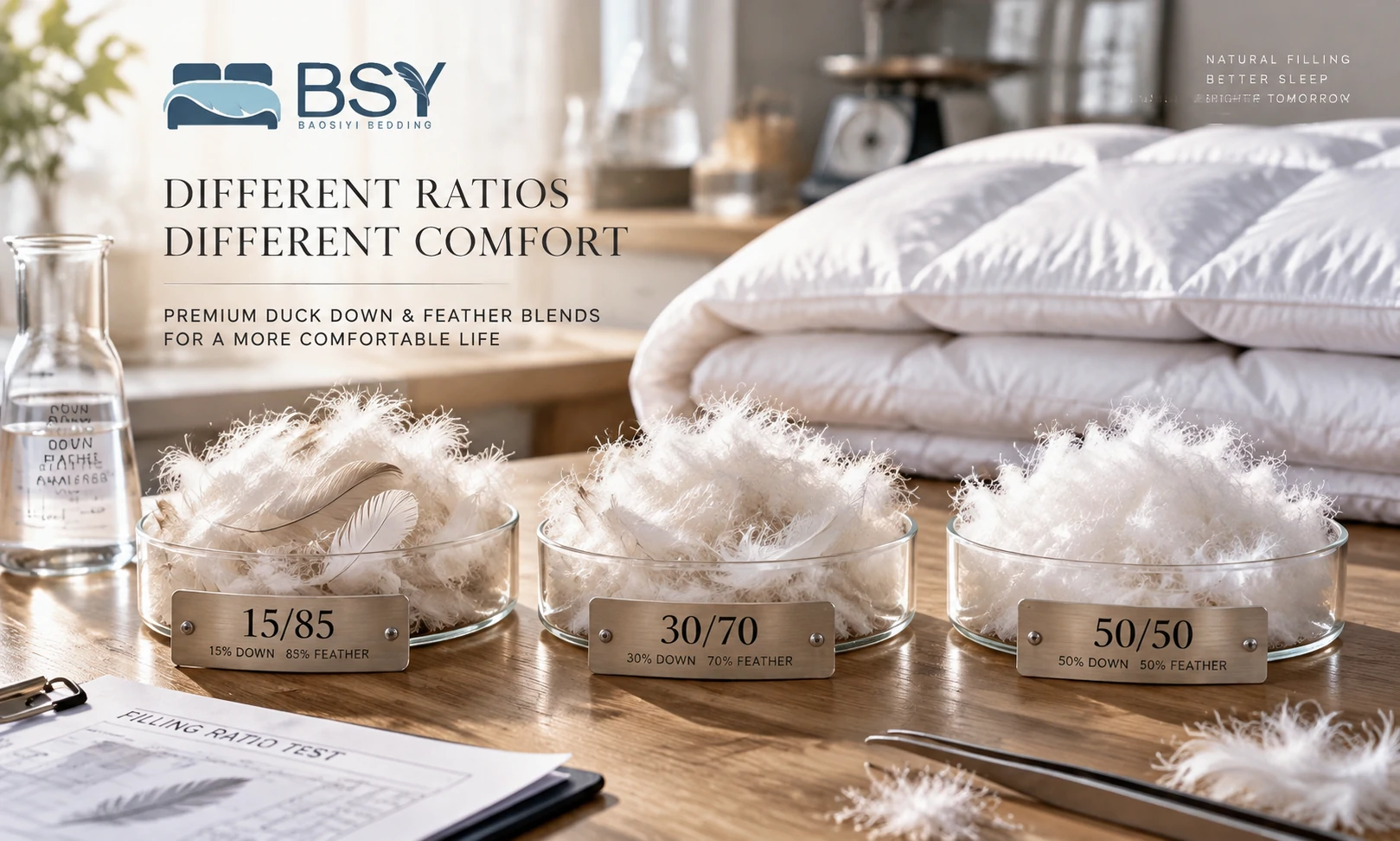
By strategically blending soft, insulating duck down clusters with resilient, supportive small duck feathers, sourcing managers can engineer duvets to meet exact retail price architectures.
Understanding the physical dynamics, shell fabric requirements, and legal labeling thresholds of 15/85, 30/70, and 50/50 blends allows commercial buyers to capture robust margins while delivering dependable guest satisfaction.
1. Deconstructing Down & Feather Blends: Anatomy and Physical Dynamics
Formulating an effective blend requires understanding the structural differences between down clusters and waterfowl feathers.
Down Clusters (Plumules) vs. Waterfowl Feathers (Quills & Vanes)
- Down Clusters (Plumules): The light, fluffy undercoating growing beneath waterfowl feathers. Down features a 3D spherical structure with thousands of microscopic barbules radiating from a central point without a quill. Down provides thermal insulation by trapping stagnant air, offering high fill power and near-zero weight.
- Waterfowl Feathers: The exterior plumage of the bird, featuring a flat 2D shape supported by a distinct central structural spine (quill). Feathers provide physical springiness, dimensional support, and reassuring downward drape, but offer lower thermal insulation per gram than down.
The Trade-Off: Volumetric Loft vs. Tactile Weight
When formulating a commercial duvet, down and feathers play complementary roles:
- Higher Down Ratios (50%+): Produce a comforter that is airy, highly compressible, and cloud-like, achieving high European Tog ratings at low fill weights.
- Higher Feather Ratios (70%+): Produce a comforter with pronounced physical heft, a grounded drape, and structural body that many consumers—particularly in the UK and colder European regions—equate with traditional winter warmth.
The Quill Puncture Threat: Small Feathers vs. Wing/Tail Feathers
In commercial blend manufacturing, feather selection is critical. Low-tier suppliers sometimes cut corners by using ground feathers or coarse wing and flight feathers with thick, stiff quills. These thick quills easily puncture fabric shells and poke sleepers.
BSY manufacturing standards enforce:
- Small Duck Feathers Measuring 2 cm to 4 cm: Sourced exclusively from body plumage.
- These miniature feathers possess flexible, curved quills that bend smoothly under compression without piercing fabric barriers, ensuring safety and comfort.
2. The 15/85 Formulation (15% Duck Down / 85% Feather): The Promotional Price Champion
The 15/85 blend represents the primary volume engine of mass-market retail and hypermarket chains.
Formulation Mechanics & Physical Profile
Comprising 85% small duck feathers and 15% soft duck down, this formulation uses feathers as the primary insulating and structural mass. The 15% down content is critical: it coats the feather quills, buffering sharp points and creating a softer surface hand-feel than pure 100% feather bedding.
The Promotional Retail Playbook
For mass-market retailers, discount department stores, and supermarket promotions (such as Black Friday, Autumn Home Events, or Back-to-College drives), the 15/85 blend is the ultimate weapon:
- It allows retailers to market genuine “Natural Duck Down & Feather” packaging claims.
- It hits aggressive promotional retail price points between $25.00 and $40.00 (or £25.00 to £35.00), driving massive seasonal turnover.
Mandatory Shell Engineering: 233T Heavy-Duty Calendared Cotton
Because 15/85 duvets contain 85% feathered quills, they cannot be paired with lightweight or delicate fabrics:
- Sourcing teams must specify 233T 100% Cotton Percale (40s × 40s yarn).
- The casing must undergo heavy double-sided mechanical calendaring (heated steel pressure rolling) to flatten the weave and create an impenetrable mechanical shield against quill puncture.
Target Distribution Channels
- Supermarket hypermarket programs (e.g., Walmart, Asda, B&M, The Range).
- Budget accommodation groups, student housing contracts, and holiday parks.
- High-volume entry-level e-commerce bundles.
3. The 30/70 Formulation (30% Duck Down / 70% Feather): The Mainstream Sweet Spot
For mid-tier department stores and lifestyle retailers, the 30/70 blend serves as the foundational baseline for quality natural bedding.
Formulation Mechanics: Soft Surface Loft with Core Resilience
With nearly one-third of the filling composed of pure down clusters, the 30/70 blend delivers a noticeable step up in plushness:
- The down clusters expand throughout the casing, significantly dampening the presence of interior quills.
- The duvet compresses smoothly without feeling crunchy or stiff, providing comfortable body-contouring drape.
The Thermal Efficiency Sweet Spot
The 30/70 blend achieves popular British and European warmth standards (such as 10.5 Tog all-season and 13.5 Tog winter) without requiring excessive, uncomfortable fill weights. A 10.5 Tog Queen-size duvet can be achieved at approximately 380 to 420 GSM, delivering balanced thermal insulation and manageable product weight.
High-Street Retail Placement
The 30/70 formulation is the standard private-label specification for established high-street department stores (such as Next, Dunelm, and Target Home):
- It avoids the commodity image of entry-level 15/85 lines while remaining affordable to middle-market consumers.
- It delivers strong gross margins (frequently 60% to 65% retail markup) while keeping consumer return rates exceptionally low.
Target Distribution Channels
- Mid-tier department stores and specialty home furnishings retailers.
- 3-star superior and 4-star commercial business hotels.
- Core catalog lines for established direct-to-consumer (DTC) bedding brands.
4. The 50/50 Formulation (50% Duck Down / 50% Feather): The Executive Hybrid Benchmark
When commercial buyers seek a product that rivals the sensory experience of a luxury down duvet at a fraction of the cost, the 50/50 blend is the definitive solution.
Formulation Mechanics: Equal Equilibrium of Fluffiness and Body
At a 1:1 ratio of down to feathers, the down clusters completely envelop the small feather quills:
- In tactile touch tests, consumers and hotel guests cannot feel the feather quills through the fabric casing.
- The comforter presents a thick, cloud-like silhouette with dramatic loft recovery when shaken, closely mimicking an 80% down duvet.
Hospitality Laundering Durability
For corporate hotel chains, the 50/50 blend offers an operational advantage over pure down:
- The 50% small feather content acts as an internal structural spring network.
- Under repeated commercial washing, extraction, and tumble drying, the feather quills prevent the down clusters from felting or collapsing, allowing the duvet to maintain its lofty shape across 35 to 45 commercial laundry cycles.
Capital Expenditure Savings: Competing Against 80% Down
A Queen-size 80% white duck down comforter commands an FOB China export price between $38.00 and $45.00.
A 50/50 duck down duvet delivers roughly 90% of the visual and tactile loft of the 80% down product at an FOB price between $25.00 and $30.00—generating an immediate 30% to 35% reduction in initial procurement capital expenditure.
Target Distribution Channels
- 4-star business hotel chains and boutique hospitality suites.
- Upper-mid-market retail brands seeking a luxury product at an accessible price.
- Corporate gift programs and residential serviced apartment developments.
5. When to Upgrade: Stepping Up to 85/15 and 90/10 Formulations
While blended formulations dominate mass and mid-tier markets, luxury hospitality and premium department stores require pure down performance.
Fill Power Escalation: Crossing the 650 FP Threshold
- Blends containing 50% or more feathers typically deliver fill powers between 350 and 500 FP.
- When down content reaches 85% to 90%, fill power jumps to 650 to 720+ FP. This transition allows manufacturers to reduce fill weight drastically, creating an ultra-lightweight, airy comforter that floats over the sleeper.
Shell Fabric Upgrades: Unlocking 300T Sateen and 400T Percale
Because 85/15 and 90/10 formulations contain virtually zero rigid quills, sourcing teams are no longer restricted to heavy 233T cotton:
- The casing can be upgraded to 300T cotton sateen or 400T combed long-staple cotton, delivering silent acoustic performance, buttery softness, and elegant fabric sheen suitable for five-star presidential suites.
6. Technical Sourcing Matrix & Cost Modeling
The following matrix compares standard commercial duck down formulations based on a standard Queen Size (230 × 220 cm) duvet engineered to achieve a certified 10.5 Tog all-season rating:
| Blend Formulation | Average Fill Power | Target Fill Weight (GSM) | Required Shell Specification | Estimated FOB China Cost | Primary Retail / Hospitality Channel |
| 15% Down / 85% Feather | 350 – 400 FP | 520 – 580 GSM | 233T Cotton Percale (Heavy Calendered) | $12.50 – $15.50 | Hypermarkets, discount retail, promotional events |
| 30% Down / 70% Feather | 420 – 480 FP | 440 – 490 GSM | 233T Cotton Percale (Calendered) | $16.00 – $20.00 | High-street department stores, 3/4-star hotels |
| 50% Down / 50% Feather | 500 – 550 FP | 360 – 410 GSM | 233T or 300T Cotton Percale | $23.00 – $28.00 | 4-star boutique hotels, premium retail DTC lines |
| 85% Down / 15% Feather | 650 – 700 FP | 260 – 300 GSM | 300T Cotton Sateen or Percale | $36.00 – $44.00 | 5-star hotels, luxury department stores |
| 90% Down / 10% Feather | 700 – 750 FP | 230 – 260 GSM | 300T or 400T Combed Cotton | $42.00 – $52.00 | Luxury flagship suites, prestige private label |
7. Legal Labeling Standards, Tolerances, and Purchase Order Guidelines
Importing down and feather bedding requires strict adherence to international labeling regulations. Declaring inaccurate blend percentages can result in customs seizures, consumer protection fines, and retailer chargebacks.
European Norms (EN 12934) vs. USA FTC Regulations
- European Standard (EN 12934): Enforces strict classification for down bedding. To qualify as Class I, all down and feathers must originate from new, un-recycled waterfowl, and the actual tested down percentage must fall within a strict commercial tolerance (typically within ±3% of the stated label claim).
- United States (FTC & ABFLO Guidelines): The Federal Trade Commission mandates that down and feather products state exact minimum percentages. Under US rules, a product labeled “Down” must contain at least 75% down clusters; products containing lower ratios must be explicitly labeled as “Down and Feather Blend” with exact component percentages stated.
Mandatory Cleanliness Standards for Duck Down
Because ducks naturally forage in aquatic environments, duck down carries higher natural lipids than goose down. Regardless of whether sourcing 15/85 or 50/50, procurement contracts must strictly mandate:
- Turbidity: Minimum 1,000 mm (proving complete industrial extraction of dirt, organic dust, and debris).
- Oxygen Number: Maximum 10 mg per 100g (guaranteeing that residual animal fats have been scoured, eliminating odor risks during humid shipping or laundering).
5 Sourcing Clauses for Blend Duvet Purchase Orders
- Mandate Feather Length Limits: State: All feather content shall consist of small waterfowl body feathers not exceeding 4.0 cm in length, free from crushed or flight feathers.
- Specify Shell Calendering: Require: Outer shell fabric shall be 100% cotton percale treated with double-sided mechanical calendaring, tested under EN 12132 to ensure zero feather quill puncture.
- Include IDFB Testing Reports: Require: Every production lot must be accompanied by an accredited IDFB (International Down and Feather Bureau) composition and cleanliness test certificate.
- Enforce Ethical Traceability: Mandate: All down and feathers must carry certified RDS (Responsible Down Standard) or Downpass chain-of-custody documentation.
- Establish Weight Tolerances: State: Finished comforter filling weight shall maintain a maximum commercial tolerance of ±3.0% per individual unit.
8. Frequently Asked Questions (FAQ)
Why do commercial retailers source duck down and feather blends instead of 100% pure down?
Pure 100% down is an expensive luxury material that prices products out of mass-market retail and commercial hotel replacement budgets. By blending small duck feathers with down, manufacturers reduce FOB unit costs by 40% to 70%, allowing retailers to market genuine “Natural Down & Feather” products at accessible consumer price points while maintaining strong profit margins.
How does feather quill size impact the quality and shell requirements of a 15/85 duvet?
In a 15/85 blend, feathers constitute 85% of the filling. If a factory uses large, coarse wing feathers with thick, stiff quills, those quills will poke through the fabric and scratch sleepers. Sourcing specifications must strictly mandate small body feathers measuring 4 cm or less, encased inside a heavy-duty, mechanically calendered 233T cotton percale shell that provides a dense barrier against quill penetration.
What is the allowable legal tolerance for down percentages under European EN 12934 and US FTC regulations?
Under European norm EN 12934, down blend labeling allows a narrow commercial tolerance of ±3% to ±5% from the stated claim upon laboratory testing. In the United States, the FTC requires exact percentage disclosures (e.g., “50% Duck Down / 50% Duck Feather”), and products claiming pure down must contain at least 75% down cluster content. Contract specifications should mandate pre-shipment IDFB laboratory testing to ensure compliance.
What is the average FOB price difference between a 15/85 and a 50/50 duck down duvet?
On average, holding shell fabric and duvet dimensions constant, a 50/50 duck down duvet carries an FOB price premium of approximately $8.00 to $13.00 per unit over a 15/85 duvet. The higher down cluster content in the 50/50 blend requires significantly more raw down commodity, but delivers superior loft, a softer tactile hand-feel, and lower overall product weight.
Conclusion: Engineering the Right Balance for Your Portfolio
In commercial bedding procurement, there is no single universal down formulation. Successful retail merchandisers and hotel procurement directors build tiered product portfolios tailored to specific commercial objectives:
- Deploy 15/85 Duck Down & Feather to capture high-volume promotional sales, dominate discount retail price points, and drive back-to-college volume.
- Deploy 30/70 Duck Down & Feather as your dependable, mid-market retail workhorse, delivering reliable all-season warmth, comfortable drape, and consistent customer satisfaction.
- Deploy 50/50 Duck Down & Feather across upscale commercial business hotels and premium DTC collections, delivering near-down luxury, exceptional commercial wash durability, and significant capital expenditure savings compared to pure down.
Located in Xiaoshan, Hangzhou—the global hub of waterfowl down processing and textile export—BSY Bedding operates automated sorting machinery, precision quantitative blowing lines, and an in-house laboratory testing facility. We engineer and manufacture custom-calibrated duck down and feather blends tailored to your exact price targets, shell specifications, and international import compliance standards.