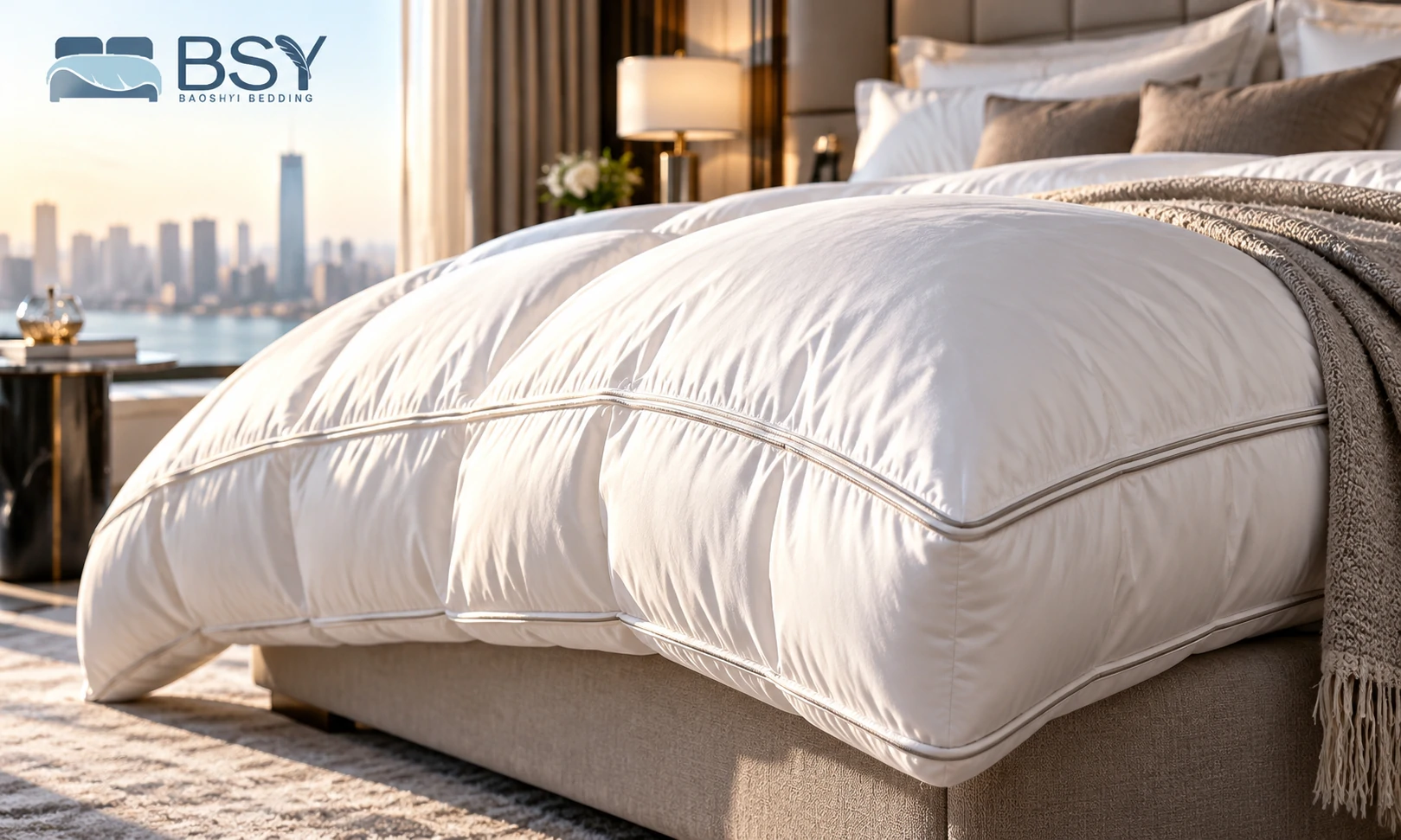
Goose Down & Feather Gusset Duvets: Why Luxury 5-Star Suites Demand Raised Sidewalls
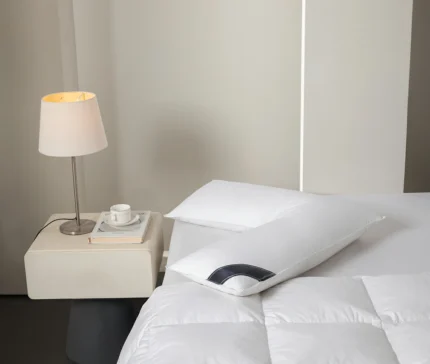
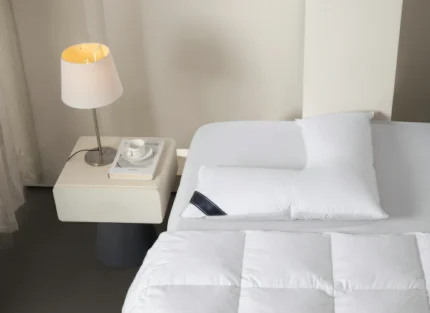
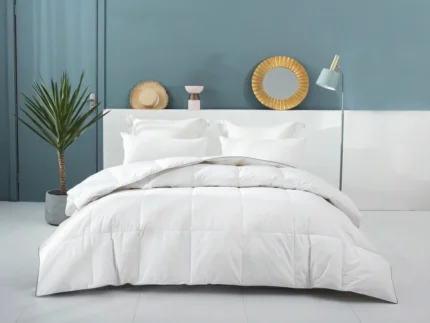
October 9, 2026When evaluating the visual impact of an executive presidential suite in properties managed by brands like Ritz-Carlton, Four Seasons, or St. Regis, the bed is the immediate visual and tactile focal point. It stands like a cloud-sculpted centerpiece: architectural, uniformly thick, and perfectly tailored right to the perimeter of the mattress.
For hotel owners, general managers, and hospitality procurement directors, achieving that iconic five-star bed presentation involves more than simply injecting more grams of goose down into a comforter casing.
Traditional bedding construction features a flat perimeter closure—often called a knife-edge seam. As a result, the comforter thins out toward the borders, creating hollow corners inside duvet covers and allowing cold drafts to slip under the covers along the sides of the bed.
To eliminate this structural defect, luxury hospitality groups mandate 3D Gusset Construction (Raised Sidewalls).
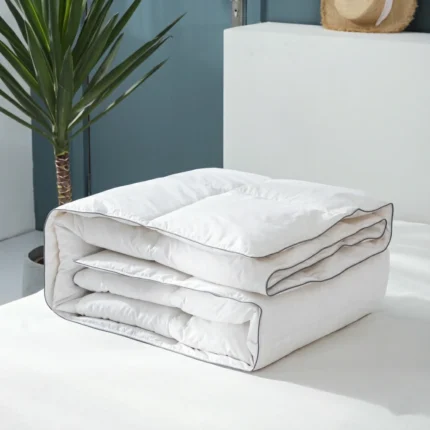
By inserting a vertical fabric wall around the entire perimeter of the comforter, a gusset duvet transforms a two-dimensional envelope into a three-dimensional chamber.
This technical guide explores the structural mechanics, thermal ergonomics, bed-making efficiencies, and sourcing economics of specifying white goose down gusset duvets for premier commercial properties.
1. Understanding Gusset Construction: 3D Sidewalls vs. Flat Knife Edges
To understand why gusseted engineering dominates high-tier hospitality contracts, procurement managers must evaluate seam geometry along the outer borders of the duvet.
The Flat Knife-Edge Defect: Perimeter Pinching and Tapering
In conventional comforter production, the top and bottom fabric shells are sewn directly together along the perimeter border.
This creates a fundamental physical limitation:
- While the center of each interior quilting square might expand to a loft of 3.0 cm to 4.0 cm, the outer perimeter boxes taper downward to zero millimeters at the outer seam line.
- This tapering effect starves the perimeter pockets of vertical expansion space, compressing the outer down clusters and leaving the edges of the bed noticeably thinner than the center.
Anatomy of the Raised Perimeter: 2.5 cm to 5.0 cm Vertical Sidewalls
A gusset duvet solves perimeter tapering by inserting a continuous, structural fabric border—known as the gusset sidewall—between the top and bottom fabric shells:
- Sidewall Height: Ranging from 2.5 cm to 5.0 cm (1.0 to 2.0 inches) depending on seasonal warmth ratings.
- Geometric Conversion: The vertical sidewall converts the outer perimeter of the duvet from a pinched wedge into a true three-dimensional rectangular box.
- Uniform Edge Loft: The outer chambers along the edge of the mattress have the exact same vertical expansion space as the chambers in the dead center of the bed, ensuring 100% consistent loft from seam to seam.
2. Sleep Ergonomics: Eliminating Edge Drafts and Cold Air Leaks
Beyond visual appeal, gusseted construction delivers tangible physiological benefits that directly impact guest sleep quality scores.
Sealing Against Mattress Borders: The 3D Gasket Effect
When a guest lies under a flat knife-edge comforter, the pulled fabric tends to bridge across the sleeper’s body and the mattress surface, leaving open triangular gaps along the edges where cool room air enters.
A gusseted duvet behaves differently:
- The 3.0 cm to 5.0 cm vertical sidewall gives the perimeter border structural downward mass.
- As the duvet drops over the edge of the bed, the thick, down-filled border drapes vertically against the sides of the mattress, acting like an insulated fabric gasket that seals out nighttime room drafts.
Partner Movement and Low-Center Drape
When two guests share a bed, movement by one partner frequently tugs the comforter, lifting flat edges and exposing the other guest to cool air.
Because a gusset duvet maintains its three-dimensional volume all the way to the outer piping, the comforter drapes with lower surface tension, staying securely anchored against the mattress during tosses and turns.
The Cloud-Immersion Experience
Luxury travelers pay premium Average Daily Rates (ADR) for sensory indulgence. A gusseted white goose down duvet provides full three-dimensional immersion, enveloping the sleeper in an unbroken thermal cocoon that flat comforters cannot replicate.
3. Visual Merchandising: The Flawless Five-Star Hotel Bed Presentation
Housekeeping presentation is vital in luxury hospitality. A rumpled or misshapen bed immediately diminishes perceived guest room cleanliness and quality.
Filling the “Hollow Corners” of Luxury Duvet Covers
Luxury hotels specify heavy, high-thread-count cotton sateen or jacquard duvet covers (often 300T to 400T). These dense outer covers possess substantial fabric weight:
- When a standard flat-edge comforter is inserted, its tapered corners lack the structural loft needed to fill the corners of the heavy cover, causing the bed cover corners to flop, sag, and wrinkle.
- A gusset duvet features squared, three-dimensional 90-degree corners that fill out the duvet cover completely, delivering crisp, tailored bed lines.
Commercial Tie Anchoring: 8-Point Fastener Loops
To prevent internal shifting, high-standard commercial gusset duvets incorporate 8 reinforced perimeter loop ties (one at each of the four corners, and one centered along each side).
These heavy-duty twill loops tie directly to internal ribbons inside the hotel’s custom duvet covers, locking the comforter in place and eliminating internal bunching during guest use.
Housekeeping Efficiency: The Self-Plumping Duvet
In commercial hotel operations, housekeeping turnaround speed directly impacts labor costs:
- Flat comforters require manual shaking and smoothing to redistribute collapsed edge down.
- A gusseted duvet maintains an internal structural memory. When an attendant shakes the comforter, air rushes through the perimeter sidewalls, causing the entire comforter to self-plump instantly and reducing bed-making times by several minutes per room.
4. Fill Formulations for Gusset Duvets: White Goose Down Selection
A spacious three-dimensional gusset box requires high-grade filling materials to support its expanded internal volume.
The Core Fill: 700 to 800+ Fill Power White Goose Down
Because the perimeter sidewalls create up to 25% more internal cubic volume than a flat comforter, using low-grade, heavy feathers will cause the edges to feel dense and heavy.
Five-star properties mandate:
- 700 to 800+ Fill Power Mature White Goose Down: High fill-power clusters expand with immense springiness, filling the tall vertical chambers with buoyant, weightless warmth.
Structural Feather Calibration: The 90/10 Formulation
While residential buyers often request 100% down, luxury hotel groups frequently specify a 90% White Goose Down / 10% Small Goose Feather Blend:
- The 10% small, curved waterfowl feathers act like microscopic internal leaf springs.
- They provide physical resilience within the tall perimeter sidewalls, preventing the vertical edge borders from collapsing under repeated commercial laundering and handling.
Differential Chamber Fill Density
On automated BSY production lines, filling machines can be programmed to inject 5% to 8% higher fill density into the perimeter gusset chambers than the center chambers.
This extra filling ensures that the side edges—which hang over the bed and experience the greatest handling—remain plump and upright over years of guest turnover.
5. Manufacturing Standards: Dual-Row Piping and Baffle Architecture
Building a commercial-grade gusset duvet requires rigorous factory engineering to prevent seam blowouts.
Integrating 3D Internal Baffles with Perimeter Sidewalls
A true gusset duvet is a continuous three-dimensional lattice:
- The internal vertical mesh baffle walls (typically 3.0 cm to 3.5 cm in height) must be precision-stitched directly to the perimeter vertical sidewalls.
- This internal connection creates an unbroken honeycomb of chambers, allowing natural down clusters to breathe and loft without migrating into adjacent pockets.
Dual-Row German Piping (Double-Cord Reinforcement)
A standard comforter has one row of edge piping. A gusset duvet features a vertical wall, creating two parallel outer seam lines: an upper perimeter seam and a lower perimeter seam.
- Dual-Row Piping: Sourcing contracts must mandate structural, pre-shrunk cotton cord piping sewn into both the top and bottom perimeter seams.
- The upper cord provides a crisp, tailored visual edge along the top of the mattress.
- The lower cord reinforces the base seam against tension, doubling the mechanical defense against down leakage along the outer edge.
Shell Fabric Specification: 300T to 400T Combed Long-Staple Cotton
Gusset duvets should be paired with premium casings:
- 300T 100% Cotton Sateen (60s yarn): Delivers a soft, quiet hand feel with minimal fabric rustling.
- 400T Combed Percale (80s yarn): An ultra-light casing that lets expansive 800 FP goose down clusters reach maximum loft without being weighed down by a heavy outer shell.
- Both fabrics must undergo double-sided mechanical calendaring to seal microscopic weave pores against down migration without using chemical coatings.
6. Sourcing Matrix & Cost Economics: Flat Edge vs. Gusseted Duvet
| Technical Parameter | Standard Flat Knife-Edge Duvet | 3D Baffle-Box Duvet (Flat Border) | Luxury 3D Gusset Duvet (Raised Sidewalls) |
| Edge Seam Geometry | Top & bottom shells sewn flat | Flat outer edge with internal baffles | Raised vertical sidewall (2.5 cm to 5.0 cm) |
| Edge Thickness (Loft) | Tapers to 0 mm along perimeter | Tapers to 0 mm along outer border | Maintains full 3.0 cm–5.0 cm edge loft |
| Draft Protection | Prone to side air leaks | Moderate draft protection | 3D Gasket seal against mattress borders |
| Duvet Cover Corner Fit | Rounded, empty corners | Soft corners | Crisp, fully supported 90-degree corners |
| Perimeter Piping | Single-row or unpiped | Single-row corded piping | Dual-row structural German piping |
| Tie Anchoring Points | 4 corner loops | 4 corner loops | 8 heavy-duty reinforced twill loops |
| Manufacturing Labor | Baseline | + 20% labor time | + 45% labor time (complex 3D assembly) |
| FOB Price Variance | Baseline | + $3.50 – $5.00 per unit | + $7.50 – $12.00 per unit over flat edge |
| Target Channel | Economy & mid-scale hotels | 4-Star business hotels | 5-Star luxury hotels & presidential suites |
7. 5 Non-Negotiable Contract Specifications for Hotel Gusset Duvet POs
When drafting a commercial Purchase Order (PO) for gusseted duvets, include these technical clauses:
- Mandate Exact Sidewall Height: Specify: Perimeter sidewall shall measure exactly 3.5 cm (±0.3 cm) in finished height, constructed from down-proof matching shell fabric.
- Require Dual-Row Piping: State: Both upper and lower perimeter seams of the vertical sidewall must incorporate pre-shrunk cotton cord wrapped in bias-cut down-proof casing.
- Specify 8 Fastener Loops: Require: Duvet shall feature 8 reinforced herringbone twill loops (4 corners, 4 mid-sides), each bartacked to withstand at least 50 Newtons of tensile pulling force.
- Enforce Cleanliness Benchmarks: Mandate: All white goose down must test at Turbidity
≥1000 mm≥1000 mmand Oxygen Number≤10 mg/100g≤10 mg/100g, backed by certified RDS transaction certificates. - Verify EN 12132 Seam Down-Proofness: Require: Finished production samples must pass EN 12132-1 rotating box testing with fewer than 15 total penetrated fibers along gusset seam lines.
8. Frequently Asked Questions (FAQ)
What is the functional difference between an internal baffle box and an exterior perimeter gusset?
An internal baffle box refers to the vertical mesh walls sewn inside the comforter to separate individual quilting squares, preventing cold spots across the surface of the bed. An exterior perimeter gusset is a vertical fabric wall sewn around the outer borders of the entire duvet, ensuring that the outer edges maintain the same loft as the center rather than pinching flat. Premium hotel comforters combine both features: internal 3D baffle boxes integrated with an exterior perimeter gusset.
How does a gusseted duvet improve hotel housekeeping and bed-making speed?
A gusseted duvet possesses structural three-dimensional memory. Instead of collapsing into a flat sheet that requires extensive shaking, smoothing, and corner-tucking, a gusseted duvet self-plumps with minimal handling. Its square corners fill out the duvet cover automatically, and the 8-point loop tie system keeps the comforter centered, saving room attendants valuable minutes during turnover.
What is the recommended vertical sidewall height for a luxury hotel gusset duvet?
For luxury hospitality, the commercial standard sidewall height is 3.0 cm to 4.0 cm (approximately 1.2 to 1.5 inches) for all-season weights (9.0 to 10.5 Tog). For heavy winter duvets (13.5 Tog+) or ultra-luxury presidential suite lines using 800+ fill power down, sidewalls are frequently specified at 4.5 cm to 5.0 cm (2.0 inches) to allow maximum down cluster expansion.
What is the typical wholesale FOB price premium for a gusseted duvet over a standard flat knife-edge duvet?
Holding the outer fabric and goose down fill constant, a 3D gusseted duvet commands an FOB price premium of roughly $7.50 to $12.00 per unit over a flat knife-edge comforter. This price delta covers the additional fabric cutting, dual-row piping cord, labor-intensive 3D edge sewing, and specialized chamber blowing required to assemble the three-dimensional perimeter.
Conclusion: Engineering the Benchmark of Luxury Sleep
In premier hospitality, luxury is measured in physical execution. A bed that looks flat or develops cold drafts along its borders undermines the five-star guest experience, regardless of raw thread count or room rates.
By specifying 3D Gusset Construction with Raised Sidewalls, hotel asset owners and procurement directors eliminate perimeter cold spots, speed up housekeeping turnover, and deliver the deeply lofted, cloud-like silhouette that discerning travelers expect.
Located in Xiaoshan, Hangzhou—the global hub of down textile manufacturing—BSY Bedding is an established OEM/ODM manufacturer specializing in commercial-grade goose down gusset duvets. Equipped with advanced automated sewing lines, dual-piping attachments, and in-house laboratory testing facilities, we engineer luxury gusset comforters built to the exacting standards of five-star hospitality brands worldwide.