How to Prevent Down Leakage: Double-Needle Stitching and Piping Quality Standards
September 29, 2026In the commercial home textile industry, down leakage represents an operational and financial disaster. When a retail customer unzips their duvet cover to discover fine down filaments clinging to the fabric, or when a luxury hotel guest wakes up covered in feather quills, brand reputation suffers immediate damage.
For procurement managers, product development heads, and quality assurance directors, managing down leakage is a complex engineering challenge.
A common misconception in bedding sourcing is that down containment is solely a function of outer fabric thread count. Sourcing teams invest heavily in 300T or 400T calendered cotton, only to face consumer returns due to shedding.
In commercial production, laboratory analysis reveals that more than 80% of down and feather migration occurs not through the fabric weave, but directly through sewing needle holes and improperly reinforced perimeter seams.
Preventing down leakage requires a comprehensive factory-floor quality system that addresses needle gauge selection, sewing thread tension, structural piping barriers, and precision seam redundancy.
This technical guide outlines the engineering specifications and quality control benchmarks necessary to guarantee completely leak-proof down bedding in high-volume OEM/ODM production.
1. The Anatomy of Down Leakage: Identifying Seam Vulnerabilities
To eliminate down migration, quality assurance teams must understand the physical mechanisms that allow fibers to escape along stitch lines.
The Needle Puncture Tunnel Effect
Natural down clusters consist of a microscopic central point radiating delicate, flexible barbules measuring just 5 to 10 microns in diameter. Meanwhile, small waterfowl feathers possess stiff, pointed central quills.
When an industrial sewing machine needle pierces dense, calendered cotton fabric, it creates an entrance hole measuring roughly 0.7 to 1.0 millimeters in diameter. Compared to microscopic down fibers, this needle perforation is an expansive open tunnel. If the hole is not properly filled by thread and compressed by perimeter tension, natural down clusters will be pulled through the opening by internal air currents.
High-Speed Needle Friction and Thermal Yarn Scorching
Automated commercial sewing machines operate at speeds between 3,000 and 4,500 revolutions per minute (RPM). At these velocities, friction between the steel needle and dense cotton fabric generates temperatures exceeding 180°C to 200°C.
This localized heat creates two severe defects:
- It scorches natural cotton yarns, causing them to become brittle, snap, and permanently widen the puncture opening.
- If synthetic polyester sewing thread is used, heat can soften the thread, causing micro-snags that leave loose gaps around the needle perforation.
Dynamic Air Pressure During Sleep and Laundering
A down duvet is not a static object; it acts as a dynamic pneumatic pump. When a sleeper lies down, moves, or rolls over, the duvet is compressed, forcing liters of internal air to rapidly vent outward.
If perimeter seams lack adequate mechanical resistance, this high-velocity escaping air acts as a carrier stream, forcing loose down filaments and feather shafts directly through the needle puncture holes. The exact same hydraulic pressure occurs during the spin-extraction cycle of commercial laundry tunnel washers.
2. Double-Needle Seam Engineering: Two Layers of Redundancy
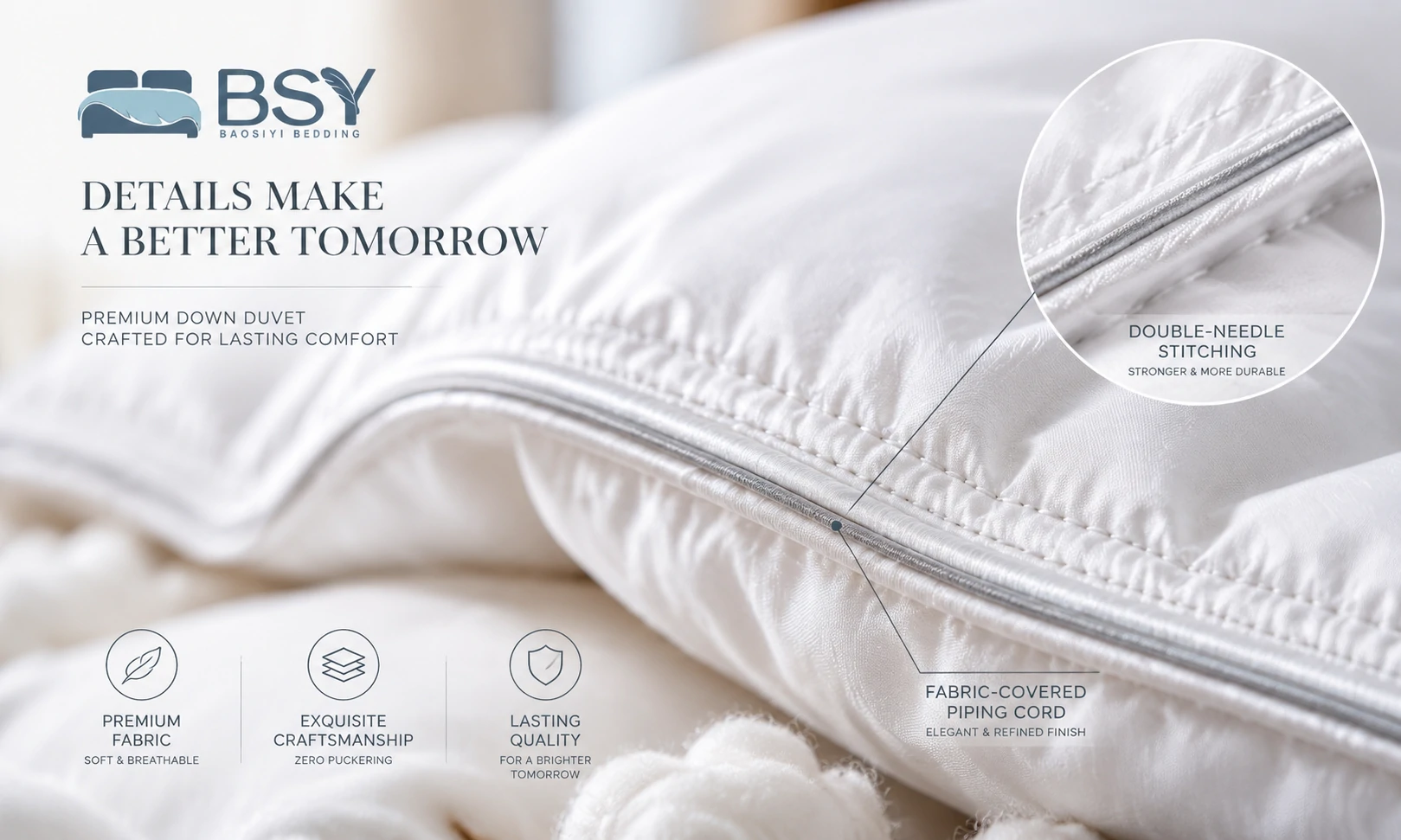
In commercial duvet manufacturing, single-needle perimeter stitching is an unacceptable operational shortcut. High-quality export production mandates Double-Needle Topstitching (Twin-Needle Lockstitching).
The Double-Needle Geometry (4 mm to 6 mm Gauge Spacing)
A double-needle machine utilizes two synchronized vertical needles fed by independent thread cones, driven through a single presser foot to create two perfectly parallel rows of lockstitching.
- Gauge Spacing: Factory specifications must mandate an exact gauge spacing of 4.0 mm to 6.0 mm between the inner and outer stitch lines.
- Spacing narrower than 4.0 mm concentrates excessive needle punctures into a tiny fabric zone, perforating and weakening the casing like a stamp sheet.
- Spacing wider than 6.0 mm creates loose fabric channels between the rows where migrating fibers can accumulate.
Stress Distribution and Burst Prevention
Double-needle stitching provides vital mechanical redundancy:
- The Primary Inner Row: Absorbs the primary hydraulic stress generated when the duvet is compressed, holding the internal filling within the core.
- The Secondary Outer Row: Acts as an impenetrable backup gate. If an interior thread ruptures due to laundering friction or snagging, the exterior row maintains structural containment, completely preventing catastrophic seam blowouts.
Stitch Density Calibration: The 10 to 12 Stitches Per Inch (SPI) Rule
Controlling stitch density (measured in Stitches Per Inch, or SPI) is a critical balancing act:
- Low Stitch Density (<8 SPI): Leaves loose gaps between adjacent thread passes. When the duvet expands, fabric layers pull apart slightly, allowing down fibers to slip through the loose gaps.
- High Stitch Density (>14 SPI): Drives too many needle penetrations into the fabric, severing structural warp and weft yarns. Under tension, the punctured casing tears like perforated paper.
- The Gold Standard (10 to 12 SPI): Delivers optimal seam strength while maintaining thread tension tight enough to plug every needle hole completely.
3. German Piping (Corded Trim): The Hidden Barrier Inside the Seam
While double-needle stitching creates structural strength, Piping (Corded Edging / German Piping) provides the crucial physical seal that prevents fibers from creeping between fabric layers.
The Anatomy of High-Standard Piping
True commercial piping is not a decorative ribbon; it is a three-dimensional structural gasket consisting of:
- The Core Cord: A continuous, high-density braided or knitted 100% cotton cord (typically 2.0 mm to 3.0 mm in diameter) that has undergone pre-shrinking.
- The Bias-Cut Shell: A strip of high-density down-proof fabric cut at a precise 45-degree angle (bias) to the grain line, ensuring smooth bending around 90-degree corners without puckering.
- The Embedded Flange: The wrapped cord is inserted directly between the top and bottom duvet shells and locked securely into the main seam assembly.
Physical Obstruction: Plugging Perimeter Seam Cavities
When two flat layers of fabric are sewn together, microscopic gaps remain along the folded edge where the two faces meet.
German piping solves this:
- As the double-needle machine clamps down, the thick, cylindrical cotton cord is compressed firmly into the perimeter fold.
- The cord functions like a silicone rubber gasket, physically filling and blocking the entire internal cavity. Down clusters moving toward the edge collide with the solid barrier of the cord and cannot escape.
Geometric Stability: Preserving 90-Degree Box Corners
Beyond leak prevention, structural piping provides essential dimensional rigidity. It reinforces the outer edges of the duvet, ensuring that comforter corners remain square, crisp, and firmly anchored inside duvet covers rather than collapsing into rounded, shifting balls.
4. Tooling & Machine Calibration on Automated Factory Lines
Precision sewing requires strict tooling calibration on high-speed factory production lines.
Needle Gauge Selection: Size 70/10 to 75/11 Ball-Point (SES) Needles
Using standard heavy sewing needles (such as Size 90/14 or 100/16) is the leading cause of down leakage. Quality-certified factories enforce:
- Micro-Fine Needle Sizes: Needles must not exceed Size 70/10 or 75/11.
- Light Ball-Point Tips (SES): Unlike sharp cutting-point needles (which slice through woven cotton yarns), an SES ball-point needle gently slides between the warp and weft threads, parting them without severing the structural fibers. When the needle withdraws, the elastomeric nature of the cotton yarns causes them to spring back toward the thread, naturally sealing the hole.
Pneumatic Needle Air Cooling Systems
To solve needle heating at 4,000 RPM, high-end automated lines (such as automated Jack sewing units) integrate continuous pneumatic needle cooling:
- High-velocity compressed cold air is directed via micro-nozzles directly onto the needle blade immediately above the fabric plate.
- This maintains needle blade temperatures consistently below 80°C, completely preventing yarn scorching and thread thermal distortion.
High-Tenacity Glazed Core-Spun Thread
Standard spun polyester sewing thread is fuzzy, uneven, and porous. Down comforters must be sewn exclusively with Polyester-Wrapped Core-Spun Thread with Lubricated Finish (e.g., Tex 24 to Tex 30):
- The continuous polyester filament core provides exceptional tensile strength (resisting laundry spin cycles).
- The smooth, glazed cotton or synthetic exterior wrap swells slightly upon contact with moisture, physically plugging the needle perforation.
- High-grade silicone lubrication ensures the thread glides smoothly through high-tension guides without snapping.
5. Internal Baffle Wall Attachment: Securing the 3D Lattice
In 3D baffle-box duvets, down leakage is not limited to the exterior borders; internal baffle blowouts can compromise the entire product.
If an internal vertical baffle wall tears loose from the casing, down from two adjacent chambers merges. The duvet develops huge clumps in one area and empty cold spots in another, completely ruining thermal performance.
Interlock Overedging of Baffle Mesh Edges
Internal vertical partition walls are woven from lightweight, highly breathable fabric mesh. If the edges of this mesh are raw or unsealed, fraying threads can unravel under commercial washing friction.
Factories must ensure that:
- Every internal baffle strip features ultrasonically sealed edges or interlock overedge stitching.
- Baffle strips are sewn to the interior face of the casing using high-density chain stitching with a minimum seam allowance of 8 mm.
Cross-Joint Tacking at High-Stress Intersections
The points where horizontal and vertical internal baffle walls intersect represent extreme mechanical stress points. Automated factory lines apply specialized bar-tacking (reinforced cross-stitches) at every junction, ensuring the internal lattice can withstand the violent pulling forces of commercial laundry extractors.
Quantitative Injection Port Sealing
When down is blown into each baffle chamber through a narrow side aperture, that injection opening must be permanently closed. Top-tier manufacturers utilize an internal fold-over stitch:
- The raw edges of the injection port are folded inward by at least 15 mm.
- The opening is sealed with a dense lockstitch featuring 3 back-tack stitches at each end to guarantee that the injection point never unseats.
6. Laboratory Testing & Quality Verification for Down-Proof Seams
Prior to approving mass container shipments, commercial purchase orders should mandate accredited third-party laboratory verification of seam integrity.
EN 12132-1 & EN 12132-2: Rotating Box and Impact Cushion Tests
European testing norms EN 12132-1 and EN 12132-2 are the global benchmarks for down-proof performance:
- EN 12132-1 (Rotating Box Test): A finished pillow cushion incorporating the exact production seam and piping is tumbled inside a rotating mechanical chamber packed with hard silicone rubber balls for 2,700 revolutions.
- EN 12132-2 (Impact Cushion Test): A pneumatic mechanical mallet repeatedly impacts the comforter seam under controlled cyclic pressure, simulating a sleeper rolling over thousands of times.
- Passing Standard: The total number of down clusters, feather plumes, and fibers that penetrate the seam must be under 20 to 30 particles. Premium hospitality tenders enforce a strict limit of fewer than 15 particles.
Seam Slippage and Tensile Strength (ISO 13936-1)
Under ISO 13936-1, seams are pulled in opposing directions under a standardized tensile force of 100 Newtons:
- The permanent seam opening (slippage gap) must not exceed 2.0 millimeters. Seams that pull open wider than 2.0 mm will leak feather quills under commercial laundering stress.
100% Backlit LED Table Inspection on the Production Floor
Beyond sample testing, every single comforter passing through the BSY production facility undergoes 100% Backlit LED Inspection:
- Finished duvets are laid across specialized, high-intensity frosted glass light tables in a darkened inspection room.
- Inspectors visually inspect every inch of the perimeter double-needle stitching and piping under powerful backlighting. Any enlarged needle holes, skipped stitches, broken threads, or bunched piping are instantly spotted, tagged, and routed for repair before packing.
7. Commercial Specification Matrix & Purchase Order Clauses
| Seam Construction Type | Leak Resistance Rating | Burst Strength | Manufacturing Cost Impact | Ideal Sourcing Application |
| Single-Needle Knife Edge (Flat) | Poor (High leak risk) | Low (Single failure point) | Baseline (Lowest cost) | Low-cost promotional lines, budget synthetic wadding |
| Self-Piped Single-Needle | Moderate | Moderate | + $0.80 – $1.20 | Mid-tier consumer retail, synthetic microfiber duvets |
| Standard Double-Needle (No Piping) | Good (Dual barrier) | High (Redundant strength) | + $1.50 – $2.20 | Commercial business hotels, 100% down-rich comforters |
| German Piping + Double-Needle Topstitching | Superior (Near-zero leakage) | Ultra-High (Piping gasket + 2 stitch lines) | + $2.80 – $4.00 | 5-Star luxury hotels, premium duck/feather winter duvets, luxury DTC brands |
5 Non-Negotiable Stitching Terms for Down Bedding POs
- Mandate Needle Size and Type: State explicitly: Perimeter sewing shall use Size 70/10 or 75/11 SES light ball-point needles equipped with pneumatic air-cooling systems.
- Specify Double-Needle Spacing: Require: Double-needle topstitching must feature parallel rows spaced exactly 4 mm to 6 mm apart with a stitch density of 10 to 12 stitches per inch (SPI).
- Require Pre-Shrunk Corded Piping: Mandate: All four outer borders must incorporate German-style piping constructed from pre-shrunk cotton cord wrapped in 45-degree bias-cut down-proof casing.
- Enforce Back-Tacking on Ports: State: All chamber blowing injection ports must be folded inward by at least 15 mm and secured with reinforced lockstitching featuring minimum 3 back-tack stitches.
- Establish EN 12132 Acceptance Thresholds: Require: Finished production samples must pass EN 12132-1 testing with total particle penetration not to exceed 20 fibers.
8. Frequently Asked Questions (FAQ)
Why do down duvets leak feathers even when made with high thread-count fabric?
Down and feather leakage rarely occurs through the center of high-density fabric. Instead, it occurs along perimeter seam lines where thick sewing needles puncture permanent holes through the calendered yarns, or where single-needle stitching allows fabric edges to pull apart under body weight, creating micro-tunnels that allow feathers and down filaments to escape.
What is the ideal stitch density (SPI) to prevent down leakage without weakening the fabric?
The commercial sweet spot is 10 to 12 Stitches Per Inch (SPI). Stitch density below 8 SPI leaves loose gaps between threads where down can slip out; conversely, stitch density exceeding 14 SPI drives too many needle punctures into the cotton, cutting structural yarns and causing the fabric to tear along the seam like perforated paper.
How does German piping cord physically stop down clusters from escaping at the edges?
German piping consists of a dense, pre-shrunk cotton cord wrapped in bias-cut down-proof fabric sewn directly into the seam fold. When double-needle stitching clamps down, the cord acts as an internal gasket, physically filling and compressing the seam cavity. Migrating down clusters hit the solid barrier of the cord and cannot push their way through to the exterior.
What needle size and cooling methods should commercial duvet manufacturers use?
Manufacturers should use Size 70/10 to 75/11 SES (light ball-point) needles. Ball-point needles separate cotton yarns rather than cutting them, allowing yarns to spring back and close around the thread. Furthermore, automated lines must deploy continuous pneumatic air cooling nozzles aimed at the needle blade to prevent friction temperatures from exceeding 80°C and scorching fabric holes.
Conclusion: Engineering an Impenetrable Seam Defense
In commercial down bedding procurement, the outer shell fabric is only as dependable as the seams that bind it together. Specifying premium raw down and expensive high-thread-count cotton will fail in the marketplace if perimeter stitching is treated as an afterthought.
By mandating double-needle topstitching, integrating pre-shrunk German piping cords, enforcing micro-needle calibration, and verifying compliance under EN 12132 testing, commercial buyers eliminate down leakage risks, extend product lifespan, and protect brand equity across global hospitality and retail markets.
Located in Xiaoshan, Hangzhou—the epicenter of China’s down textile export trade—BSY Bedding operates computerized Jack automated sewing units equipped with pneumatic needle coolers, automated double-needle lockstitching, and 100% backlit LED light-table inspection. We engineer and manufacture fully certified, leak-free down and feather duvets built to the world’s most demanding hospitality and retail specifications.