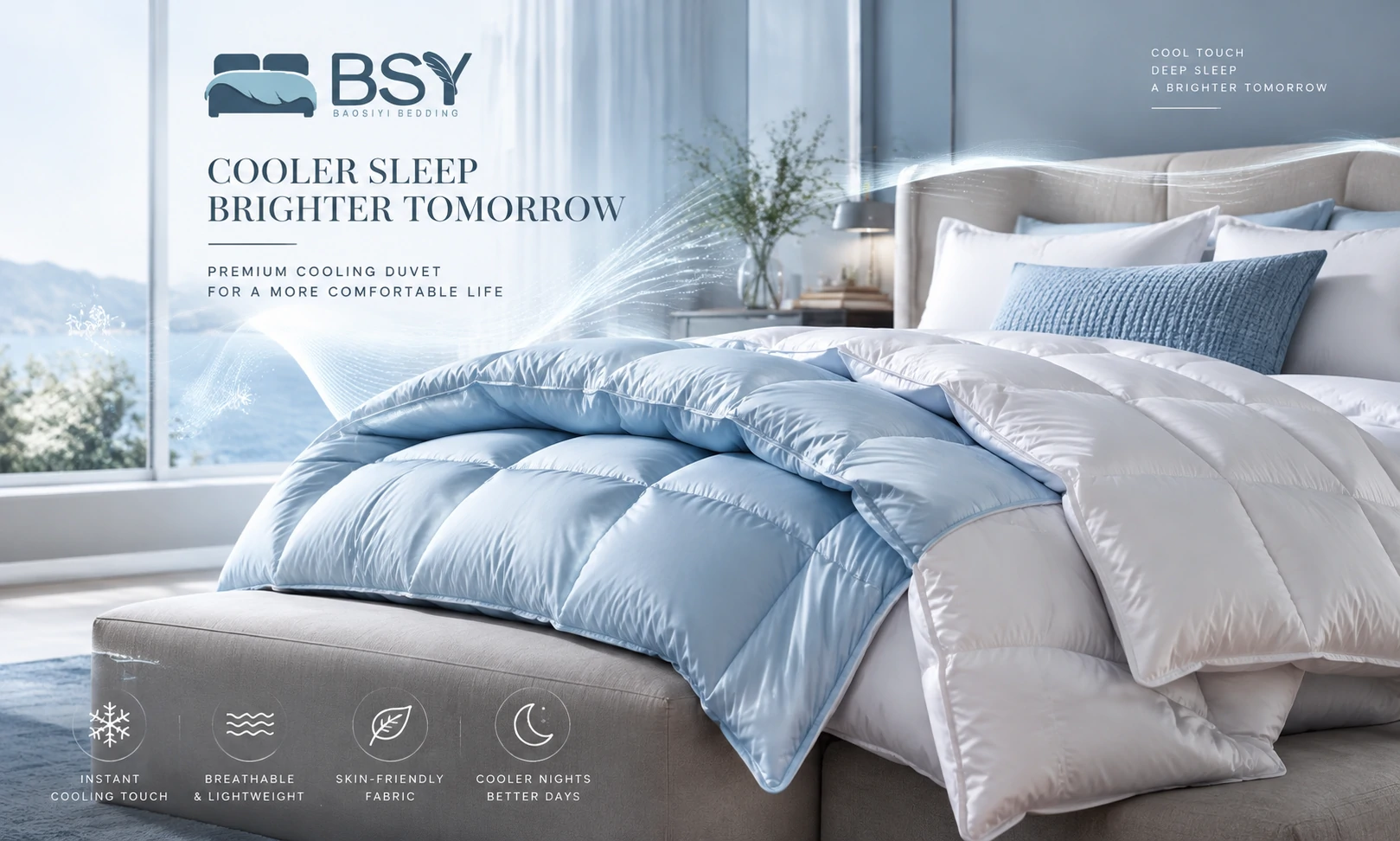
The Science of Cooling Duvets: Q-Max Values and Mica Nylon Fabrics Demystified
September 29, 2026Across the global home textile landscape, consumer sleep priorities are shifting dramatically. Driven by rising summer temperatures, heightened urban heat island effects, and a widespread desire to reduce nighttime air-conditioning energy consumption, “hot sleepers” represent one of the fastest-growing customer segments in modern bedding.
In response, the retail market has been flooded with products labeled “ice silk,” “freeze touch,” or “instant cooling.” Yet procurement managers and commercial buyers frequently discover that many of these claims fail in practical use.
Comforters that feel cool in an air-conditioned showroom can quickly trap heat and sweat once a sleeper has been in bed for an hour. Worse still, low-cost suppliers often rely on topical chemical softeners that wash out after three laundry cycles, generating high return rates and customer dissatisfaction.
To build a profitable, defensible summer bedding program, commercial buyers must look past marketing buzzwords and evaluate cooling bedding through the lens of thermodynamics: Thermal Conduction, Q-Max Ratings, and Inherent Mineral-Infused Fiber Science.
1. The Thermodynamics of Cool-Touch Bedding: How Cooling Fabrics Work
Cooling textiles do not generate refrigeration; they operate on the laws of heat transfer. For a comforter to keep a sleeper comfortable on warm nights, it must address two distinct thermal phases: Instant Contact Cooling and Continuous Micro-Climate Ventilation.
Instant Contact Cooling (Thermal Conduction)
Human skin typically maintains an average surface temperature of 33°C to 35°C. When a sleeper makes physical contact with bedding at room ambient temperature (e.g., 22°C to 24°C), heat naturally conducts from the warmer body to the cooler textile.
If the fabric possesses high thermal conductivity, heat transfers away from the skin at an accelerated rate, causing a rapid drop in cutaneous temperature that sensory nerve endings register as an immediate, refreshing chill.
Sustained Thermal Dissipation (Continuous Convection)
Initial contact cooling lasts only seconds if the fabric cannot disperse the absorbed energy. Once the textile fibers reach thermal equilibrium with skin temperature, the cooling sensation ceases.
True high-performance cooling duvets solve this by pairing thermally conductive outer yarns with an open, breathable weave that continuously transfers heat away toward the room air, preventing heat buildup within the sleeping micro-climate.
Moisture Vapor Transmission and Sweating Prevention
Trapped humidity ruins cooling comfort. When a fabric lacks moisture vapor permeability, perspiration cannot evaporate, turning the bedding clammy and warm. High-performance summer duvets utilize specialized cross-sectional fiber profiles that wick sweat away via capillary action, cooling the body naturally through evaporation.
2. Demystifying Q-Max: The Universal Benchmark for Cool Touch
In technical textile specifications, subjective phrases like “cool to the touch” are replaced by an exact physical metric: The Q-Max Value.
What is Q-Max? Scientific Definition
Q-Max (Maximum Heat Flux Density) measures the peak rate of heat transfer from skin to fabric upon initial contact, expressed in Watts per square centimeter (W/cm²) or Joules per square centimeter per second (J/cm²·s):
Q-Max = Maximum Heat Flux Detected Upon Initial Surface Contact
The higher the tested Q-Max number, the faster heat leaves the body, and the more pronounced the instant cooling sensation felt by the sleeper.
Laboratory Testing Protocols (JIS L 1927 & FTTS-FA-019)
International standards enforce strict laboratory testing protocols, most notably JIS L 1927 (Japanese Industrial Standard) and FTTS-FA-019 (Taiwan Functional Textile Standard), utilizing the standardized Thermo-Labo II apparatus:
- The fabric specimen is conditioned in a laboratory maintained at 20°C and 65% relative humidity.
- A copper heating plate calibrated to 34°C (representing human body temperature) is placed onto the cooler fabric surface under a standardized contact pressure of 10 grams per square centimeter.
- High-precision sensors record the peak heat flow rate in the fraction of a second after contact, generating the certified Q-Max rating.
The Commercial Q-Max Scale: Sourcing Thresholds
To evaluate factory spec sheets, buyers should reference the industry-recognized commercial Q-Max spectrum:
- 0.12 to 0.15 W/cm² (Standard Non-Cooling Textiles): Traditional 100% cotton percale, standard polyester, and linen. No noticeable initial chill.
- 0.20 to 0.25 W/cm² (Entry-Level Commercial Cooling): The baseline threshold required by international standards to legally market a product as “Cool Touch.” Suitable for budget retail programs.
- 0.35 to 0.40 W/cm² (High-Performance Luxury Cooling): The commercial standard for premium retail collections and luxury boutique hotels. Provides an unmistakable, refreshing chill that persists through body shifts.
- 0.45 to 0.50+ W/cm² (Extreme Instant Ice Chill): Top-tier engineering utilizing specialized polyethylene polymers. Delivers an immediate, dramatic icy feel designed for hot summer markets.
3. Core Cooling Fibers: Material Chemistry and Sourcing Profiles
Achieving a durable Q-Max rating above 0.35 demands advanced polymer extrusion. Manufacturers rely on two primary inherent cooling yarn technologies: Mica-Infused Nylon and High-Density Polyethylene (HDPE).
Mineral-Infused Mica Nylon (Jade & Mineral Micro-Particles)
One of the most durable and commercially successful technologies is Mica Nylon. Natural jade and sub-micron silicate mica mineral powders are ground into microscopic particles and blended directly into molten Nylon 6 (Polyamide) chips prior to filament spinning.
- The Thermal Mechanism: Minerals possess a naturally high specific heat capacity and thermal conductivity. Embedding these mineral particles within the nylon filament creates microscopic heat conduits throughout the yarn matrix.
- Tactile Quality: Unlike rough raw minerals, the resulting yarn is silky, ultra-soft, and drapes naturally like silk charmeuse.
- Permanent Durability: Because the minerals are physically encapsulated inside the polymer fiber core, the cooling performance is inherent and permanent—it cannot wash out or degrade over time.
High-Density Polyethylene (HDPE / UHMWPE Yarns)
For brands seeking extreme Q-Max values reaching 0.45 to 0.50+, High-Density Polyethylene (HDPE) is the primary material choice.
- The Thermal Mechanism: Polyethylene polymers feature an exceptionally high degree of molecular crystallinity and linear chain orientation, allowing thermal energy to conduct across molecular backbones at speeds up to four times faster than standard polyester.
- Operational Considerations: HDPE has a lower melting threshold than nylon or cotton. It cannot tolerate high-temperature commercial drying, and its surface is naturally slick and smooth, requiring fine knit constructions to prevent snagging.
The Pitfall of Chemical Softener Post-Treatments
Low-tier manufacturers frequently cut costs by taking ordinary, low-density polyester fabric and passing it through a chemical bath containing hydrophilic silicone softeners and menthol derivatives.
Buyers must be vigilant:
- Chemical post-treatments wash out completely after 3 to 5 laundering cycles.
- Chemical additives can trigger contact dermatitis in sensitive sleepers, failing OEKO-TEX testing.
- Purchase orders should strictly mandate: Inherent Mineral-Infused or Polymer-Based Cooling Yarns; No Topical Chemical Wash Finishes.
4. Interior Fillings for Summer Cooling Duvets
A cooling shell fabric is useless if paired with a dense, non-breathable interior core.
Moisture-Wicking Fiber Blends: Microfiber + Viscose / Bamboo
The ideal filling for a cooling comforter balances lightweight loft with active moisture absorption:
- 0.8D to 1.2D Ultra-Fine Microfiber: Provides cloud-like loft and soft cushioning.
- Viscose / Bamboo Rayon Fibers: Spliced into the filling matrix at a 30% to 50% ratio, natural cellulose fibers pull moisture away from the interior core, preventing humidity buildup.
Phase Change Materials (PCM – Microencapsulated Waxes)
In premium flagship lines, fillings can incorporate Phase Change Materials (PCM). Microscopic polymer spheres containing purified paraffin waxes are embedded within the fiber structure:
- As the sleeper’s body heat rises, the micro-waxes absorb heat and melt from solid to liquid, absorbing excess thermal energy without getting hotter.
- When ambient temperatures drop during early morning hours, the waxes solidify and release stored warmth, maintaining a balanced 28°C to 30°C micro-climate throughout the night.
Calibrating Summer Fill Weights (100 to 180 GSM)
Unlike winter duvets that demand 350 to 500 GSM, cooling duvets must remain feather-light:
- Ultra-Light Summer: 100 to 120 GSM (best for humid tropical climates and non-AC rooms).
- All-Season Climate-Controlled: 140 to 180 GSM (provides comfortable physical weight while remaining temperature-neutral under air conditioning).
5. Commercial Construction Innovations: The 2-in-1 Dual-Sided Summer Comforter
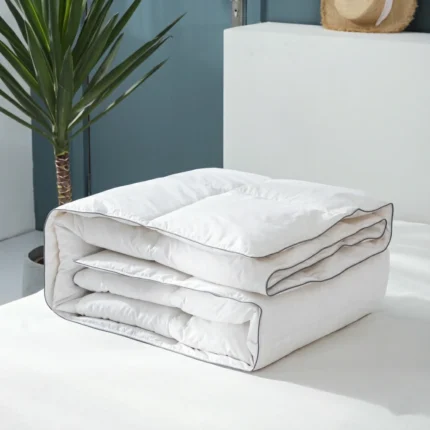
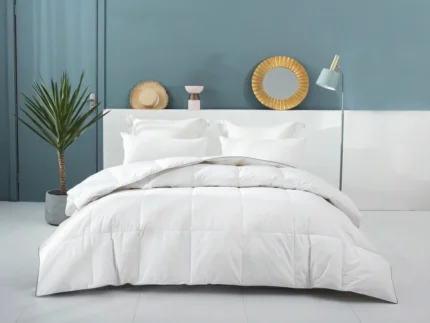
In modern retail and hospitality merchandising, single-function summer quilts are rapidly being replaced by Reversible “2-in-1” Dual-Sided Comforters.
- Top Face (Cooling Side): Q-Max 0.40+ Mica Nylon Fabric for immediate thermal relief on hot nights.
- Interior Core (Breathable Layer): 120–150 GSM Moisture-Wicking Bamboo & Microfiber Fill for balanced ventilation.
- Bottom Face (Comfort Side): 100% Washed Cotton or Bamboo Percale for breathable warmth when room temperatures drop.
The Merchandising Power of Dual-Sided Designs
- Side A (Peak Summer / Hot Nights): Constructed with high Q-Max mica nylon or HDPE fabric, providing an instant cool touch when bedtime temperatures are high.
- Side B (Spring / Autumn / Air-Conditioned Hours): Crafted from 100% pre-washed cotton percale, soft bamboo jersey, or modal. When temperatures drop in the early hours of the morning, sleepers simply flip the duvet over to enjoy natural, breathable comfort without freezing.
- Commercial Advantage: Extends the retail selling season from a 3-month summer window to an 8-month spring-through-autumn sales cycle.
Ultrasonic Wave Quilting vs. Needle Stitching
High-performance cooling duvets frequently deploy Ultrasonic Bonding:
- High-frequency acoustic vibrations fuse the synthetic shell and interior fibers together in continuous wave or geometric patterns without using needles or threads.
- Eliminating needle holes prevents internal microfibers from leaking out (bearding) and creates a flat, smooth surface that maximizes direct skin contact area for superior Q-Max performance.
3D Perimeter Air-Mesh Ventilation Panels
To prevent internal heat trapping in humid climates, high-end designs incorporate a 2.0 cm to 3.0 cm 3D breathable spacer mesh gusset around the outer perimeter border, allowing body heat to vent horizontally into the room.
6. Wash Durability, Laundering, and Q-Max Retention
A major concern for commercial buyers is whether cooling performance degrades under laundering.
Testing Q-Max Retention Across Laundry Cycles
High-quality inherent cooling fabrics retain their performance over years of use:
- Testing under JIS L 1927 confirms that mineral-infused mica nylon fabrics retain over 95% of their initial Q-Max rating after 30 standard commercial machine wash cycles.
- Because the cooling mineral particles are permanently embedded in the core polymer, they cannot dissolve or abrade away.
Laundering Guidelines for Contract Buyers
To protect synthetic cooling filaments from heat degradation, commercial care labels must clearly state:
- Machine Wash Cold: Maximum water temperature 30°C to 40°C.
- No Chlorine Bleach: Bleach degrades synthetic nylon and polyethylene molecular structures.
- Air Dry or Tumble Dry Low: High commercial dryer temperatures (above 60°C to 70°C) can melt fine HDPE fibers and damage elasticity. Line drying or gentle, low-heat tumbling is required.
Snagging and Pilling Resistance (ISO 12945-2)
Because cooling fabrics utilize ultra-smooth, fine-filament yarns, they can be vulnerable to surface snagging from rough skin or pet claws if woven loosely.
BSY production standards mandate high-gauge circular knitting or dense plain weaving, achieving a Pilling and Snagging Resistance rating of Grade 4.0 or higher under standard ISO 12945-2 Martindale testing.
7. Technical Sourcing Matrix & Procurement Checklist
| Sourcing Parameter | Entry-Level Cooling Quilt | Professional Mica Nylon Quilt | Flagship 2-in-1 Extreme Ice Comforter |
| Tested Q-Max Value | 0.20 – 0.25 W/cm² | 0.35 – 0.40 W/cm² | 0.45 – 0.50+ W/cm² |
| Cooling Mechanism | Modified Polyester / Poly | Inherent Mica Mineral Nylon | HDPE + Mica Nylon Blend |
| Target Shell Construction | Knitted Cooling Polyester | Mica Nylon + Spandex Interlock | Side A: HDPE / Side B: Washed Cotton |
| Fill Composition | 100% Virgin Hollowfiber | 70% Microfiber / 30% Bamboo | 50% Microfiber / 50% TENCEL Lyocell |
| Target Fill Weight | 150 – 180 GSM | 120 – 150 GSM | 100 – 130 GSM |
| Quilting Method | Multi-needle diamond | Ultrasonic ergonomic wave | Ultrasonic contour box with mesh |
| Wash Life (Q-Max) | 10 to 15 washes (gradual loss) | 30+ washes (permanent inherent) | 30+ washes (permanent inherent) |
| Estimated Unit Cost (FOB) | $8.50 – $11.50 | $13.50 – $17.50 | $18.50 – $24.00 |
5 Non-Negotiable Contract Clauses for Your Cooling Bedding PO
- Mandate Certified Q-Max Testing: Require an accredited third-party test report (SGS, Intertek, or TÜV) under JIS L 1927 confirming minimum Q-Max thresholds before container release.
- Specify Fiber Inherence: Contractually require that cooling performance is derived from inherent mineral/polyethylene polymers, barring topical chemical softeners.
- Verify Snagging Standards: Mandate minimum Grade 4.0 pilling and snagging resistance under ISO 12945-2.
- Ensure Chemical Safety: Require valid OEKO-TEX Standard 100 Class I certification verifying zero toxic VOCs, heavy metals, or skin irritants.
- Enforce Packaging Quality: Specify heavy-duty waterproof PEVA zippered handle bags with color inserts highlighting certified Q-Max metrics and thermal care icons.
8. Frequently Asked Questions (FAQ)
What is considered a good Q-Max value for a commercial cooling duvet?
Under international testing standards (JIS L 1927 / FTTS-FA-019), any value at or above 0.20 W/cm² meets the legal threshold to be labeled “Cool Touch.” However, for premium commercial hospitality and high-satisfaction retail lines, a Q-Max rating between 0.35 and 0.45 W/cm² is the industry sweet spot, delivering an unmistakable, refreshing chill upon skin contact without feeling overly slick or plastic-like.
Does the cooling effect in mica nylon bedding wash out after multiple laundry cycles?
No. In genuine mica nylon textiles, micro-scale jade and mineral powders are embedded directly inside the molten nylon polymer during fiber extrusion. Because the minerals are physically locked inside the filament’s molecular core, the thermal conductivity cannot wash out or degrade, maintaining over 95% of its initial Q-Max rating across 30+ commercial washings.
Can cooling duvets be tumble-dried in commercial laundry equipment?
Cooling duvets require gentle thermal handling. While mineral-infused nylon can withstand moderate temperatures, high-performance HDPE cooling filaments have a low thermal melting point. Commercial laundries must tumble dry cooling duvets on low heat (below 50°C) or air dry them. High-temperature industrial drying can warp or melt the delicate cooling fibers.
What is a “2-in-1” dual-sided cooling comforter, and why is it popular in retail?
A “2-in-1” dual-sided comforter features a high Q-Max cool-touch fabric (such as mica nylon) on one side and a breathable natural fabric (such as 100% pre-washed cotton or bamboo rayon) on the reverse. This design allows sleepers to use the cooling side on hot summer evenings, and simply flip the duvet over to the cotton side during cooler spring, autumn, or early-morning air-conditioned hours, extending the product’s usable retail lifespan to three seasons.
Conclusion: Partnering with an Advanced Functional Bedding Manufacturer
Cooling bedding represents a permanent, structural shift in consumer sleep habits driven by global climate dynamics. By moving away from unverified marketing buzzwords and building product lines based on certified Q-Max values, inherent mineral mica nylon, and breathable dual-sided architectures, commercial buyers can capture high retail margins and earn lasting customer loyalty.
Operating advanced extrusion partnerships, precision ultrasonic bonding machinery, and computerized carding lines in Xiaoshan, Hangzhou, BSY Bedding is a specialized OEM/ODM manufacturer of high-performance cooling duvets, mattress protectors, and sleep accessories. We provide fully certified, lab-tested cooling comforters engineered to exact international retail and hospitality specifications.