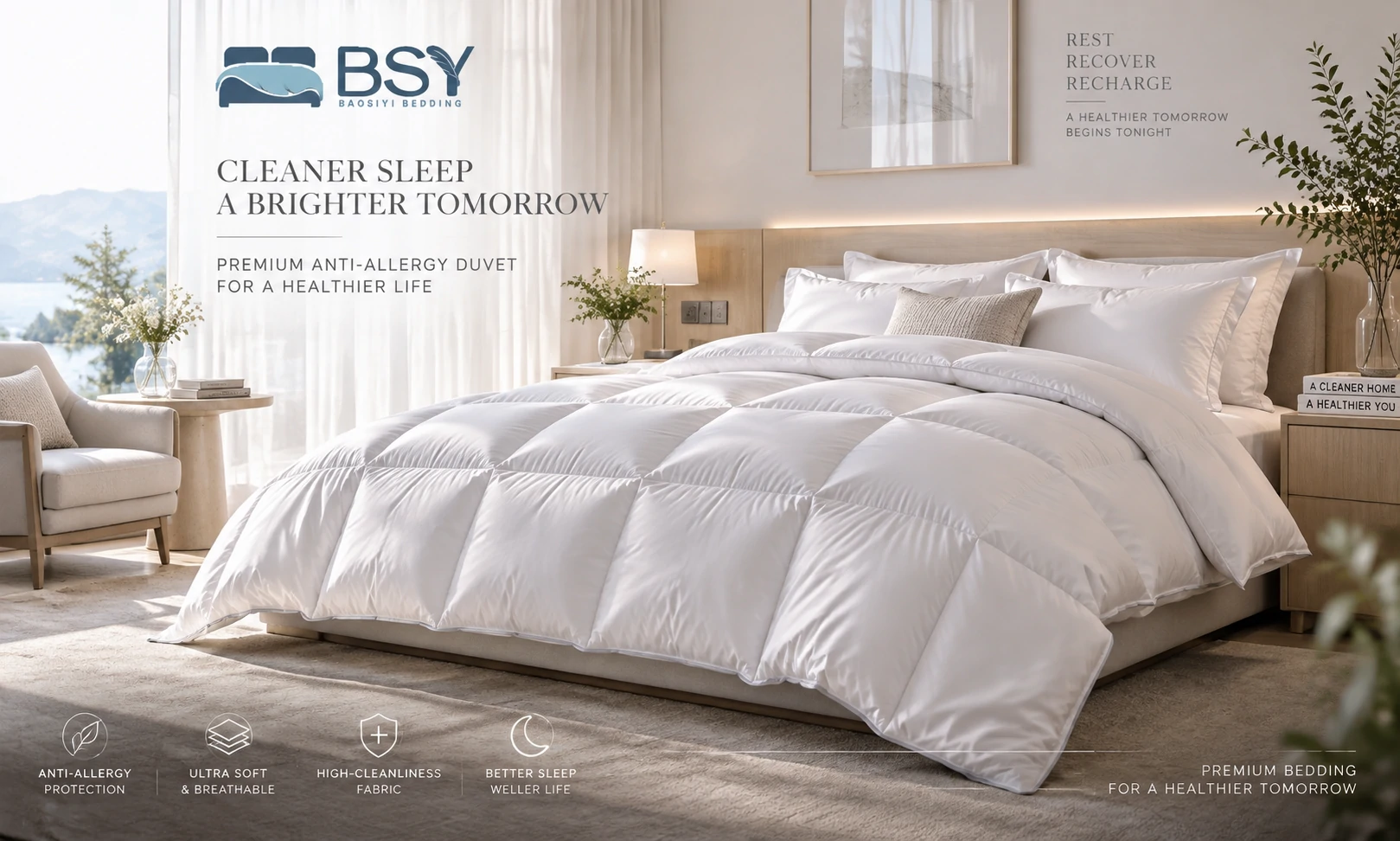
Hypoallergenic and Anti-Allergy Duvet Sourcing for Healthcare and Hospitality Chains
September 22, 2026In commercial lodging and institutional healthcare, guest well-being and clinical infection control have converged. Worldwide, clinical studies indicate that over 30% of the adult population suffers from allergic rhinitis, asthma, or contact dermatitis triggered by environmental allergens.
Within a hotel room or clinical care suite, the bed is the primary microbial reservoir. Every night, human bodies shed approximately 1.5 grams of skin flakes and expel hundreds of milliliters of moisture, creating an ideal incubator for dust mites, fungal spores, and bacterial colonies deep inside comforter fillings.
For institutional procurement directors, hospital supply managers, and hotel brand executives, bedding selection involves significant health and commercial liabilities:
- In healthcare and senior living, comforters must withstand aggressive thermal sanitization cycles without harboring bacterial pathogens.
- In hospitality, premier hotel brands now leverage “Pure Rooms” and certified allergy-friendly room tiers to drive room-rate premiums and capture corporate traveler loyalty.
However, sourcing commercial anti-allergy bedding requires navigating complex textile science. What is the real technical difference between a generic “hypoallergenic” label and a laboratory-verified “anti-allergy” comforter?
This technical procurement guide explores the mechanics of allergen barrier engineering, antimicrobial fiber chemistry, commercial laundry disinfection protocols, and international compliance testing.
1. Defining the Threat: Dust Mites, Fungal Spores, and Microbial Colonization
To specify effective protective bedding, buyers must identify the biological pathogens that colonize commercial linens.
The Dust Mite Life Cycle and the Der p 1 Allergen
The primary culprit behind bedding-induced allergic reactions is not the house dust mite (Dermatophagoides pteronyssinus) itself, but its digestive enzymes.
Mites excrete microscopic fecal pellets containing Der p 1 and Der f 1 proteolytic enzymes. When dry, these sub-microscopic particles (measuring between 10 and 40 microns) break into fine airborne dust that penetrates standard loosely woven bedding casings, triggering violent respiratory histamine reactions upon inhalation.
Moisture, Heat, and Microbial Colonization
During sleep, a human body maintains a localized bed micro-climate characterized by temperatures between 25°C and 30°C paired with relative humidity exceeding 70%.
These conditions accelerate the growth of fungal species (such as Aspergillus fumigatus) and bacterial strains (including Staphylococcus aureus). In institutional environments, untreated bedding fibers can cross-contaminate successive patients or guests if laundering protocols fail.
Commercial and Legal Liabilities
For healthcare institutions, poor textile infection control contributes to Hospital-Acquired Infections (HAIs), directly impacting accreditation scores and insurance payouts. For hospitality operators, guest allergic reactions translate into immediate negative TripAdvisor reviews, comped room stays, and brand erosion.
2. Physical Barrier Engineering vs. Chemical Antimicrobial Finishes
When engineering an anti-allergy duvet, manufacturers deploy two primary defense mechanisms: Passive Mechanical Barriers and Active Chemical Treatments.
Tight-Weave Physical Micro-Pore Barriers (Pore Size < 10 Microns)
The most dependable, permanent defense against allergens is physical pore exclusion:
- Standard adult dust mites measure roughly 200 to 300 microns in length.
- Dust mite fecal pellets measure 10 to 40 microns.
- Allergenic protein fragments measure down to roughly 5 to 10 microns.
By weaving combed long-staple cotton or high-density synthetic microfibers to a mean pore opening size below 8 to 10 microns, the fabric forms an impassable physical shield. Dust mites cannot enter the duvet interior to colonize the filling, and existing internal particles cannot migrate outward toward the sleeper.
Chemical Antimicrobial Treatments (Silver Ion and Organic Quats)
Active chemical treatments introduce biocidal or biostatic functionality directly onto the fiber surface:
- Silver Ion Technology (Ag+): Silver ions bind to bacterial cell membranes and disrupt essential enzyme pathways, inhibiting 99.9% of bacterial replication.
- Zinc Pyrithione: Delivers broad-spectrum antifungal and antibacterial protection, preventing fungal spore incubation within humid duvet cores.
- Organosilane Quaternary Ammonium Compounds: Create a microscopic layer of positively charged “spikes” that mechanically puncture negatively charged bacterial cell walls on contact.
Durability Comparison: Inherent Weaves vs. Chemical Finishes
- Chemical Finishes: While highly effective initially, topically applied antimicrobial finishes gradually wash out after 20 to 30 commercial laundering cycles, steadily degrading protection over time.
- High-Density Mechanical Barriers: A tightly woven, calendered fabric shell (such as a 233T or 300T cotton percale) retains its micro-pore dimensional stability for the entire operational life of the duvet, provided the weave is not chemically compromised.
The Golden Sourcing Rule: For multi-year commercial procurement, mandate a high-density physical micro-pore shell as the primary defense line, using chemical antimicrobial finishes as a secondary, active hygiene layer.
3. Interior Filling Selection: Engineered Non-Allergenic Polymers
The interior core of an anti-allergy comforter must be inherently inhospitable to biological pests.
Siliconized Virgin Hollowfiber: The Inert Synthetic Standard
Natural animal down and feathers contain trace keratin proteins, lipids, and avian dander that can serve as nutritional substrates for mites and fungi if moisture enters the core.
In contrast, synthetic polyester polymers are biologically inert:
- They contain zero organic nutrients, starving dust mites of a food source.
- Hollow conjugated fibers feature smooth internal and external surfaces that resist moisture absorption, accelerating drying and denying microbes the humidity required for spore germination.
Masterbatch Antimicrobial Extrusion
In high-standard medical bedding production, antimicrobial agents are not merely sprayed onto finished fiber sheets. Instead, active agents (such as zinc or silver compounds) are blended directly into the polymer masterbatch pellets prior to fiber extrusion.
Because the antimicrobial chemistry is fused permanently into the molecular matrix of the polyester filament, it cannot wash out or abrade away, maintaining permanent efficacy through 50+ industrial laundering cycles.
Can Natural Down Ever Be Certified Truly Anti-Allergy?
Many high-end boutique hotels prefer the prestige of natural down but operate designated “Allergy-Friendly” guest rooms. Natural down can achieve certified anti-allergy status under strict conditions:
- Extreme Thermal Scouring: Raw down must undergo repeated industrial washings and pressurized steam sterilization at temperatures exceeding 120°C.
- Cleanliness Benchmarks: Sourcing contracts must mandate a Turbidity rating of at least 1,000 mm and an Oxygen Number below 10 mg/100g, proving complete extraction of animal fats and dust.
- The NOMITE Standard: Certified under European norm EN 13186, down duvets encased in tightly calendered, down-proof cotton casings are scientifically proven to prevent dust mite colonization, carrying the prestigious NOMITE seal recognized by European allergy foundations.
4. Shell Fabric Engineering for High-Cleanliness Sectors
The outer casing serves as the primary barrier separating the sleeper from interior fillings.
High-Density Anti-Mite Micro-Percale (233T to 300T Calendared Weaves)
For hospitality suites where tactile softness and silent drape are essential, 233T to 300T 100% Cotton Percale represents the commercial standard.
The fabric must undergo heavy mechanical calendaring (high-pressure, high-temperature hydraulic rolling). This compresses the round cotton yarns into flat ribbons, shrinking weave pores below 10 microns to physically block dust mites while maintaining natural air permeability between 6 and 12 L/m²/s.
Fluid-Resistant and Breathable TPU Membrane Interlinings
In clinical healthcare, nursing homes, and pediatric hospital wards, allergy protection must be paired with fluid defense.
For these institutional environments:
- The shell fabric is laminated to an ultra-thin (0.015 mm to 0.02 mm) breathable Thermoplastic Polyurethane (TPU) membrane.
- This creates a 100% barrier against bodily fluids, blood, urine, and liquid medicines, preventing moisture from entering the core while allowing micro-vapor transmission to prevent patient sweating.
Seam Encapsulation: Preventing Needle-Hole Penetration
Dust mites are opportunistic; even if a fabric weave blocks them, they can enter through standard sewing needle perforations.
BSY manufacturing standards require:
- Micro-Fine Ballpoint Needles (Size 70/10) to separate rather than tear woven yarns.
- High Stitch Density (10 to 12 stitches per inch).
- Internal Overlocked Seams or Ultrasonic Welded Seams on healthcare lines, eliminating needle punctures along high-stress perimeter borders.
5. Commercial Laundering and Thermal Sanitization Protocols
An anti-allergy duvet is only as good as its ability to survive aggressive commercial laundering.
The Thermal Kill Curve: 60°C to 75°C Washing Endurance
Clinical entomology proves that home laundering at 30°C or 40°C does not kill dust mites; it merely washes away surface dust while leaving mites alive inside the warm core.
To eliminate biological threats, commercial duvets must withstand the Thermal Kill Curve:
- Washing at 60°C for at least 20 minutes kills 100% of live house dust mites.
- Temperatures reaching 71°C to 75°C denature and deactivate the Der p 1 allergenic protein structure completely.
Institutional purchase orders must explicitly specify that all shell fabrics, synthetic fillings, and perimeter threads remain dimensionally stable (shrinkage under ±3%) when washed at 60°C to 75°C.
Chemical Disinfection Compatibility: Oxygen vs. Chlorine Bleach
In healthcare laundering:
- Anti-allergy comforters must withstand continuous industrial dosing of oxygen-based bleaching agents (such as hydrogen peroxide or peracetic acid) without fiber embrittlement or yellowing.
- For standard hospitality, fabrics must resist mild alkaline commercial wash formulas without degrading the internal siliconization coating on synthetic fibers.
6. Regulatory Compliance and Third-Party Clinical Certifications
To satisfy clinical procurement audits and substantiate consumer marketing claims, commercial shipments must be backed by accredited laboratory certifications.
| Certification / Standard | Testing Scope & Methodology | Commercial Significance |
| ISO 20743 / AATCC 100 | Quantitative evaluation of antibacterial efficacy against Staphylococcus aureus and Klebsiella pneumoniae | Verifies active microbial reduction exceeding 99.9% after commercial washing |
| NOMITE (PAS 1008 / EN 13186) | Confirms down and feather bedding is encased in tightly woven casings impenetrable to dust mites | Mandatory certification for marketing down bedding to European allergy sufferers |
| Allergy UK Seal of Approval | Rigorous independent clinical evaluation testing product efficacy against specific chemical and biological allergens | Globally respected consumer trust badge for retail packaging and hotel collateral |
| OEKO-TEX Standard 100 Class I | Extensive laboratory screening for over 300 toxic chemicals, formaldehyde, and heavy metals | Guarantees the duvet releases zero toxic volatile organic compounds (VOCs) |
| BS 7175 / NFPA 701 | Standardized fire safety testing for contract bedding utilizing smoldering cigarettes and flame sources | Mandatory statutory compliance for UK and international contract hotel tenders |
7. Sourcing Strategy: Healthcare Tenders vs. Allergy-Friendly Hotel “Pure Rooms”
Sourcing specifications diverge sharply between clinical healthcare and premium hospitality.
Healthcare & Eldercare Procurement (Barrier and Sterilization First)
- Filling: Siliconized virgin hollowfiber or antimicrobial masterbatch polyester.
- Shell: Fluid-resistant, wipe-clean polyurethane (PU/TPU) coated fabric or 233T dense polyester-cotton.
- Quilting: High-speed sewn-through channel or box stitching (easy fluid run-off, zero internal mesh walls).
- Core Priority: 75°C industrial wash durability, 100% fluid barrier, low replacement unit cost.
Hospitality “Allergy-Friendly / Pure Room” Programs (Luxury and Drape First)
- Filling: 0.8D ultra-fine blown microfiber (Feels Like Down) or NOMITE-certified 800 FP white goose down.
- Shell: 300T combed long-staple cotton sateen treated with double-sided mechanical calendaring.
- Quilting: 3D Baffle-Box construction (2.5 cm internal walls) with double-needle German piping.
- Core Priority: Five-star cloud-like loft, completely silent fabric acoustics, body-contouring fluid drape, verified OEKO-TEX Class I certification.
8. Technical Sourcing Specification Matrix
| Feature | Medical Isolation & Clinic Duvet | Senior Living & Eldercare Quilt | Hotel “Pure Room” Down-Alternative | 5-Star Hotel NOMITE Natural Down |
| Target Fill Weight | 250 – 300 GSM | 300 – 350 GSM | 300 – 350 GSM | 240 – 280 GSM |
| Core Filling Type | Antimicrobial Hollowfiber | Siliconized Conjugated Fiber | 0.8D Blown Microfiber Clusters | 90% White Goose Down (800 FP) |
| Outer Shell Casing | Fluid-Proof Breathable TPU | 233T Water-Resistant Cotton | 300T Calendered Cotton Sateen | 300T Down-Proof Cotton Percale |
| Allergen Mechanism | 100% Fluid & Pore Barrier | Pore Exclusion + Biocide | Sub-10 Micron Pore Exclusion | High Cleanliness + NOMITE Casing |
| Max Washing Temp | 75°C (Full Disinfection) | 65°C to 71°C | 60°C | 40°C Delicate |
| Fire Retardancy | BS 7175 Source 0, 1, & Crib 5 | BS 7175 Source 0 & 1 | BS 7175 Source 0 & 1 | BS 7175 Source 0 & 1 |
| Estimated Unit Cost (FOB) | $9.50 – $13.50 | $11.00 – $15.00 | $14.50 – $19.50 | $65.00 – $95.00 |
9. Frequently Asked Questions (FAQ)
What is the fundamental difference between a “hypoallergenic” and a certified “anti-allergy” duvet?
“Hypoallergenic” is an unregulated descriptive term meaning the product is less likely to trigger allergic reactions, typically because it uses synthetic polyester instead of animal down. In contrast, a certified “anti-allergy” duvet has undergone accredited laboratory testing verifying that its outer shell physically blocks dust mite penetration (pore size below 10 microns) or that its fibers actively inhibit bacterial and fungal proliferation under standards like ISO 20743.
How does washing temperature impact dust mites and the Der p 1 allergen?
Standard home washing at 30°C or 40°C removes surface dirt but leaves dust mites alive inside the warm duvet core. Clinical studies confirm that water temperatures must reach 60°C for at least 20 minutes to kill 100% of live house dust mites. Washing at 71°C to 75°C denatures and permanently deactivates the potent Der p 1 allergenic digestive enzymes.
Can a natural down duvet ever qualify for healthcare or allergy-friendly hotel programs?
Yes, provided it meets strict European NOMITE standards (EN 13186). The raw down must undergo intensive multi-stage washing and pressurized thermal sterilization achieving a Turbidity rating of at least 1,000 mm and an Oxygen Number under 10 mg/100g, and it must be encased inside a tightly woven, mechanically calendered down-proof cotton casing that physically blocks dust mite entry.
What outer casing pore size is required to physically block dust mites without chemical finishes?
To physically prevent dust mites, their larvae, and their fecal pellets from migrating through a fabric casing, the average weave pore size must measure between 5 and 10 microns. Standard 233T and 300T combed cotton fabrics treated with heavy double-sided mechanical calendaring achieve this pore threshold while maintaining healthy air permeability for sleeper comfort.
Conclusion: Securing Certified Barrier Bedding Programs
Sourcing anti-allergy and hypoallergenic duvets requires rigorous engineering verification. Institutional procurement teams cannot rely on generic packaging claims; they must evaluate exact pore size metrics, verify industrial washing endurance at 60°C to 75°C, and mandate accredited third-party clinical testing.
Whether outfitting high-traffic clinical recovery wards, residential senior living facilities, or premium hotel “Pure Rooms,” specifying certified barrier bedding protects your balance sheet from guest complaints, satisfies stringent healthcare audits, and guarantees restful, allergen-free sleep.
Operating high-precision computerized quilting and automated blowing lines in Xiaoshan, Hangzhou, BSY Bedding manufactures certified institutional, medical-grade, and luxury anti-allergy duvets. Our products are fully tested under ISO 20743, certified under OEKO-TEX Standard 100 Class I, and engineered to withstand the most demanding commercial laundering protocols worldwide.