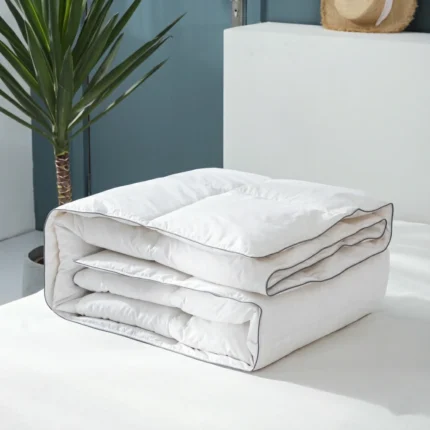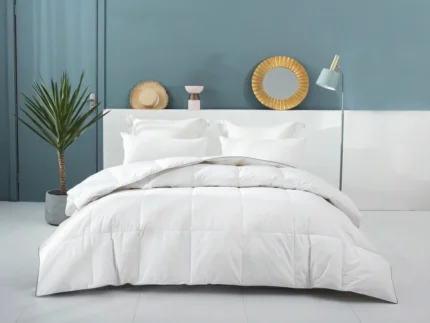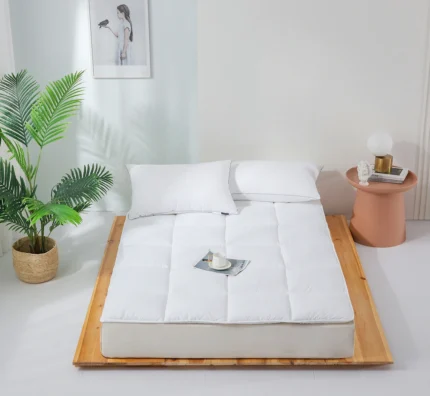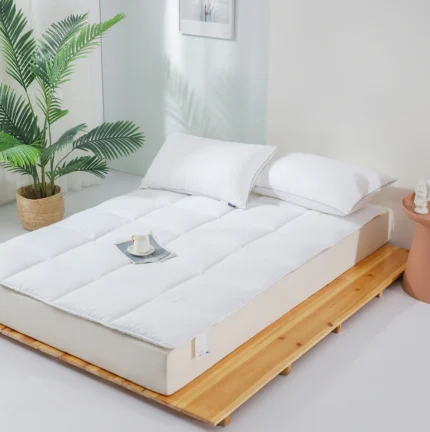
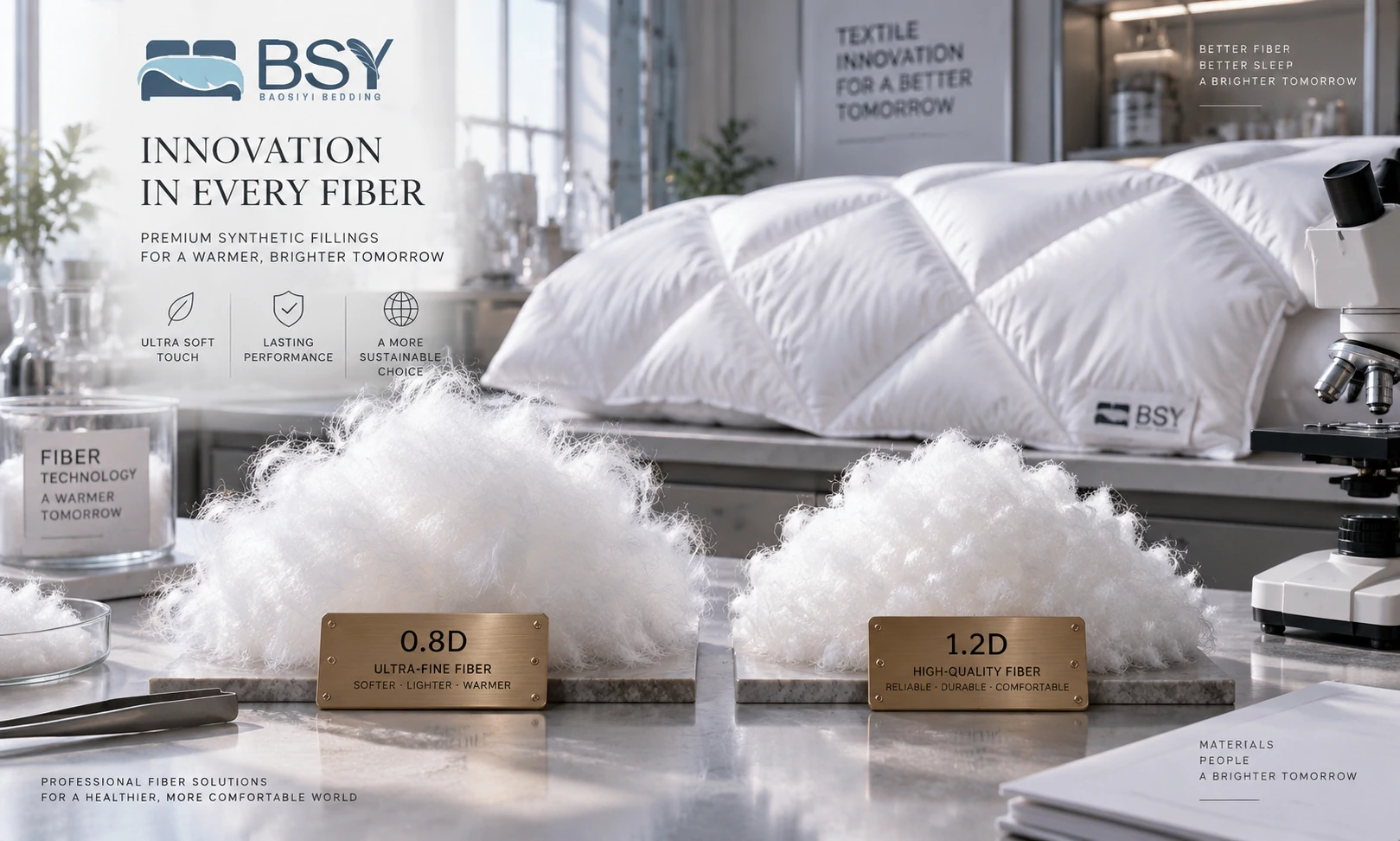
Sourcing Ultra-Fine Denier Quilts: 0.8D vs. 1.2D Synthetic Fiber Comparison
September 22, 2026The global bedding industry has moved far beyond basic, coarse polyester batting. Today, commercial hospitality chains, boutique lifestyle brands, and high-volume departmental retailers routinely seek synthetic comforters that rival the hand-feel, fluid drape, and thermal retention of natural waterfowl down.
Driving this synthetic revolution is Micro-Denier Extrusion Technology. By drawing synthetic polyester polymers down to diameters finer than natural silk and human hair, textile engineers produce duvets that provide cloud-like sink-in softness without the allergens, odor vulnerabilities, or volatile commodity pricing associated with natural down.
However, when reviewing OEM manufacturer specifications, procurement directors frequently confront technical fiber designations: 0.8 Denier (0.8D) and 1.2 Denier (1.2D).
Though seemingly minor, this fraction of a denier dictates whether a finished quilt drapes like liquid silk or provides firm, resilient bed-dressing volume. Selecting the wrong denier balance can lead to premature fiber compaction in commercial laundries or costly fabric leaks across retail distribution networks.
This technical sourcing guide explores the physical mechanics, manufacturing trade-offs, and commercial blending strategies of 0.8D and 1.2D microfibers to ensure your supply chain achieves the perfect balance of tactile luxury and operational durability.
1. The Physics of Micro-Denier Polyester: What Does Denier Measure?
To understand how synthetic fibers insulate, commercial buyers must grasp the fundamental unit of linear textile measurement: The Denier (D).
Scientific Definition of Denier (D)
Denier quantifies the physical fineness of a single filament. By definition, 1 Denier equals the mass in grams of 9,000 meters of continuous single filament:
Denier (D) = Mass (Grams) of 9,000 Meters of Fiber
- A standard human hair measures between 40D and 60D.
- Natural sheep wool ranges from 20D to 40D.
- Fine mulberry silk measures approximately 1.0D to 1.5D.
- Standard commercial hollowfiber (used in budget institutional quilts) measures between 6.0D and 7.0D.
- Ultra-Fine Microfiber is defined as any synthetic filament measuring under 1.0D, such as 0.8D, while fine microfiber extends to roughly 1.2D to 1.5D.
The Sub-1.0 Denier Threshold
When a synthetic polymer is drawn below 1.0 denier, its structural bending rigidity drops precipitously. The individual filaments become so flexible that they bend under microscopic friction, eliminating the prickly or stiff sensation common in conventional polyester batting.
Specific Surface Area and Microscopic Air Trapping
Insulation performance is governed by surface area. As individual fiber diameters shrink, the total surface area per gram of filling increases exponentially.
In a comforter, these dense networks of microscopic 0.8D and 1.2D filaments form millions of microscopic dead-air chambers per cubic centimeter. These static air pockets impede convective heat transfer, delivering certified thermal Tog insulation comparable to medium-fill duck down.
2. 0.8D Ultra-Fine Microfiber: The Silk-Touch Luxury Standard
Engineered specifically to compete with natural white goose down and mulberry silk, 0.8D microfiber represents the pinnacle of tactile luxury in synthetic fiber extrusion.
Physical Characteristics: Supreme Fineness and Cloud-Like Hand-Feel
At just 0.8 grams per 9 kilometers of thread, 0.8D filament is extraordinarily delicate. When processed and siliconized, it produces a buttery, silky hand-feel that completely masks its synthetic polymer origins.
Superior Body Contouring (Fluid Drape)
A common flaw in synthetic bedding is “tenting”—where a stiff comforter arches rigidly over the sleeper’s shoulders, allowing room drafts to penetrate.
Because 0.8D fibers possess minimal bending resistance, a comforter filled with 0.8D micro-clusters flows effortlessly over the contours of the human body. This fluid, body-hugging drape creates an immediate sense of luxurious, draft-free security.
Operational Trade-Offs: Lower Structural Rebound
The physical softness of 0.8D fibers introduces an operational challenge: Compressive Fatigue.
Because the filaments are micro-thin, their individual columnar strength is low. If subjected to prolonged compression or heavy commercial laundering without proper silicone finishing, pure 100% 0.8D fibers can gradually interlock and compact, losing their initial lofty bounce over multi-year cycles.
Primary Sourcing Applications
- Luxury five-star hotel boutique suites and executive guest rooms.
- High-end direct-to-consumer (DTC) vegan bedding brands retailing comforters above $80.00 FOB.
- Lightweight summer comforters and fine-drape all-season luxury lines.
3. 1.2D Microfiber: The High-Resilience Commercial Workhorse
While 0.8D focuses on sensory softness, 1.2D microfiber is engineered for resilience, elastic recovery, and heavy-duty commercial service life.
Physical Characteristics: Balanced Fineness with Core Elastic Memory
Measuring 50% thicker in linear mass than 0.8D, a 1.2D filament maintains a stronger structural core while remaining fine enough to deliver premium softness.
The slightly thicker polymer cross-section provides higher bending modulus and elastic memory, allowing the fiber to spring back instantly when compressed.
Laundering Resilience Under Commercial Conditions
For high-turnover hotels, commercial laundries subject bed covers to violent mechanical shear inside continuous tunnel washers and high-heat commercial extractors.
- 1.2D fibers resist filament snapping and mechanical friction fatigue far better than 0.8D.
- They withstand repeated 60°C to 75°C sanitization wash cycles without felting or forming dense, hardened internal nodules.
Long-Term Loft Longevity
Even after extended vacuum roll-pack storage during trans-oceanic shipping or multiple quarters in hotel linen closets, 1.2D microfiber comforters recover over 90% to 95% of their initial uncompressed volume with minimal manual shaking.
Primary Sourcing Applications
- Four-star commercial business hotels and high-occupancy resort portfolios.
- Volume retail programs for department stores and hypermarkets (e.g., Target, Costco, Dunelm).
- Commercial pillow inners and heavy winter comforters requiring durable, springy support.
4. The Golden Ratio: 0.8D / 1.2D Hybrid Blends Explained
In high-standard bedding manufacturing, master fiber blenders rarely deploy 100% single-denier fillings for premium hotel lines. Instead, they engineer Hybrid Microfiber Formulations.
The Limitations of Pure Single-Denier Fillings
- A comforter filled exclusively with 100% 0.8D feels exceptionally soft upon initial touch, but can feel too thin or flat once pressed down under body weight.
- A comforter filled exclusively with 100% 1.2D offers outstanding bounce and volume, but lacks the distinctive silky gliding sensation that mimics natural down.
The 70/30 and 50/50 Sourcing Formulations
To achieve optimal performance, BSY Bedding calibrates precision hybrid formulations:
- 70% 0.8D + 30% 1.2D (The Luxury Down-Alternative Standard): The 70% 0.8D content provides cloud-like surface fluidity and skin-level softness, while the 30% 1.2D content acts as an internal structural spring network, preventing the duvet from matting flat over time. Ideal for luxury retail and high-ADR hotels.
- 50% 0.8D + 50% 1.2D (The Hospitality Workhorse Standard): Engineered for commercial balance. Delivers premium softness during guest stays while offering maximum tensile recovery against industrial washing, providing a dependable 3-to-4-year service life.
Multi-Cylinder Precision Carding vs. Blown Blending
Achieving a uniform hybrid blend requires advanced factory opening machinery. BSY utilizes automated multi-cylinder carding lines that open both raw fiber bales simultaneously, blending the 0.8D and 1.2D filaments into a completely homogenous, tangle-free web before insertion into comforter shells.
5. Manufacturing Methods: Carded Wadding vs. Loose Cluster Blowing
How the micro-denier fibers are physically inserted into the duvet casing dramatically alters the finished product’s texture and loft.
Multi-Layer Cross-Lapped Carded Wadding
In this process, carding machines comb the blended 0.8D/1.2D fibers into ultra-thin, continuous webs. A cross-lapper layers these webs horizontally until the target GSM weight (e.g., 300 GSM) is achieved.
- Characteristics: Extremely uniform, smooth, and flat. Best suited for continuous multi-needle quilted summer quilts, coverlets, and lightweight institutional blankets.
Pneumatic Chamber Blowing into 3D Baffle Boxes
For a true “feels-like-down” comforter, the fibers must not be laid into flat sheets. Instead, the siliconized fibers are opened into loose, fluffy clouds and injected via pneumatic air nozzles directly into individual, pre-sewn 3D baffle-box chambers.
- Characteristics: The fibers remain free-floating inside each compartment. They expand in all directions, delivering a lofty, pillowy silhouette and natural fluid drape that mirrors a genuine natural down duvet.
Siliconization Chemistry and Hydrophobic Coatings
Both 0.8D and 1.2D fibers must undergo certified polysiloxane (silicone) curing during extrusion. This microscopic silicone coating:
- Eliminates surface friction, allowing filaments to glide past one another smoothly.
- Prevents static electricity buildup during dry winter operations.
- Provides water repellency, ensuring moisture evaporates rapidly during commercial tumble-drying.
6. Casing Selection & Needle Engineering: Preventing Fiber “Bearding”
A critical defect unique to ultra-fine microfibers is Fiber Bearding (Filament Migration).
Because 0.8D filaments are so microscopic in diameter, they can easily squeeze through the weave intersections of loosely woven outer fabrics or escape through needle stitch perforations, giving the finished duvet an unsightly, hairy appearance on the surface.
Compatible Shell Fabrics
- 233T to 300T 100% Cotton Percale / Sateen: Must undergo double-sided heavy mechanical calendaring (high-pressure heated rollers) to permanently flatten the cotton yarns and close microscopic pores.
- High-Density Brushed Microfiber (90 to 110 GSM): An economical, silent, all-synthetic shell option with pore openings tight enough to contain 0.8D filaments while remaining ultra-soft.
Precision Sewing Needle Calibration
Using standard heavy sewing needles (such as Size 100/16) punches permanent holes in the outer shell fabric. When the comforter is handled or compressed, thousands of microscopic 0.8D fibers will sprout through these needle puncture holes.
BSY production facilities enforce:
- Micro-Point Needles (Size 70/10 to 75/11) featuring fine ball-point tips (SES) that part fabric yarns without severing warp or weft threads.
- Continuous Pneumatic Needle Cooling to prevent high-speed sewing friction from melting synthetic polyester filaments along seam lines.
7. Technical Sourcing Matrix, Economics, and PO Guidelines
| Sourcing Parameter | 0.8D Ultra-Fine Microfiber | 1.2D Microfiber | 70/30 Hybrid Formulation (0.8D/1.2D) | Standard 7D Hollowfiber |
| Filament Caliber | Ultra-fine (<1.0 denier) | Fine (1.2 denier) | Engineered Dual-Denier | Coarse (7.0 denier) |
| Tactile Softness | Silk-like, cloud-soft | Very soft, springy | Luxury down-alternative feel | Resilient, slightly stiff |
| Body Contouring Drape | Superior (fluid drape) | Good (slight resistance) | Excellent (balanced fluid drape) | Low (rigid, boardy) |
| Compressive Elastic Recovery | Moderate | Outstanding | High (optimal core bounce) | Very High (bouncy) |
| Industrial Wash Tolerance | Up to 60°C | Up to 75°C | Up to 65°C | Up to 60°C |
| Fiber Bearding Risk | High (requires 233T+ shell) | Moderate | Moderate (requires 233T+ shell) | Very Low |
| Relative Raw Fiber Cost | + 15% to 20% over 1.2D | Baseline Premium Fiber | + 8% to 12% over 1.2D | – 30% (Budget fiber) |
| Target Distribution Tier | Luxury retail & boutique | Business hotels & retail | 4/5-star hospitality & DTC | Budget motels & institutional |
5 Critical Clauses for Your Next Microfiber Quilt Purchase Order
- Mandate Denier Specifications: Explicitly state the required ratio (e.g., 70% 0.8D / 30% 1.2D virgin siliconized polyester).
- Require Mechanical Calendaring: Ensure the casing fabric is mechanically calendered rather than treated with temporary chemical coatings.
- Specify Needle Tolerances: Require micro-fine needle sizes (maximum Size 75/11) to eliminate fiber bearding along seam lines.
- Mandate Metal Detection: Require 100% in-line needle detection scanning for every finished comforter prior to vacuum packaging.
- Verify Chemical Compliance: Mandate OEKO-TEX Standard 100 Class I certification confirming zero harmful residues, heavy metals, or toxic finishes.
8. Frequently Asked Questions (FAQ)
What is the fundamental difference between 0.8D and 1.2D polyester microfiber in duvets?
The fundamental difference is filament thickness and resulting physical behavior. A 0.8D fiber is exceptionally fine, yielding an ultra-soft, silky hand-feel with body-contouring fluid drape that mirrors natural down clusters. In contrast, 1.2D fiber has a slightly thicker structural core, providing greater elastic bounce, superior resistance to clumping, and longer service life under industrial high-temperature commercial laundering.
Why do factories frequently blend 0.8D and 1.2D fibers together instead of using 100% of either?
A pure 100% 0.8D duvet can feel overly delicate and flatten under body pressure over time, while a pure 100% 1.2D duvet can feel slightly too bouncy and springy. Combining them in a 70/30 or 50/50 blend creates a synergistic golden ratio: the 0.8D fibers provide cloud-like surface softness, while the 1.2D fibers act as an internal elastic skeleton that maintains volumetric loft through repeated commercial wash cycles.
What outer shell fabrics are recommended to prevent 0.8D micro-filaments from leaking (fiber bearding)?
Because 0.8D filaments are ultra-fine, loosely woven fabrics will permit fibers to migrate through the pores. Sourcing directors should mandate either a 233T or 300T 100% cotton casing treated with double-sided mechanical calendaring (heat-pressed under high tonnage), or a high-density, tightly woven brushed peach-skin microfiber shell measuring between 90 and 110 GSM.
How does the wholesale cost of an ultra-fine denier quilt compare to a natural down duvet?
An ultra-fine denier comforter (whether 0.8D, 1.2D, or a hybrid blend) typically exports at an FOB price between $12.00 and $18.50 for a Queen size, depending on shell fabric and GSM. In contrast, an equivalent natural duck down comforter costs $40.00 to $55.00, and a goose down comforter costs $75.00 to $100.00+. Ultra-fine denier quilts deliver roughly 85% of down’s tactile luxury at roughly 20% to 30% of the raw material cost.
Conclusion: Partnering with an Advanced Synthetic Bedding Manufacturer
In the modern bedding supply chain, ultra-fine denier synthetic duvets are no longer viewed merely as cheap alternatives to natural down; they represent an advanced, highly specialized product category that delivers verified hypoallergenic safety, effortless machine-wash sanitization, and remarkable guest satisfaction.
By understanding the distinct behavioral characteristics of 0.8D silk-touch fibers and 1.2D high-resilience filaments—and strategically specifying calibrated hybrid formulations—commercial buyers can build resilient, high-margin comforter collections that withstand years of commercial use.
Located in Xiaoshan, Hangzhou, BSY Bedding operates state-of-the-art automated fiber opening systems, high-precision carding machinery, and computerized pneumatic blowing lines. We engineer custom-tailored 0.8D, 1.2D, and hybrid down-alternative duvets in certified OEKO-TEX Standard 100 and GRS recycled configurations to satisfy rigorous retail and hospitality specifications worldwide.