
Why 15 Tog Duck Down Duvets Dominate the UK Winter Bedding Retail Market
September 22, 2026In the global home textile industry, thermal comfort preferences are intensely regional. While North American consumers rely on central HVAC systems to maintain year-round indoor temperatures of 21°C, and Nordic homeowners sleep under breathable 9.0 Tog duvets inside triple-glazed passive houses, the United Kingdom marches to an entirely different seasonal rhythm.
Every year between September and January, British department stores, hypermarkets, and home retail chains experience a massive consumer surge for the heaviest, warmest comforters commercially manufactured: The 15 Tog Winter Duvet.
For retail category buyers, international importers, and e-commerce brands targeting the UK market, 15 Tog duvets represent the single highest average transaction value (ATV) item in the annual bedding inventory.
However, sourcing a 15 Tog duvet is an engineering and commercial challenge. Overfilling with low-grade feathers creates an unyielding, heavy sack, while using expensive goose down drives retail price points beyond high-street consumer budgets.
This procurement analysis explores the unique architectural, socioeconomic, and material factors that have established duck down and feather blends as the undisputed volume leaders of the British winter bedding trade.
1. Cultural and Architectural Drivers Behind 15 Tog Demand in the UK
To understand why British consumers demand 15 Tog bedding, international sourcing directors must examine the physical realities of the UK housing stock and domestic energy habits.
The UK Housing Stock: Solid Walls, Single Glazing, and Drafty Heritage Homes
The United Kingdom has some of the oldest residential housing in Western Europe. Millions of Victorian terraces, Edwardian semis, and post-war brick properties feature:
- Uninsulated Solid Brick Walls: Traditional single-skin or uninsulated cavity brickwork that radiates ambient outdoor cold directly into indoor bedrooms.
- Sash Windows and Natural Ventilation: High draft permeability compared to modern airtight continental homes.
- Intermittent Radiator Heating: British domestic central heating operates predominantly on automated timers that shut off completely between 11:00 PM and 6:00 AM, allowing bedroom temperatures to plummet below 12°C to 14°C on winter nights.
The “Heat the Human, Not the Home” Consumer Shift
Escalating natural gas and electricity tariffs across the UK have permanently altered domestic energy behavior. Rather than setting whole-house thermostats to maintain nighttime ambient warmth throughout the winter months, British households intentionally lower their central heating settings to manage energy bills.
Investing in a premium 15 Tog duvet allows consumers to stay exceptionally warm in bed while keeping domestic radiators off overnight—delivering an immediate, tangible financial return on investment for the household.
Regional Geographic Demand Peaks
While demand is consistent nationwide, retail sales of 15 Tog duvets are particularly intense across:
- Scotland and the Highlands: Where freezing outdoor winter temperatures extend the heavy bedding season from early October through late April.
- Northern England and Yorkshire: Traditional volume hubs for heavyweight bedding lines.
- Rural Ireland and Wales: Properties relying on domestic heating oil or solid-fuel stoves where nighttime temperature drops are pronounced.
2. Material Economics: Why Duck Down Trumps Goose Down at 15 Tog
Achieving a certified 15 Tog rating requires a massive volume of trapped static air. Sourcing teams face a critical choice between goose down, duck down, and synthetic hollowfiber.
The Prohibitive Cost Barrier of 15 Tog Goose Down
To achieve a verified 15 Tog thermal resistance using luxury white goose down (750+ FP), a manufacturer must inject between 360 and 420 grams per square meter (GSM) of high-grade down into an extra-deep baffle-box casing.
Given international goose down commodity market prices, the FOB manufacturing cost of a King-size 15 Tog goose down duvet routinely exceeds $85.00 to $110.00. Once factoring in ocean container shipping, UK customs import duties, domestic VAT (20%), and standard retail gross margins, the high-street retail price climbs to £250.00 to £350.00+.
This astronomical price ceiling confines goose down to ultra-luxury flagship department stores, excluding over 85% of British retail shoppers.
The “Cozy Weight” Factor: Why British Sleepers Crave Tactile Drape
A common mistake made by non-British product developers is assuming lighter is always better. While ultra-light goose down comforters excel in luxury hotels, British winter consumers culturally associate thermal warmth with reassuring physical weight.
A bed cover that feels weightless can feel insecure in a cold, drafty room. Blended duck down and feather comforters provide the perfect physical compromise: generous avian loft and thermal trapping combined with a comforting, gentle downward drape that seals the sleeper’s shoulders against ambient bedroom drafts.
Dominant Commercial Fill Formulations in the UK Market
British retail merchandisers segment duck down 15 Tog duvets into three distinct pricing tiers:
- 15% White Duck Down / 85% Small Duck Feather (Mass Volume Retail): The undisputed promotional volume driver for UK supermarket chains and discount home retailers (such as Argos, Asda George, and B&M). The heavy feather content provides substantial weight at an unbeatable price point, allowing retail promotions under £30.00 to £45.00.
- 30% White Duck Down / 70% Duck Feather (Mid-Market High Street): The commercial sweet spot for mainstream retail (such as Next, Dunelm, and Habitat). Offers enhanced surface softness with balanced loft, serving as an attractive upgrade over entry-level synthetic polyester quilts.
- 85% to 90% White Duck Down (Premium Department Store): Engineered for luxury retailers (such as John Lewis and boutique lifestyle brands). Delivers extraordinary cloud-like loft, minimal feather quills, and premium tactile luxury, commanding retail price tags between £120.00 and £180.00 while delivering strong gross margin percentages.
3. Factory Technical Blueprint: Building a Compliant 15 Tog Duvet
Manufacturing a 15 Tog duvet requires specialized factory engineering. The sheer volume of internal filling exerts intense outward hydraulic pressure during guest movement and laundering.
Fill Weight (GSM) Calibration: 450 to 550 GSM Formulas
To satisfy British Standard laboratory audits under BS 5335, factories must calibrate fill weight to the exact down percentage:
- 85% White Duck Down: Calibrated at 420 to 460 GSM (High loft allows lower weight to trap equivalent air).
- 30% Duck Down / 70% Feather: Calibrated at 480 to 520 GSM.
- 15% Duck Down / 85% Feather: Calibrated at 520 to 580 GSM (Higher mass required to compensate for lower natural fill power).
Deep 3D Baffle-Box Walls (4.0 cm to 5.0 cm Vertical Mesh)
Sewn-through flat stitching is completely impossible for 15 Tog comforters. The massive volume of feathers would be crushed flat along the stitch lines, creating severe conductive cold bridges and causing customer returns.
BSY manufacturing protocols mandate:
- Internal vertical breathable mesh walls measuring 4.0 cm to 5.0 cm in height.
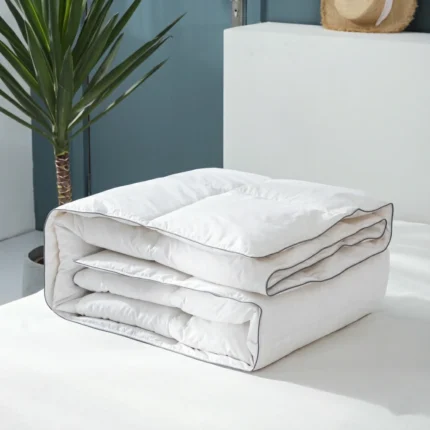
- This vertical clearance allows the duck down and feather clusters to bloom to their full 3D volume, maintaining an unbroken insulating blanket across the entire mattress surface.
Shell Fabric Selection: 233T 100% Cotton Percale
Because 15 Tog duvets commonly incorporate natural duck feathers alongside down clusters, casing selection is paramount. Feathers contain natural central quills that can pierce fragile, ultra-fine fabrics.
- Sourcing contracts must specify 233T 100% Cotton Percale (40s × 40s yarn).
- The fabric must undergo heavy double-sided mechanical calendaring (high-pressure heated rollers) to seal microscopic weave pores, ensuring complete puncture resistance against feather quills without relying on chemical plastic coatings that crack under laundering.
Double-Needle Perimeter Stitching and Piped Borders
A King-size 15 Tog comforter contains roughly 2.5 kilograms of filling. When handled, shaken, or laundered, this mass exerts heavy tension on perimeter edges. High-standard factories enforce double-needle topstitching spaced 5 mm apart, reinforced with a structural pre-shrunk piping cord sewn into the perimeter bias seam to eliminate seam blowouts.
4. Commercial Adaptation for British Retail Distribution
Sourcing for the UK market requires precise adherence to British sizing, merchandising, and packaging standards.
Standard UK Bedding Dimensions
European continental sizing does not fit British mattresses or duvet covers. Purchase orders must strictly reflect UK imperial-metric standards:
- UK Single: 135 × 200 cm
- UK Double: 200 × 200 cm (Consistently the highest volume SKU in the UK market)
- UK King: 230 × 220 cm (The primary SKU for master bedrooms)
- UK Super King: 260 × 220 cm (Rapidly growing luxury retail segment)
Retail Packaging Strategy: High-Visibility “15 Tog Extra Warm” Merchandising
In high-street retail stores, shelf presentation dictates sell-through velocity:
- Comforters must be packaged in heavy-duty clear PVC or PEVA zippered handle bags featuring reinforced non-woven side gussets that allow shoppers to compress and feel the softness of the fabric.
- Packaging inserts must feature prominent, bold typography highlighting 15 TOG – EXTRA WARM WINTER in deep, seasonal color palettes (navy blue, burgundy, or forest green) accompanied by verified thermal insulation iconography.
High-Ratio Vacuum Compression Limits
Because 15 Tog comforters are voluminous, ocean shipping costs per unit can easily erode gross margins if packed loosely.
- Best Practice: Use calibrated mechanical compression reducing volume by 50% to 60% for ocean container transit.
- Avoid exceeding 65% compression when packaging feather-rich blends (15/85), as excessive hydraulic pressure can snap central feather quills, damaging long-term loft recovery once unboxed in the UK.
5. Navigating UK Regulatory and Certification Standards
Exporting down bedding into the United Kingdom requires strict statutory documentation to satisfy HM Revenue & Customs (HMRC), the British Standards Institution (BSI), and major retailer supplier audits.
British Standards Thermal Resistance Testing (BS 5335)
To advertise and legally label a comforter as “15 Tog” in the UK, manufacturers must supply certified laboratory testing under BS 5335 or EN ISO 11092.
Under British retail guidelines, the tested thermal resistance must verify that the product delivers at least 14.2 to 15.8 Tog under standard laboratory room conditions, ensuring the product performs as advertised.
UK Fire Safety Compliance: BS 5852 & BS 7175
- Domestic Retail Bedding: Natural down duvets encased in 100% cotton shells must meet the requirements of the UK Furniture and Furnishings (Fire) (Safety) Regulations where applicable.
- Commercial Contract / Hotel Tenders: Bedding supplied to student housing, holiday parks, and hotels must pass BS 7175 Source 0 (Cigarette) and Source 1 (Match) test standards.
Responsible Down Standard (RDS) Traceability
Major British retail consortiums (including members of the British Retail Consortium) mandate 100% certified ethical down sourcing. Every shipment must be backed by official RDS (Responsible Down Standard) or Downpass transaction certificates proving zero live-plucking and humane animal welfare across the entire agricultural chain.
Cleanliness Metrics to Prevent Moisture Odor
Given the UK’s high ambient winter humidity, duck down must undergo intensive multi-stage washing:
- Turbidity: Minimum 1,000 mm (clean, debris-free water clarity).
- Oxygen Number: Maximum 10 mg per 100g (complete removal of residual organic lipids).
6. Sourcing Timelines, Container Logistics, and Landed Margin Analysis
The winter retail season in the UK is unforgiving. A delay of three weeks at the port can miss the critical pre-Christmas shopping peak, devastating retail profitability.
Production and Logistics Milestones
- May to June: Purchase orders finalized, fabric batches reserved, and packaging print proofs approved.
- July to August: Mass production, automated chamber blowing, in-house needle detection, and vacuum packaging in Xiaoshan.
- Late August: Containers loaded and dispatched via direct sea freight from Ningbo or Shanghai Port.
- Late September to Early October: Containers clear customs at Felixstowe, Southampton, or London Gateway, delivering stock into distribution centers exactly as autumn temperatures drop.
- October to December: High-street shelf placement, promotional retail features, and peak consumer sell-through.
40HQ High Cube Container Loading Optimization
A standard 40HQ ocean container provides roughly 68 cubic meters (CBM) of usable cargo volume. Using precision vacuum roll-packing:
- A 40HQ can accommodate approximately 1,800 to 2,400 units of King/Double 15 Tog duck down duvets.
- This density drives ocean freight costs down to under $2.50 to $3.50 per unit, protecting high gross margins for the importer.
Landed Margin Analysis: Why Retailers Love 15 Tog
- Factory FOB China Cost (Double 200x200cm, 30% Down): ~$18.00 – $22.00
- Estimated Landed Cost UK (Freight, Tariff, Port Handling): ~£18.50 – £22.00
- High-Street Retail RRP: £55.00 – £75.00
- Gross Margin Percentage: 60% to 70%
This robust margin structure allows retailers to absorb seasonal promotional discounting (such as Black Friday sales) while maintaining healthy net profits.
7. Frequently Asked Questions (FAQ)
Why is 15 Tog so popular in the UK compared to continental Europe?
British housing contains a high proportion of older, uninsulated brick homes that lose heat rapidly overnight. Additionally, British consumers commonly lower or turn off central radiator heating overnight to reduce domestic energy bills. A heavy 15 Tog duvet provides the necessary localized thermal micro-climate to keep sleepers warm in bedrooms that drop to 12°C to 14°C.
What is the most cost-effective duck down and feather fill ratio for retail 15 Tog duvets?
The 15% Duck Down / 85% Feather and 30% Duck Down / 70% Feather blends represent the primary volume drivers for UK mass retail. These formulations provide the high physical mass and cozy drape British sleepers expect, while keeping factory FOB costs low enough to support volume retail price points between £35.00 and £55.00.
Can a 15 Tog duvet be vacuum-compressed for ocean freight without damaging the filling?
Yes, provided calibrated mechanical compression is used. BSY recommends compressing 15 Tog duvets by a maximum of 50% to 60% of their uncompressed volume. High-fill duck down and small feathers will recover 95% to 100% of their original loft within 24 to 48 hours after unboxing and shaking, while significantly reducing container shipping costs.
What British testing standard must an imported 15 Tog duvet comply with?
Imported commercial duvets marketed with a Tog claim must comply with BS 5335 or EN ISO 11092 laboratory thermal resistance testing, maintaining a variance within ±0.5 Tog. Furthermore, products must feature certified fiber content labeling under UK textile regulations and comply with domestic fire safety standards where applicable.
Conclusion: Securing Your 15 Tog Supply for the UK Winter Rush
The 15 Tog duck down duvet is an essential, high-margin pillar of the British winter retail calendar. By pairing authentic duck down and feather blends with deep 3D baffle-box internal architecture, heavy-duty 233T down-proof cotton shells, and British Standard BS 5335 certified testing, retail buyers and bedding brands can dominate high-street sales and minimize customer returns.
Located in Xiaoshan, Hangzhou—the epicenter of China’s down processing and bedding export industry—BSY Bedding manufactures custom-engineered, fully certified 15 Tog duck down duvets tailored to UK dimensions and retail packaging standards. Backed by RDS ethical down traceability and in-house laboratory testing, we partner with leading European and British retailers to deliver dependable winter bedding programs on time and on budget.