Shredded vs. Molded Memory Foam Pillows: Manufacturing & Sourcing Guide for Bedding Brands
October 27, 2026In the global sleep technology sector, memory foam (viscoelastic polyurethane foam) has secured an enduring reputation for superior pressure-relieving ergonomics. By softening under body heat and molding precisely to the contours of the head and cervical spine, memory foam pillows alleviate pressure points, align vertebrae, and reduce tossing and turning.
However, for bedding brand founders, retail product developers, and wholesale procurement directors, specifying a memory foam pillow line requires navigating a critical manufacturing fork in the road: Should your brand source single-piece Molded Memory Foam or adjustable Shredded Memory Foam clusters?
The distinction is not merely cosmetic; it dictates manufacturing tooling investments, retail return rates, thermal regulation performance, and sea freight shipping economics.
This technical engineering and sourcing guide breaks down the physical properties, production workflows, and commercial viability of both memory foam categories to help your brand optimize its private-label sleep portfolio.
1. The Physics of Memory Foam: Viscoelasticity, Density, and Hardness
Before evaluating pillow construction types, sourcing managers must understand the core material science governing commercial polyurethane foam production.
The Viscoelastic Principle: Slow Rebound Mechanics
Viscoelastic foam exhibits a dual physical personality: it behaves partly like a viscous liquid (flowing slowly under sustained pressure) and partly like an elastic solid (returning gradually to its original shape once pressure is removed).
This slow-rebound hysteresis absorbs kinetic energy, preventing head bounce and distributing facial pressure evenly across the surface of the pillow.
Density Ratings (40 kg/m ³ to 80 kg/m ³)
Foam density is measured in kilograms per cubic meter (
kg/m3kg/m3) and serves as the primary indicator of material durability and support grade:
- Low Density (40 to 50 kg/m ³): Soft, pliable, and quick-rebound. Provides an immediate soft sink-in feel, popular in budget retail promotions.
- Medium Density (50 to 65 kg/m ³): The global commercial standard for luxury hotels and mainstream retail bedding. Balances supportive resistance with plush contouring.
- High Density (70 to 80+ kg/m ³): Heavy, dense, and exceptionally durable. Delivers firm medical-grade cervical support that resists sagging across multi-year commercial contracts.
Indentation Load Deflection (ILD / IFD)
While density measures material mass, Indentation Load Deflection (ILD) measures firmness. It records the weight in pounds required to compress a 4-inch foam sample by 25%. High-density foam can be formulated with a soft ILD, giving buyers independent control over foam weight and surface softness.
2. Molded Memory Foam Pillows: Ergonomic Precision and Structural Support
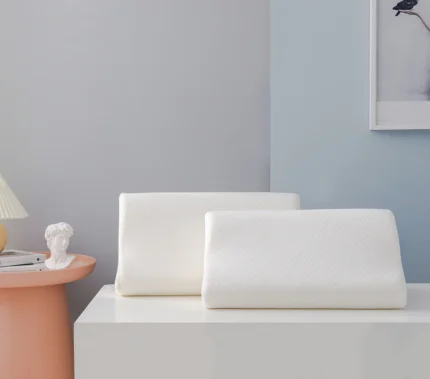
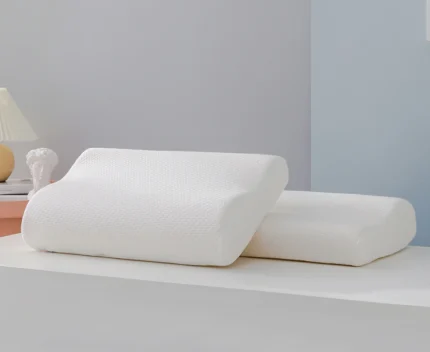
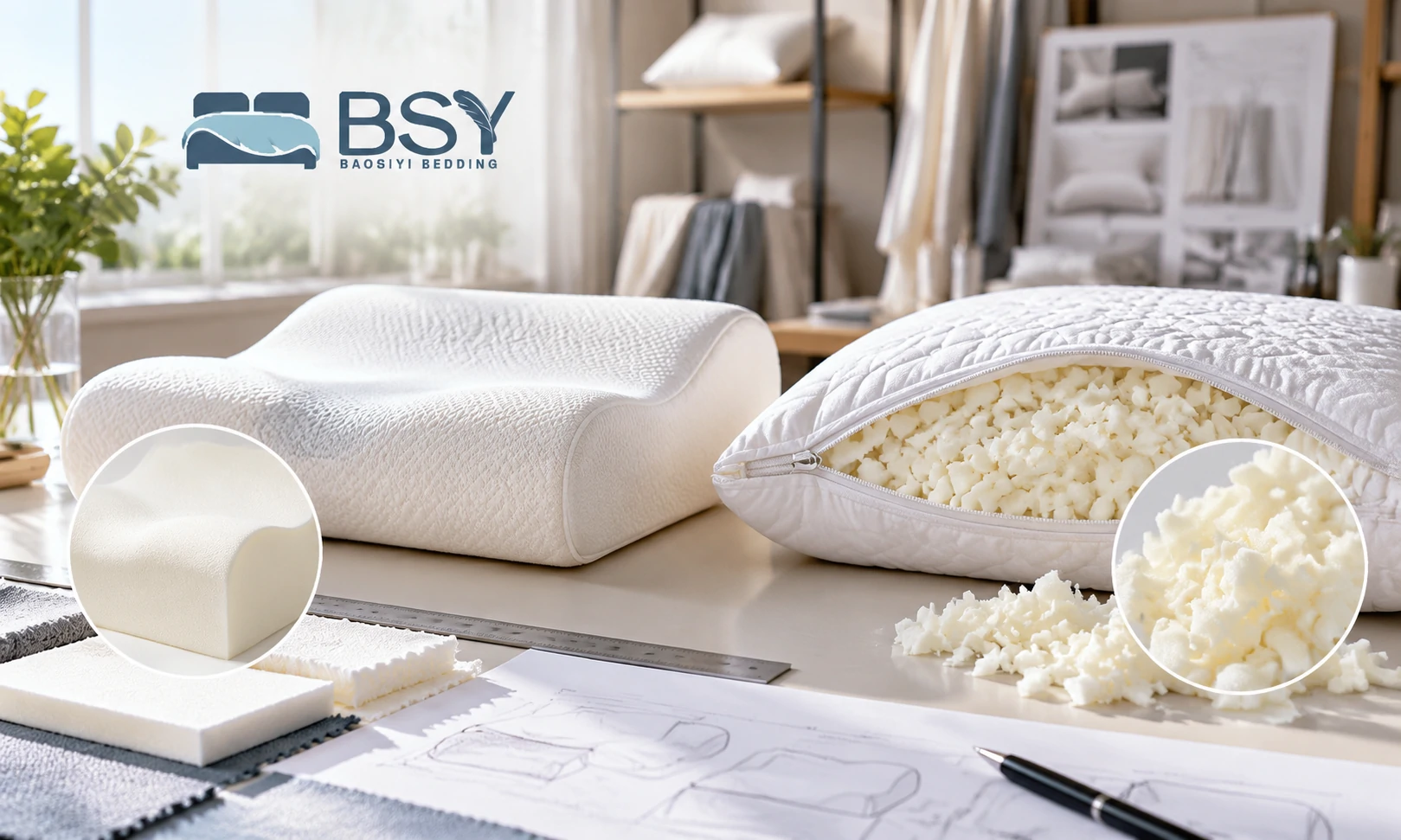
Molded memory foam pillows are produced using custom-engineered metal tooling. Liquid chemical formulations are injected into precision-sealed aluminum molds where they expand and cure into finished ergonomic shapes.
Aluminum Mold Injection and Chemical Foaming Processes
The manufacturing process requires high engineering precision:
- Liquid polyols, isocyanates, water, and foaming catalysts are mixed at high speeds and poured into heated aluminum cavity molds.
- As the chemical reaction generates carbon dioxide gas, the foam expands uniformly, filling every curve of the mold cavity and forming a smooth, protective micro-skin outer layer (skin layer) during curing.
The Advantage of Anatomical Ergonomic Zoning
Molded foam allows factories to engineer complex therapeutic geometries that cannot be replicated by loose stuffing:
- Contour Wave (Cervical Design): Features dual-height lobes (e.g., 10 cm and 12 cm) to accommodate back and side sleepers, maintaining correct cervical alignment.
- Butterfly & Ergonomic Cutouts: Incorporates shoulder recesses, arm rest tunnels, and center cradle depressions designed for specialized therapeutic retail markets.
Durability and Shape Retention Under Commercial Use
Because molded foam cures as a single, homogenous block enclosed by a protective outer skin layer, it exhibits exceptional structural integrity:
- It resists tearing, shredding, or deformation under heavy commercial use.
- It maintains its precise ergonomic contour across thousands of nights, making it the premier choice for high-end hospitality and medical sleep clinics.
3. Shredded Memory Foam Pillows: Adjustable Loft and Enhanced Airflow
Shredded memory foam pillows take a completely different architectural approach, utilizing loose foam clusters rather than a solid block.
Precision Foam Milling: Turning Slab Foam into Clusters
- High-grade memory foam slab blocks (leftover factory production offcuts or specialized virgin foam sheets) are fed into industrial milling and shredding machines.
- Rotary steel blades chop the foam into irregular, soft clusters measuring roughly 1.0 cm to 2.5 cm in size.
The Adjustable Loft Advantage (Lowering Retail Return Rates)
One of the leading causes of online bedding returns is incorrect pillow loft: a side sleeper receives a pillow that is too thin, while a stomach sleeper receives one that is too thick.
Shredded memory foam solves this brilliantly:
- Pillows are supplied with an inner zippered casing containing the shredded foam clusters.
- End-users can open the zipper and remove or add foam clusters to customize the loft and firmness to their exact physical posture, reducing e-commerce return rates by up to 40%.
Enhanced Micro-Ventilation and Air Circulation
Unlike solid molded foam—which acts as a dense thermal block—shredded foam clusters possess massive internal interstitial space:
- Countless air channels weave between the loose foam pieces.
- When a sleeper moves, air pumps through the pillow interior, preventing heat accumulation and dissipating moisture vapor far more effectively than solid blocks.
4. Thermal Management: Gel-Infusion and Advanced Cooling Technologies
Both molded and shredded memory foam share an inherent physical vulnerability: Heat Retention.
Because memory foam conforms tightly to the body, it restricts airflow around the head, causing foam to warm up during the night. Premium OEM manufacturing deploys advanced thermal management solutions:
Liquid Cooling Gel Overlays vs. Infused Gel Particles
- Liquid Cooling Gel Overlays: A solid, medical-grade blue cooling gel pad is adhesively bonded to one surface of a molded memory foam pillow. The gel possesses a high specific heat capacity, absorbing facial heat rapidly upon initial contact.
- Gel-Infused Foam Particles: Microscopic cooling gel capsules are blended directly into the liquid chemical formula during foam molding or mixed into shredded foam clusters, dispersing thermal energy throughout the entire pillow core.
Phase Change Materials (PCM) and Breathable Inner Covers
- PCM Microcapsules: Integrated into the inner knit cover, Phase Change Materials absorb excess heat by melting from solid to liquid, buffering temperature spikes.
- Air-Mesh Side Gussets: 3D breathable spacer mesh sidewalls sewn around the perimeter of the pillow allow trapped warm air to vent horizontally into the room.
5. Compression Packaging and Container Logistics for Memory Foam
For international brand owners, shipping voluminous pillows across oceans represents a major landed cost factor.
Vacuum Roll-Packing Molded vs. Shredded Foam Pillows
- Shredded Foam Compressibility: Highly forgiving. Because the pieces are loose, shredded foam pillows can be compressed by up to 75% in automated vacuum-packing machines without damaging structural memory.
- Molded Foam Compressibility: Requires caution. While molded pillows can be roll-packed or flat-compressed, exceeding a 60% compression ratio can rupture internal air cells or deform the molded contour lobes if stored under compression for prolonged periods (exceeding 4 to 6 months).
Container Cubic Meter (CBM) Optimization for 40HQ
Proper compression packaging transforms shipping economics:
- A standard uncompressed container of memory foam pillows carries prohibitive volumetric freight charges.
- Precision vacuum-compression and roll-packing into retail cartons allows up to 3,000 to 4,000 compressed pillows per 40HQ high-cube container, driving ocean freight amortization down to a fraction of a dollar per unit.
6. Technical Sourcing Matrix & Cost Breakdown
| Sourcing Parameter | Molded Contour Memory Foam Pillow | Shredded Foam Adjustable Pillow | Gel-Infused Molded Cooling Pillow |
| Core Construction | Single-piece injected foam block | Milled shredded foam clusters | Molded block + Surface cooling gel pad |
| Ergonomic Shape | Fixed therapeutic wave contour | Adjustable loft (zippered inner casing) | Fixed ergonomic contour with chill pad |
| Foam Density | Medium to High (55–75 kg/m ³) | Mixed Density (50–65 kg/m ³) | Medium-High (60–75 kg/m ³) |
| Air Circulation | Low to Moderate (Solid core) | High (Loose internal cluster spaces) | Moderate (Enhanced by gel thermal transfer) |
| Vacuum Compression Limit | Max 55% to 60% compression | Up to 75% compression | Max 50% (To protect gel pad) |
| Target Retail Return Rate | Moderate (Depends on fixed loft) | Lowest (Fully user-adjustable) | Low to Moderate |
| Estimated FOB China Cost | $6.50 – $10.50 | $5.50 – $8.50 | $9.50 – $15.00 |
| Primary Target Market | Chiropractic, luxury hotels, medical | E-commerce DTC, mass retail | Premium wellness brands, hot sleepers |
7. Purchase Order Guidelines & Quality Verification Standards
When drafting an international Purchase Order (PO) for bulk memory foam pillows, enforce these five technical quality clauses:
- Mandate Density Tolerances: Specify: Molded or shredded foam core density shall be verified within a commercial tolerance of ±2 kg/m ³ of the specified nominal density (e.g., 60 kg/m ³).
- Require Zero-VOC and Odorless Certification: State: Polyurethane foam must be cured completely, exhibiting zero harsh chemical odors or volatile organic compounds (VOCs), backed by accredited chamber testing.
- Enforce Compression Storage Limits: Require: Vacuum-compressed pillows must recover at least 95% of their original uncompressed loft height within 24 hours of opening after up to 6 months in storage.
- Mandate OEKO-TEX Standard 100 Class I: Require: All inner foam cores, inner mesh liners, and outer removable zippered covers must carry valid OEKO-TEX Standard 100 certification confirming zero toxic chemical residues.
- Specify Outer Cover Specifications: State: Outer removable cover shall feature a heavy-duty nylon zipper, constructed from high-GSM bamboo jacquard or cooling cooling knit fabric.
8. Frequently Asked Questions (FAQ)
What is the main difference between molded and shredded memory foam pillows?
Molded memory foam is manufactured by injecting liquid chemical foam into a sealed aluminum mold, creating a single-piece solid pillow with a fixed ergonomic contour shape (such as a cervical wave). Shredded memory foam is produced by milling slab foam blocks into small, loose clusters placed inside a zippered inner casing, allowing end-users to manually add or remove foam to adjust the pillow’s loft and firmness.
Which memory foam pillow type is better for reducing retail customer returns?
Shredded memory foam adjustable pillows consistently generate lower e-commerce return rates. Because many online shoppers select the wrong pillow height, an adjustable shredded pillow allows the consumer to customize their loft at home, eliminating returns driven by incorrect height specifications.
Can memory foam pillows be vacuum-compressed for container shipping without permanent damage?
Yes, provided proper compression ratios are maintained. Shredded foam pillows tolerate high compression (up to 75%) exceptionally well. Molded memory foam pillows can also be vacuum-compressed and roll-packed for ocean shipping, but procurement managers must ensure compression does not exceed 60% and that pillows are unpacked within 4 to 6 months of packaging to guarantee 100% loft recovery.
How does gel-infusion technology solve the heat-trapping issue in memory foam pillows?
Traditional memory foam conforms tightly to the body, restricting airflow and trapping facial heat. Gel-infusion technology solves this by embedding microscopic cooling gel particles directly into the foam matrix or bonding a solid gel pad to the pillow surface. Because gel has a high specific heat capacity, it absorbs and dissipates thermal energy faster than polyurethane foam, providing an immediate and sustained cool-to-the-touch sensation.
Conclusion: Sourcing the Ideal Memory Foam Pillow for Your Brand
In the competitive bedding market, selecting the correct memory foam configuration bridges the gap between high customer satisfaction and excessive return overhead.
- Specify Molded Memory Foam when building medical-grade cervical support lines, premium hotel pillow menus, or structured therapeutic collections where fixed ergonomic precision is paramount.
- Specify Shredded Memory Foam when launching e-commerce DTC brands, adjustable loft programs, or mass-market retail lines where lowering return rates and offering personalized comfort drive business growth.
Operating advanced polyurethane pouring lines, foam milling equipment, and precision vacuum-compression packaging lines in Xiaoshan, Hangzhou, BSY Bedding is a specialized OEM/ODM manufacturer of custom molded and shredded memory foam pillows. We engineer fully certified, high-density, odorless memory foam sleep solutions tailored to the exacting specifications of global bedding brands and hospitality groups.