The Environmental Impact of Sourcing Natural Down vs. Recycled Polyester Fillings
October 13, 2026In the modern textile sector, sustainability has evolved from a progressive marketing theme into an existential operational metric. Regulatory frameworks—most notably the European Union’s Ecodesign for Sustainable Products Regulation (ESPR), Corporate Sustainability Due Diligence Directive (CSDDD), and the Green Claims Directive—are aggressively penalizing unsubstantiated eco-claims.
At the same time, institutional hotel groups and multinational retailers are bound by corporate Environmental, Social, and Governance (ESG) targets to measure and decarbonize their Scope 3 supply chain emissions.
When sourcing bulk duvets and comforters, procurement directors confront a complex ecological debate: Natural Waterfowl Down versus Recycled Polyester (rPET).
Marketers often present this choice as a simple binary: synthetic proponents position recycled polyester as an animal-free, plastic-diverting savior, while natural fiber advocates herald down as an ancient, renewable, zero-plastic miracle.
The physical reality is far more nuanced. A comprehensive Life Cycle Assessment (LCA) reveals that both materials carry distinct ecological benefits and environmental trade-offs.
This technical report provides a transparent, data-driven analysis of natural down and recycled polyester fillings, evaluating cradle-to-grave emissions, aquatic impacts, microplastic pollution, and circular end-of-life outcomes.
1. Life Cycle Assessment (LCA) Methodology: Cradle-to-Grave Analysis
To compare two radically different raw materials objectively, environmental engineers rely on Life Cycle Assessment (LCA) standardized under ISO 14040 and ISO 14044 protocols.
Scope 1, 2, and Scope 3 Emissions in Textile Procurement
For an international retailer or hotel operator purchasing finished comforters:
- Scope 1 & 2 Emissions: Pertain to the retailer’s direct facilities and energy use.
- Scope 3 Emissions: Account for over 70% to 85% of total corporate greenhouse gas footprints, representing the embedded emissions generated upstream during raw material farming, chemical extrusion, factory assembly, and ocean freight shipping.
The Four Core Ecological Impact Indicators
A complete bedding LCA evaluates four primary impact categories:
- Global Warming Potential (GWP): Total greenhouse gas emissions expressed in kilograms of carbon dioxide equivalent (kg CO2e) per kilogram of finished filling.
- Water Depletion: Volume of freshwater consumed during agricultural rearing, recycling processing, and industrial scouring.
- Eutrophication Potential: The runoff of nitrates and phosphates into aquatic ecosystems, leading to algal blooms and marine dead zones.
- Waste Persistence & Microplastic Ecotoxicity: The duration of physical material retention in the biosphere after disposal and the release of non-biodegradable synthetic particles into oceans.
2. Natural Down: Agricultural Byproduct vs. Natural Circularity
Natural duck and goose down has insulated human bedding for centuries, but evaluating its modern ecological footprint requires analyzing industrial waterfowl agriculture.
The Zero-Allocation Byproduct Reality
A widespread misconception among non-technical buyers is that waterfowl are raised primarily for their down. In reality, natural down and feathers represent a 100% agricultural byproduct of the global poultry meat industry.
Under international carbon allocation accounting rules (such as the Higg Material Sustainability Index):
- Ducks and geese are raised, fed, and processed for food.
- If the home textile industry ceased sourcing down tomorrow, an identical number of waterfowl would still be raised for meat, and millions of tons of raw plumage would be diverted into municipal incinerators or landfills.
- Because down is a secondary byproduct, the primary agricultural methane emissions, feed grain cultivation, and land-use impacts belong overwhelmingly to the food sector. Sourcing down essentially repurposes agricultural waste into high-performance insulation.
Water and Chemical Usage in Industrial Scouring Facilities
The primary environmental burden of natural down occurs after slaughter during scouring, de-dusting, and sterilization:
- Raw down contains natural avian fats, soil, and biological debris, requiring intensive multi-stage washing.
- Washing 1 kilogram of raw down traditionally requires 30 to 50 liters of water.
- Modern Sustainable Mitigation: Leading down processing hubs in Xiaoshan, Hangzhou, operate advanced closed-loop wastewater treatment plants. Industrial scouring lines utilize biodegradable, nonylphenol ethoxylate (NPEO)-free detergents, recycling up to 75% of wash water back through biological filtration systems.
The Ultimate Ecological Advantage: 100% Biodegradability
The crowning environmental achievement of natural down is its chemical composition. Down is composed almost entirely of keratin—a natural structural protein.
- When a pure down comforter reaches the end of its useful life, the filling is 100% naturally biodegradable.
- Placed in industrial composting or standard soil conditions, natural down breaks down completely within 2 to 6 months, returning nitrogen, carbon, and organic nutrients to the earth.
- Natural down releases zero synthetic microplastics into rivers, municipal wastewater streams, or marine life.
Lifespan Longevity and Environmental Amortization
Natural down clusters possess extraordinary mechanical resilience. Maintained inside high-density cotton shells, a commercial goose down comforter lasts between 10 and 20 years in residential use and 4 to 5 years in high-turnover hotels. This prolonged service life amortizes its initial processing footprint across thousands of restful nights.
3. Recycled Polyester (rPET): Plastic Diversion vs. The Microplastic Dilemma
Recycled polyester (commonly derived from post-consumer polyethylene terephthalate bottles, or rPET) represents the primary material choice for vegan and circular economy bedding collections.
Diverting Post-Consumer Plastic Waste
The most powerful environmental attribute of rPET is municipal waste diversion:
- A standard Queen-size synthetic comforter utilizing 300 GSM of blown microfiber diverts approximately 60 to 80 plastic bottles (500 ml) from landfills, incinerators, and ocean environments.
- Utilizing post-consumer feedstock eliminates the need to extract virgin petroleum and raw petrochemical crude oil, preserving non-renewable fossil fuel reserves.
Carbon and Energy Reductions vs. Virgin Polymers
According to certified LCA data:
- Producing mechanical rPET emits approximately 40% to 60% fewer greenhouse gases than manufacturing virgin polyester.
- Mechanical recycling (sorting, flaking, melting, and re-extruding plastic bottles into fiber filaments) consumes up to 50% less energy than the energy-intensive catalytic synthesis of pure purified terephthalic acid (PTA) and monoethylene glycol (MEG).
The Microplastic Shedding Crisis in Commercial Laundering
The most severe, unresolvable ecological liability of recycled polyester is microplastic pollution.
- Polyester is plastic. Regardless of whether it originates from recycled bottles or virgin petroleum, the polymer chains remain non-biodegradable synthetic plastic.
- During commercial washing, tumbling, and spin extraction, friction fractures synthetic microfibers. Each laundry cycle sloughs off hundreds of thousands of microscopic plastic filaments (measuring less than 5 mm) into wastewater effluent.
- Municipal wastewater plants capture only a fraction of these particles; billions of synthetic microfibers bypass filtration, entering marine food webs where they accumulate inside marine organisms and bio-magnify up the food chain.
End-of-Life Bottlenecks: Non-Biodegradability in Landfills
When an rPET comforter is discarded:
- It does not biodegrade. In standard landfill conditions, synthetic polyester fibers remain stable for 200 to 500 years, leaching chemical additives and micro-fragments into surrounding soil.
- The Textile-to-Textile Bottleneck: While bottle-to-fiber recycling is mature, global infrastructure for “textile-to-textile” recycling remains nascent. Fewer than 1% of post-consumer garments and comforters are currently recycled back into new textile fibers due to blended fabrics, sewing thread contaminants, and degradation during thermal remelting.
4. Head-to-Head Environmental Comparison Matrix
Evaluating the ecological trade-offs between natural down and recycled polyester requires examining direct physical data points:
| Environmental Impact Category | Natural Waterfowl Down (RDS Certified) | Recycled Polyester (GRS rPET Microfiber) | Virgin Polyester Hollowfiber | Primary Ecological Consideration |
| Primary Raw Feedstock | Poultry meat industry agricultural byproduct | Post-consumer PET plastic beverage bottles | Virgin petrochemical crude oil & natural gas | Down and rPET utilize secondary waste streams |
| Emissions (kg CO2e / kg fill) | Low (~1.5 – 2.5 kg CO2e) | Moderate (~2.8 – 4.2 kg CO2e) | High (~6.5 – 9.0 kg CO2e) | Down has lower processing emissions than polymer melting |
| Freshwater Consumption | Moderate to High (Scouring & washing) | Low (Mechanical bottle washing & cooling) | Low to Moderate (Chemical synthesis) | Down requires closed-loop wastewater recovery |
| Microplastic Shedding | Zero (Natural organic protein) | High (Continuous shedding during laundering) | High (Continuous shedding during laundering) | rPET contributes to marine microplastic persistence |
| Biodegradability Profile | 100% Biodegradable (2 to 6 months) | Non-Biodegradable (200+ years in landfill) | Non-Biodegradable (200+ years in landfill) | Down offers closed-loop biological circularity |
| Average Service Lifespan | Long (10 to 20 years residential) | Moderate (3 to 6 years before compaction) | Short to Moderate (2 to 4 years) | Longer service life lowers annualized impact |
| End-of-Life Circularity | Soil compost / Upcycled down programs | Incineration / Downcycling / Landfill | Incineration / Landfill | Textile-to-textile recycling remains under 1% globally |
| Animal Welfare Scrutiny | High (Requires strict RDS chain of custody) | Zero (Completely cruelty-free and vegan) | Zero (Completely animal-free) | Sourcing down requires verified audit compliance |
5. Regulatory Compliance: Navigating Anti-Greenwashing Legislation
Sourcing sustainable bedding requires navigating evolving global regulatory frameworks designed to protect consumers from misleading corporate environmental marketing.
The EU Green Claims Directive
Adopted by the European Parliament, the Green Claims Directive bans broad, unsubstantiated marketing claims like “eco-friendly,” “carbon neutral,” or “green comforter.”
To sell sustainable bedding legally in the EU:
- All claims must be backed by verified, publicly accessible third-party Life Cycle Assessments.
- If advertising “Recycled Bedding,” the brand must furnish official Transaction Certificates (TCs) from the Global Recycled Standard (GRS) proving that the stated percentage of post-consumer material is chemically verified.
Corporate Sustainability Due Diligence Directive (CSDDD)
Under the EU CSDDD, large corporate enterprises are legally liable for human rights and environmental violations across their entire upstream value chain. For bedding importers:
- Natural down supply chains must prove zero deforestation in waterfowl feed grain sourcing and verified humane animal welfare via RDS.
- Synthetic supply chains must prove that recycling facilities comply with local air emissions and wastewater treatment laws.
The Third Way: Post-Consumer Recycled Down (GRS Down)
To combine the animal-welfare benefits of recycling with the biodegradable luxury of natural plumage, progressive brands are turning to Post-Consumer Recycled Down:
- Collected from discarded institutional pillows, vintage duvets, and hotel post-consumer bedding.
- Mechanically sorted, scoured at 120°C, and certified under the Global Recycled Standard (GRS).
- Delivers the ultimate ecological profile: zero agricultural footprint, circular waste diversion, and 100% organic biodegradability with zero microplastics.
6. Factory-Level Sustainable Manufacturing in China’s Industrial Hubs
Sustainable bedding is not determined solely by the internal filling; factory manufacturing practices dictate the product’s operational footprint.
In modern textile manufacturing hubs like Xiaoshan, Hangzhou, leading OEM plants invest heavily in environmental infrastructure:
- Solar-Powered Production Facilities: Rooftop photovoltaic arrays generate clean, renewable electricity to power automated fabric cutting tables and computerized Jack sewing lines.
- Biological Closed-Loop Wastewater Recovery: Multi-stage biological filtration, ozone sterilization, and sedimentation tanks recycle down-washing effluent back through early scouring cycles, slashing freshwater municipal withdrawal by over 60%.
- Zero-Waste Cutting Tables: Computerized nesting software optimizes pattern layouts on raw fabric rolls, reducing pre-consumer cotton scrap waste to less than 2.5%.
- Sustainable Packaging Formats: Eliminating heavy non-biodegradable PVC bags in favor of FSC-Certified kraft paper bands, recycled polybags, or 100% compostable cornstarch-derived PLA mailers.
7. Strategic Sourcing Framework: 5 Rules for ESG Bedding Procurement
When drafting your corporate home textile sustainability charter, align material specifications with distinct brand objectives:
- Select Natural Down for Long-Term Circularity and Luxury: If your corporate brand identity emphasizes natural luxury, 100% organic biodegradability, long product service life, and zero microplastic emissions, specify RDS-Certified Natural Down paired with an unbleached, GOTS-certified organic cotton casing.
- Select Recycled Polyester for Vegan and Strict Budget Charters: If your brand appeals to strict vegan demographics, operates under a zero-animal charter, or serves high-turnover institutional markets where frequent 75°C sanitization washes are legally mandated, specify GRS-Certified 100% Post-Consumer rPET.
- Mandate Transaction Certificates (TCs) on Every PO: Never rely on annual factory licenses. Require certified shipment-specific GRS Transaction Certificates for recycled fibers, and RDS Transaction Certificates for natural down matching container net weights.
- Demand OEKO-TEX Standard 100 Class I: Ensure that regardless of filling, the entire finished comforter (including sewing threads, piping cords, and shell fabrics) is certified free from toxic formaldehyde, heavy metals, and persistent PFAS chemistry.
- Publish Transparent Supply Chain Disclosures: Avoid generic “green” adjectives on retail packaging. Clearly state verified physical metrics: e.g., “Contains 100% RDS-Certified Down” or “Filled with 100% GRS-Certified Recycled Post-Consumer Polyester (Diverting 75 Plastic Bottles).”
8. Frequently Asked Questions (FAQ)
From a strict carbon footprint perspective, does natural down or recycled polyester have lower emissions?
When evaluated strictly under international carbon accounting guidelines, natural down typically exhibits a lower processing carbon footprint (roughly 1.5 to 2.5 kg CO2e per kg of fill) than mechanically recycled polyester (2.8 to 4.2 kg CO2e per kg). Because natural down is a 100% agricultural byproduct of poultry meat production, the primary farming emissions are allocated to the food sector, meaning down processing requires energy only for mechanical sorting, scouring, and drying.
How does the microplastic pollution issue impact the environmental rating of recycled polyester (rPET) bedding?
Microplastic pollution is the most severe environmental drawback of recycled polyester. While rPET successfully diverts plastic bottles from landfills, it converts rigid plastic into fine micro-filaments. During standard washing cycles, thousands of microscopic non-biodegradable synthetic fibers shed into wastewater streams, bypassing filtration plants and polluting marine ecosystems. Natural down is a natural protein that releases zero microplastics and biodegrades completely in soil.
Is recycled polyester comforter filling eligible for European anti-greenwashing compliance under the EU Green Claims Directive?
Yes, provided the claim is fully verified and documented. Under the EU Green Claims Directive, brands cannot use vague terms like “eco-friendly” or “green comforter.” However, retailers can legally claim “Recycled Bedding” provided they maintain an unbroken Global Recycled Standard (GRS) chain of custody backed by official Transaction Certificates (TCs) for every import batch proving post-consumer plastic origin.
What is post-consumer recycled down (GRS Down), and is it commercially viable for bulk hotel procurement?
Post-consumer recycled down is waterfowl plumage extracted from discarded down bedding, sorted, sterilized at high temperatures (120°C+), and certified under the Global Recycled Standard (GRS). It is increasingly viable for commercial procurement, offering the natural luxury, breathability, and biodegradability of real down with zero new agricultural farming footprint. However, because global collection infrastructure is still scaling, GRS recycled down carries an FOB price roughly on par with virgin duck down.
Conclusion: Partnering with a Certified Sustainable Bedding Manufacturer
There is no single “perfect” textile material in commercial manufacturing; true sustainability is about transparency, trade-off management, and third-party verification.
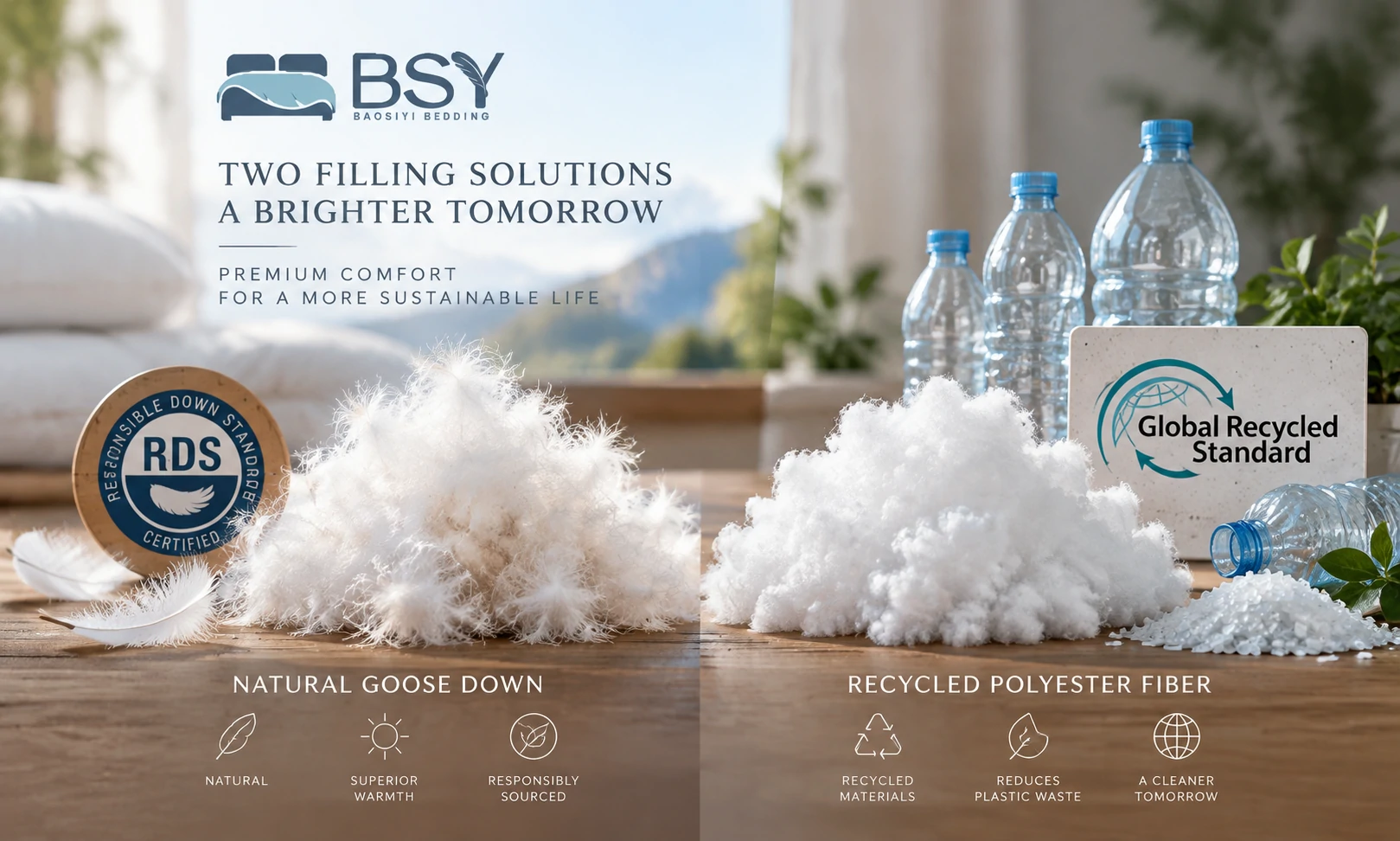
- Natural Waterfowl Down remains the premier ecological choice for buyers seeking renewable, fully biodegradable, zero-microplastic insulation with a multi-decade operational service life.
- GRS Recycled Polyester serves as an indispensable solution for cruelty-free, vegan-approved markets requiring low unit costs, excellent high-temperature washability, and verified plastic bottle landfill diversion.
As an audited export manufacturer located in Xiaoshan, Hangzhou, BSY Bedding is committed to decarbonizing the global home textile supply chain. We manufacture custom-tailored comforters utilizing 100% RDS-certified natural down, GRS-certified post-consumer recycled microfibers, and OEKO-TEX Standard 100 certified casings. We provide verified chain-of-custody documentation, transparent Life Cycle Assessment support, and solar-powered manufacturing to help our retail and hospitality partners build credible, market-leading sustainable bedding programs.