RDS (Responsible Down Standard) Certification: What Retail Buyers Must Verify
October 9, 2026In the contemporary home textile landscape, ethical sourcing has shifted from a corporate social responsibility (CSR) talking point into a mandatory legal requirement. Consumer advocacy groups, environmental watchdogs, and major retail consortiums closely scrutinize the treatment of industrial waterfowl across agricultural supply chains.
For commercial buyers sourcing bulk down comforters, a single unverified claim of animal mistreatment can trigger catastrophic brand backlash, product boycotts, and substantial fines under emerging anti-greenwashing legislation in Europe and North America.
To protect supply chains, global brands rely on the Responsible Down Standard (RDS).
However, obtaining authentic RDS-certified bedding is not as simple as checking a box on an import contract. Unscrupulous middlemen often show valid factory licenses while delivering uncertified commodity down, or supply documentation that fails customs audits.
This B2B compliance manual explains the inner workings of Textile Exchange standards, the critical legal distinction between Scope Certificates (SC) and Transaction Certificates (TC), physical segregation controls on factory floors, and the essential verification steps required before paying your final production balance.
1. What is the Responsible Down Standard (RDS)? The Global Animal Welfare Benchmark
Established by the international non-profit Textile Exchange in cooperation with animal welfare groups and global apparel brands, the Responsible Down Standard is the premier international benchmark for ethical waterfowl plumage.
The Two Non-Negotiable Animal Welfare Mandates
The RDS standard is built upon two absolute prohibitions that carry zero tolerance:
- Absolute Prohibition of Live-Plucking: Feathers and down clusters must only be harvested as a natural secondary agricultural byproduct from ducks and geese that have been slaughtered for meat. Harvesting plumage from living, conscious birds is completely forbidden.
- Absolute Prohibition of Force-Feeding: The supply chain strictly bans any down or feather material originating from farms associated with foie gras production or intentional force-feeding regimes.
The Five Freedoms of Animal Welfare
Certified farms are independently audited to guarantee the fundamental Five Freedoms of animal welfare across the entire agricultural lifecycle:
- Freedom from hunger and thirst through ready access to fresh water and balanced nutrition.
- Freedom from discomfort through sheltered, clean resting areas.
- Freedom from pain, injury, and disease via preventative veterinary care.
- Freedom to express normal animal behaviors through adequate space and enrichment.
- Freedom from fear and distress through humane handling practices.
Farm-to-Consumer Traceability: Full Chain of Custody
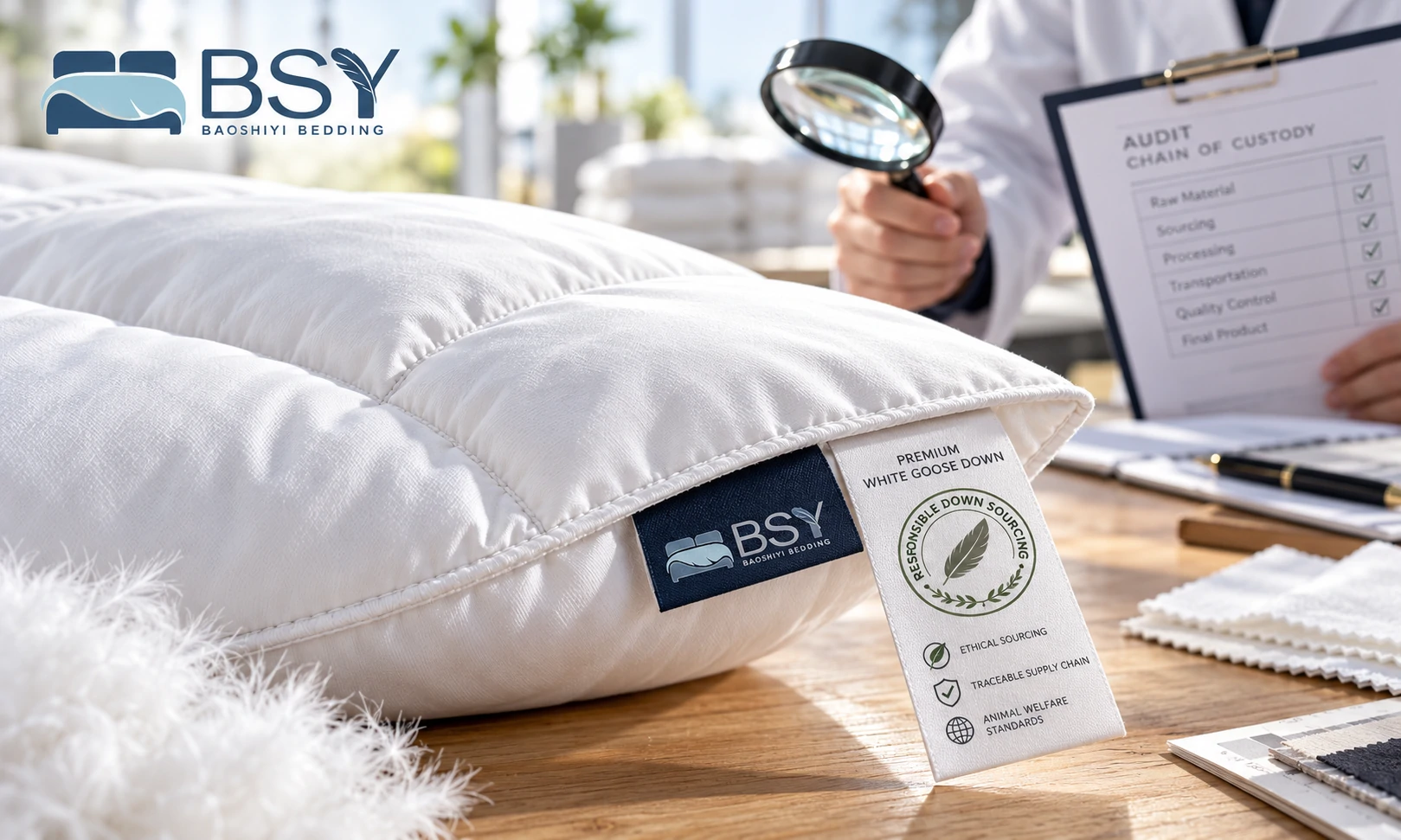
The RDS framework does not audit the sewing factory in isolation; it enforces continuous, unbroken custody tracking starting from parent breeding farms, hatcheries, raising farms, slaughterhouses, and down-washing mills, all the way to final cutting, chamber blowing, and export packing.
2. Chain of Custody (CoC): Scope Certificate (SC) vs. Transaction Certificate (TC)
The single most common compliance failure encountered by international retail buyers stems from confusing Scope Certificates with Transaction Certificates.
What is a Scope Certificate (SC)? The Factory License
A Scope Certificate is an annual facility-level license issued by an accredited third-party certification body (such as Control Union, IDFL, USB, or GCL).
- What It Proves: It confirms that a manufacturing facility (e.g., BSY Bedding in Xiaoshan) has passed a comprehensive physical audit verifying that its warehousing, inventory tracking, and production lines possess the management systems necessary to handle RDS-certified materials without cross-contamination.
- Validity: Issued annually, containing an audited expiration date and an approved scope of products (e.g., down duvets, down pillows).
What is a Transaction Certificate (TC)? The Shipment-Specific Invoice
A Transaction Certificate is a mandatory, legally binding document issued for one specific, individual commercial export shipment.
- What It Proves: It confirms that the exact quantity of down utilized in your specific purchase order was traced back through the certified supply chain.
- Key Data Points on a Valid TC:
- The legal corporate name of the seller (Manufacturer) and buyer (Importer).
- The specific shipping invoice number and ocean Bill of Lading (B/L) number.
- The exact gross and net weight of the certified down filling contained within the comforters.
- The unique certified farm lot numbers from which the raw plumage was sourced.
The Critical Sourcing Trap: Why an SC Alone Leaves Buyers Unprotected
Low-integrity traders frequently present a legitimate factory Scope Certificate to secure an order, but deliver uncertified down.
When the buyer requests an official Transaction Certificate post-export, the supplier claims it is unavailable or demands an unexpected price surcharge.
The Golden Sourcing Rule: A Scope Certificate proves a factory has the capability to produce ethical goods; only an official Transaction Certificate (TC) proves that your specific comforters are legally certified. Without an individualized TC, your brand cannot legally print the RDS logo on retail packaging or market the bedding as certified in the EU or US.
3. Mitigating Contamination and Counterfeit Risks on the Factory Floor
In large down processing hubs like Xiaoshan, Hangzhou, raw commodity down is processed in massive volume. Certified factories must enforce strict physical segregation protocols to prevent certified and uncertified stocks from mixing.
The Factory Traceability Sequence:
- Step 1: Certified Raw Material Receiving — Verified incoming shipments inspected against supplier certificates.
- Step 2: Designated Quarantine Zone — Incoming raw plumage held in an isolated bay pending initial lab verification.
- Step 3: Color-Coded Batch Barcoding — Distinct digital barcode tags applied to all bags and handling containers.
- Step 4: Dedicated Washing & Sorting Lines — Pre-purged sorting and carding machines dedicated solely to certified runs.
- Step 5: Sealed Storage in Dedicated RDS Silos — Cleaned down stored in locked, labeled storage compartments.
- Step 6: Chamber Blowing with In-Line QC — Automated pneumatic injection with electronic batch logging per unit.
- Step 7: Export Packaging with Lot Tracking — Master cartons stamped with unique traceability batch numbers.
Physical Segregation Protocols
To maintain accredited RDS status, a factory must operate segregated material storage:
- Dedicated Warehousing Zones: Certified down bales must be stored in clearly demarcated floor areas with prominent visual signage.
- Color-Coded Inventory Tracking: Raw bags and intermediate processing bins use distinct colored tags and serialized digital lot numbers.
- Clean-Down Procedures: Prior to running an RDS production run through carding, sorting, or pneumatic blowing machines, all ductwork and machinery must be completely purged of previous fiber residues.
Third-Party Accredited Certification Bodies (CBs)
Buyers should verify that certificates originate from globally accredited bodies recognized by Textile Exchange, such as:
- Control Union Certifications (CU)
- International Down and Feather Testing Laboratory (IDFL)
- USB Certification
- GCL International
Buyers can independently verify a supplier’s accreditation status via the official online Textile Exchange Certified Supplier Database.
4. RDS Brand Labeling Rules: What Retailers Can Legally Print
Printing official certification logos on consumer packaging requires adherence to the Textile Exchange Standards Claims Policy.
Labeling Tiers: 100% Certified Down vs. Blends
- 100% RDS Certified Down Claims: Can be made on packaging and point-of-sale displays only when 100% of the waterfowl down and feather filling in the finished product is certified under the standard.
- Blended Down Claims: If a duvet contains a blend of certified down and synthetic microfibers (e.g., 50% RDS duck down / 50% polyester), the packaging must explicitly state the certified component percentage (e.g., “Contains 50% RDS Certified Down”).
Artwork Approval and Certification Licensing
Retailers cannot simply download the RDS logo from the internet and print it onto a retail box insert:
- The packaging layout, care label, and marketing claims must be submitted to the factory’s certification body.
- The certification body reviews the typography, logo sizing, and required legal disclaimer text.
- Upon approval, an official Artwork Approval Code is issued, authorizing the manufacturer to print and apply the labels.
Navigating Anti-Greenwashing Regulations (EU & US)
Regulators are actively prosecuting unverified environmental claims:
- European Union (Green Claims Directive): Mandates that all environmental and animal welfare claims on consumer products be backed by verifiable, third-party certified life-cycle documentation. Retailers caught making unsubstantiated “humane down” claims face fines of up to 4% of annual corporate turnover.
- United States (FTC Green Guides): The Federal Trade Commission penalizes deceptive ethical claims, requiring brands to maintain clear, contemporaneous Transaction Certificates for every import batch.
5. True Quality Integration: Ethical Sourcing Meets Laboratory Purity
A common mistake made by retail sourcing teams is assuming that because down is RDS certified, it is automatically clean and odor-free.
RDS certifies how the bird was treated; it does not certify how cleanly the down was washed.
Commercial contracts must pair ethical animal welfare certification with strict physical cleanliness parameters.
Down Turbidity and Cleanliness Testing
Waterfowl down contains natural organic dust, soil, and biological micro-debris:
- Turbidity Test: Measures the clarity of water after washing a down sample inside an optical glass cylinder.
- The Commercial Requirement: Sourcing contracts must mandate a Turbidity rating of at least 1,000 mm. Values below 500 mm indicate dirty, dusty down that will trigger consumer dust allergies and return claims.
Oxygen Number and Lipid Scouring
- Oxygen Number: Quantifies the amount of oxidizable organic matter and residual avian oils remaining on the down clusters.
- The Commercial Requirement: Contracts must stipulate an Oxygen Number equal to or less than 10 mg per 100 grams. Levels exceeding 10 indicate under-washed plumage with residual animal fats that will spoil, cultivate bacteria, and produce repulsive odors under humid room conditions.
Chemical Safety: Pairing RDS with OEKO-TEX Standard 100 Class I
While RDS covers the internal filling, the outer cotton shell, sewing threads, and internal piping must be verified under OEKO-TEX Standard 100 Class I. This guarantees that the finished comforter contains zero toxic formaldehyde residues, heavy metal dyes, or allergenic finishing chemicals.
6. Comparative Certification Matrix: Which Standard Fits Your Market?
| Certification Standard | Custodian Organization | Primary Market Focus | Core Audit Scope | Mandatory Transaction Certificate? |
| Responsible Down Standard (RDS) | Textile Exchange | Global (US, UK, Europe, Asia) | Farm welfare, slaughterhouse, complete manufacturing chain | Yes (Shipment-specific TC required) |
| Downpass (Zero Live-Pluck) | Downpass e.V. | Strongest in Germany & Central Europe | Farm animal welfare, quality testing (fill power & cleanliness) | Yes (Tracking seal numbers applied) |
| Global Recycled Standard (GRS) | Textile Exchange | Global Circular Economy Brands | 100% Post-consumer recycled down & synthetic traceability | Yes (Shipment-specific TC required) |
| NOMITE (EN 13186) | European Down & Feather Association | European Union & UK | Mechanical down-proof weave density (dust mite exclusion) | No (Casing fabric testing certification) |
7. The B2B Buyer’s 5-Step RDS Verification Protocol
To guarantee that your supply chain is completely defensible prior to issuing financial payments, follow this factory-floor verification protocol:
- Verify the Factory Scope Certificate Online: Prior to placing a purchase deposit, request the manufacturer’s current Scope Certificate. Cross-reference the facility’s registered legal name and certificate number directly on the public Textile Exchange Certified Supplier Database.
- Contractually Mandate the TC as a Payment Milestone: Include a clause in your formal Purchase Order stating: Final payment (or release of original ocean Bill of Lading) is strictly contingent upon the supplier furnishing a draft Transaction Certificate (TC) issued by an accredited certification body matching container net weights.
- Reconcile Net Weights: When the official TC is delivered, compare the certified net down weight listed on the document against your commercial packing list and bill of lading. A discrepancy of more than 2% signals that uncertified filler material may have been blended into the order.
- Inspect Box Marks and Care Labels: Ensure that all master cartons feature unique trace lot numbers, and verify that the interior sewn-in care tags display the approved manufacturer license number and official certification statement.
- Conduct Pre-Shipment In-Line Audits: Deploy independent quality inspectors (such as SGS, Intertek, or QIMA) to inspect the factory’s raw material warehouse, verifying that filling machines were drawing exclusively from tagged, physically segregated RDS storage silos.
8. Frequently Asked Questions (FAQ)
What is the fundamental legal difference between an RDS Scope Certificate (SC) and an RDS Transaction Certificate (TC)?
An RDS Scope Certificate (SC) is an annual facility license verifying that a manufacturing plant has the physical infrastructure, inventory management systems, and tracking protocols necessary to process certified goods without cross-contamination. An RDS Transaction Certificate (TC) is a legally binding, shipment-specific document that proves the exact net weight of down filling contained in your specific ocean container shipment was sourced from verified, certified farms. You cannot legally claim products are certified without an individualized TC.
Can a retailer legally print the official RDS logo on consumer packaging if only the fabric mill holds an SC?
No. To legally use the RDS logo and claim ethical certification on retail packaging, every single tier of the physical supply chain—from raw waterfowl farms and slaughterhouses to the down washing facility, the finished comforter sewing factory, and the brand owner—must maintain certified chain-of-custody tracking. Furthermore, all consumer packaging artwork must receive explicit written authorization and an Artwork Approval Code from an accredited certification body before mass printing.
How do accredited certification bodies ensure non-certified commodity down is not mixed with certified down in the factory?
Accredited certification bodies conduct unannounced on-site audits, mass-balance accounting reconciliations, and physical storage inspections. Certified facilities must maintain physically segregated storage areas, separate processing machinery, and color-coded inventory tagging. Certification auditors cross-reference the total volume of certified raw down purchased against the total volume of finished products exported; if outbound volume exceeds inbound certified raw stock, the factory immediately loses its certification.
Does an RDS certificate automatically guarantee that the duck or goose down is clean and odor-free?
No. An RDS certification strictly audits ethical animal welfare and chain-of-custody tracking. It does not measure chemical cleanliness or industrial scouring effectiveness. Commercial buyers must contractually require that their RDS-certified down comforters also satisfy rigorous laboratory cleanliness testing: specifically a Turbidity rating of at least 1,000 mm and an Oxygen Number at or below 10 mg per 100g to guarantee odor-free, allergen-safe performance.
Conclusion: Securing a Defensible, Ethical Down Supply Chain
In the modern bedding industry, supply chain transparency is non-negotiable. Consumers and institutional clients demand verifiable proof that luxury sleep comfort does not come at the cost of animal welfare.
By establishing rigorous verification protocols—demanding shipment-specific Transaction Certificates, inspecting physical factory segregation, and pairing RDS welfare tracking with accredited laboratory cleanliness testing—commercial buyers protect their brands from regulatory exposure and earn lasting consumer trust.
Located in Xiaoshan, Hangzhou—the global capital of waterfowl down processing—BSY Bedding is an accredited OEM/ODM manufacturer holding active Scope Certification under the Responsible Down Standard (RDS), Downpass, and OEKO-TEX Standard 100 Class I. We provide complete, transparent chain-of-custody documentation, official Transaction Certificates for every commercial container export, and in-house laboratory testing to support high-standard retail and hospitality programs worldwide.