Down-Alternative (Feels Like Down) Duvets: Microfiber Blown Technology Explained
September 16, 2026In the commercial bedding sector, natural goose and duck down have historically held the crown for thermal efficiency, drape, and cloud-like loft. However, shifting consumer values, strict operational hotel requirements, and healthcare protocols have driven an unprecedented surge in the demand for premium synthetic alternatives.
Modern procurement directors face distinct operational realities:
- Allergen Sensitivity: Natural down can harbor organic dust and trigger sensitivity complaints from allergy-prone hotel guests.
- Strict Laundering Protocols: In hospitality and institutional settings, bed covers must frequently undergo high-temperature sanitization cycles (60°C to 75°C), which can strip the natural protective oils from animal down and cause premature cluster clumping.
- Ethical and ESG Mandates: An increasing segment of retail consumers and corporate hotel brands mandate certified cruelty-free, vegan-approved, or recycled supply chains.
Historically, synthetic comforters were synonymous with cheap, stiff polyester batting that clumped into unyielding lumps after minimal commercial laundering. Today, Pneumatic Microfiber Blown Technology has rewritten the rules of synthetic bedding.
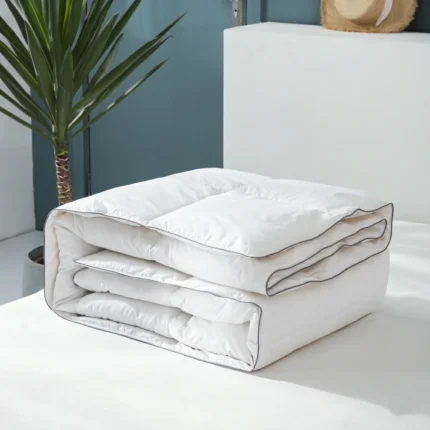
By blowing individualized, siliconized micro-denier fiber clusters into three-dimensional internal chambers, modern textile factories produce comforters that realistically emulate the fluid drape, thermal loft, and tactile responsiveness of natural down at a fraction of the raw material cost.
1. The Technological Evolution of Synthetic Bedding Fillings
To understand what separates a true “feels-like-down” comforter from a basic polyester quilt, buyers must evaluate the underlying physical geometry of the interior filling.
Traditional Resin-Bonded Batting: The Stiff, Heavy Past
Traditional polyester comforters rely on continuous non-woven wadding (batting). Chemical bonding resins or thermal heat rollers press raw polyester fibers into a continuous, flat roll of sheet wadding. This wadding is laid between two fabrics and quilted directly through using multi-needle machines.
While fast and inexpensive to manufacture, resin-bonded batting suffers severe functional drawbacks:
- Rigid Boardiness: Because the fibers are bonded into a uniform sheet, the comforter cannot drape naturally around the contours of a human body, creating air gaps that allow drafts to enter around the sleeper’s shoulders.
- Fiber Breakage and Shifting: Over repeated washings, the chemical binder degrades. The internal batting fractures, tearing into separate clumps and leaving large hollow voids throughout the comforter.
The Breakthrough: Loose Micro-Denier Fiber Clusters (Blown Fill)
The genuine feels-like-down experience is powered by blown micro-cluster technology. Instead of a bonded sheet, the raw material consists of millions of microscopic, individual synthetic fiber plumes.
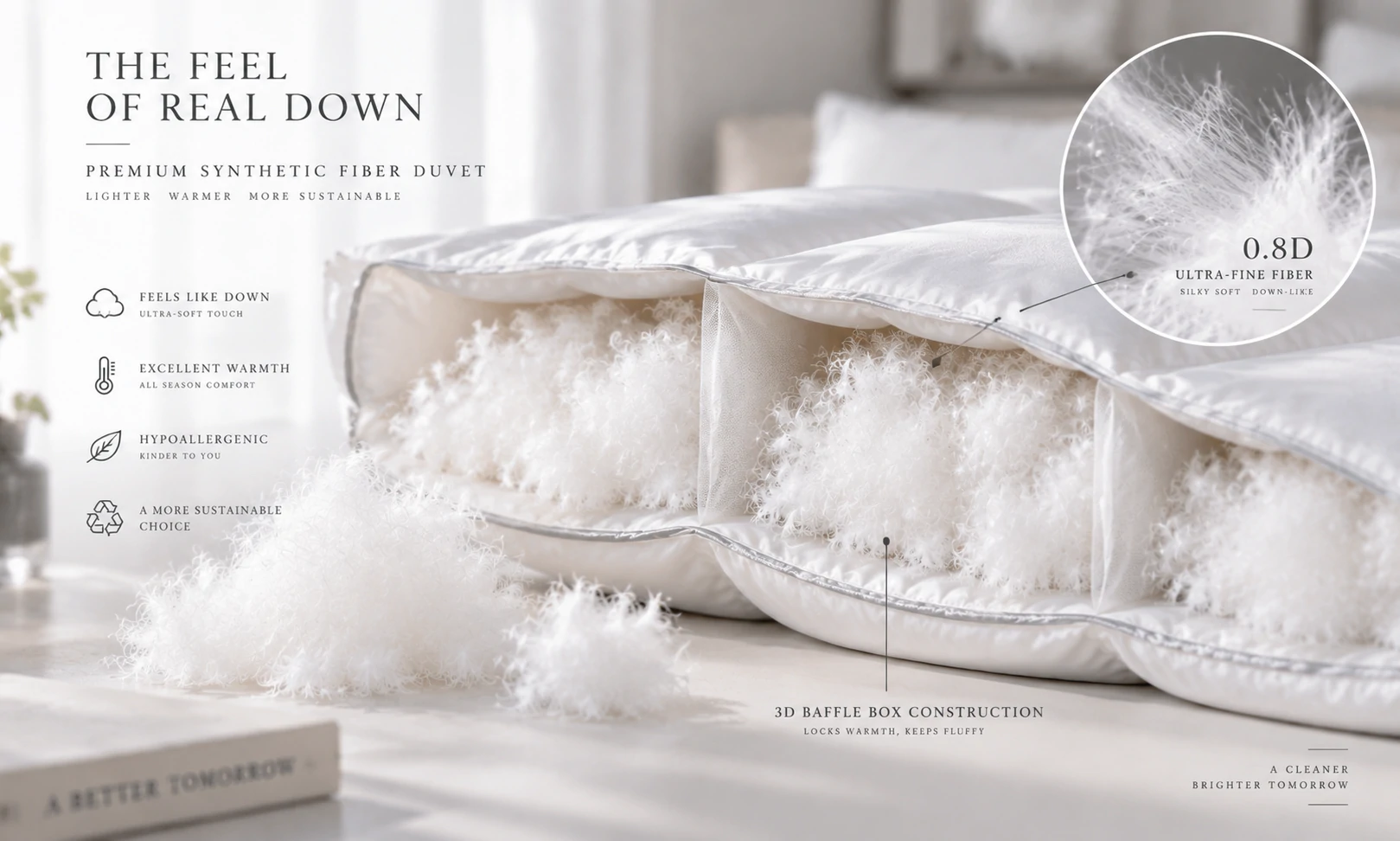
During manufacturing, high-pressure pneumatic injection nozzles blow these loose fiber clusters directly into individual, pre-sewn three-dimensional cubic pockets—the exact same manufacturing method utilized for luxury white goose down duvets.
Fluidity and Drape: How Blown Clusters Emulate Down Plumes
Because the synthetic clusters are completely unbonded within each chamber, they possess physical fluidity. When a sleeper rolls over or pulls the comforter, the microscopic fibers slide smoothly against one another, contouring instantly to body movements and eliminating the rigid “tenting” effect associated with conventional synthetic sheets.
2. Engineering “Feels Like Down”: Microfiber Specifications & Chemistry
Achieving the tactile sensation of a 700 fill-power natural down plume requires sophisticated synthetic polymer chemistry.
Denier Demystified: 0.8D to 1.2D Ultra-Fine Fibers vs. 7D Coarse Hollowfiber
Denier (D) measures the linear mass density of fibers, defined as the mass in grams per 9,000 meters of single filament:
- Standard Coarse Hollowfiber (6D to 7D): Used in economy, entry-level quilts. The fibers are thick, stiff, and springy, creating a bouncy, resilient pad that feels distinctly artificial and synthetic.
- Ultra-Fine Microfiber (0.8D to 1.2D): The core ingredient of premium feels-like-down comforters. At less than 1.0 denier, these filaments are significantly finer than human hair and silk strands. Their microscopic diameter produces an exceptionally soft, silky hand-feel with zero prickle or stiffness.
High-Grade Siliconization: Achieving Frictionless Slip and Silky Softness
Raw polyester fibers exhibit high surface friction; packed into a shell, they would quickly tangle, felt, and knot together. To prevent this, fiber producers apply a microscopic, high-temperature cured polysiloxane (silicone) coating to every single filament.
This siliconization process provides crucial commercial performance benefits:
- Frictionless Glide: The fibers slide effortlessly past each other, mimicking the natural movement of down barbules.
- Hydrophobic Protection: Prevents the core fiber from absorbing water, accelerating commercial drying times.
- Anti-Clumping Memory: Enables the clusters to untangle and spring back into shape immediately after compression or commercial spin cycles.
Three-Dimensional Conjugated Hollow Crimp
Rather than straight rods, top-tier down-alternative filaments feature a three-dimensional spiral helical crimp. Furthermore, each micro-filament contains a hollow core running longitudinally down its center.
This hollow conjugated architecture serves two vital functions:
- It reduces the physical weight of the fiber by 15% to 20%.
- It traps static dead air inside the microscopic hollow core, directly replicating the thermal insulation mechanism of natural avian down clusters.
Virgin Polymer vs. GRS-Certified Recycled Post-Consumer PET
For ESG-focused retail brands and corporate hospitality programs, blown micro-cluster fillings can be specified in:
- 100% Virgin Conjugated Hollow Polyester: Delivers maximum initial loft, purest optical white brightness, and zero odor risk.
- GRS-Certified (Global Recycled Standard) Recycled PET: Derived from mechanically sorted and re-extruded post-consumer plastic water bottles. Certified GRS down-alternative allows commercial buyers to market a powerful sustainability narrative while maintaining roughly 90% to 95% of the tactile performance of virgin fiber.
3. Factory Production Workflow: Precision Pneumatic Blowing
Manufacturing a true blown microfiber comforter demands specialized factory machinery far more sophisticated than standard flat-bed quilting machines.
Multi-Stage Opening and De-Clumping Equipment
Raw siliconized microfiber arrives at the factory compressed into high-density 300-kilogram shipping bales.
Before injection, the fiber must pass through a sequence of mechanical carding rollers and high-volume air openers. High-speed wire-wrapped cylinders gently disentangle the compressed mass, injecting air until the fiber blooms into ultra-fluffy, independent micro-clusters with zero residual clumps or hard knots.
Computerized Quantitative Pneumatic Injection (0.5% Tolerance)
Once opened, the fibers are pneumatically transported through enclosed stainless-steel ductwork to automated injection stations:
- An operator inserts a pneumatic injection nozzle into an open port on an individual comforter chamber.
- An integrated digital load-cell scale measures the exact programmed weight of fiber required for that specific box dimensions.
- High-velocity air currents blow the loose fiber clusters directly into the chamber, achieving an automated filling tolerance of ±0.5% per square.
- The injection port is immediately closed and secured with high-density lockstitching.
Baffle-Box Engineering for Synthetic Blown Fibers
Just like natural down, loose microfibers must be compartmentalized to prevent shifting:
- True feels-like-down comforters utilize 3D Baffle-Box Construction with internal vertical mesh partitions (typically 2.0 cm to 3.0 cm in height).
- These internal vertical walls hold the loose microfibers evenly distributed across the entire bed, ensuring the comforter maintains continuous loft without developing bare, uninsulated patches during sleep or laundering.
4. Objective Benchmarks: Down vs. Blown Fiber vs. Bonded Batting
| Performance Metric | Natural White Duck Down (650 FP) | Blown Microfiber Clusters (0.8D–1.2D) | Traditional Bonded Batting (7D) |
| Interior Geometry | Loose natural plumes | Loose synthetic clusters | Continuous flat fiber sheet |
| Tactile Drape | Superior (fluid contouring) | Excellent (near-down fluidity) | Rigid, board-like, stiff |
| Weight-to-Warmth Ratio | Outstanding (lightest weight) | Very Good (approx. 20% heavier) | Moderate (heavy per unit of heat) |
| Thermal Efficiency (Tog/GSM) | 10.5 Tog achieved at ~280 GSM | 10.5 Tog achieved at ~340 GSM | 10.5 Tog achieved at ~450 GSM |
| Allergenic Risk | Low (if turbidity ≥1000≥1000mm) | Completely Hypoallergenic | Completely Hypoallergenic |
| Wash Sanitization Threshold | Delicate (max 40°C recommended) | High-Temp (60°C to 75°C safe) | Moderate (binding glue degrades) |
| Commercial Drying Time | Slow (requires prolonged low heat) | Rapid (hydrophobic polymers) | Moderate |
| Initial Sourcing Cost (FOB) | High ($40.00 – $60.00+) | Highly Economical ($12.00 – $18.00) | Low ($7.00 – $10.00) |
5. Commercial Laundry Endurance: The Hotelier’s Dream
For high-turnover hospitality, commercial laundering performance is where blown microfiber comforters deliver their strongest financial return on investment.
High-Temperature Sanitization (60°C to 75°C Washing)
Housekeeping operations frequently battle biological stains, bed bug risks, and bacterial contamination. While natural down is vulnerable to structural damage, fiber embrittlement, and odor development if exposed to harsh thermal sanitization:
- Siliconized polyester micro-filaments possess a thermal degradation point well above 200°C.
- They safely withstand commercial water wash temperatures of 60°C to 75°C, satisfying hospital and international hotel sanitization protocols without suffering filament breakdown.
Rapid Tumble Drying and Operational Energy Savings
Energy consumption in commercial tunnel dryers represents a massive operational line item:
- Natural down feathers absorb water deep inside their microscopic protein shafts, demanding lengthy, gentle drying cycles to prevent internal mildew.
- Synthetic polyester fibers are inherently hydrophobic—they do not absorb moisture into the core of the polymer, holding water only on their surface via capillary action.
- In commercial extractors and gas dryers, blown microfiber comforters release moisture rapidly, cutting drying cycle durations by up to 40% to 50% compared to natural down, directly reducing hotel utility bills and commercial laundry turnaround costs.
Clumping Mitigation and Resilience Testing
Thanks to cured surface siliconization, blown microfibers resist felting. Following an industrial extraction cycle, standard tumble drying accompanied by the mechanical tumbling action causes the micro-clusters to glide apart, completely restoring the original 3D volume without manual labor.
6. Selecting the Perfect Shell for Synthetic Down
Pairing high-tech blown microfiber with an incorrect shell fabric will undermine the entire finished product.
Down-Proof Cotton Casings (233T & 300T)
Even though synthetic microfibers do not have sharp natural quills, their individual filaments are exceptionally fine (0.8 denier). Without a sufficiently dense casing, these microscopic fibers will migrate through the yarn intersections—a defect known in the textile industry as fiber bearding.
- High-end hotel programs consistently specify 233T or 300T 100% cotton percale shells with mechanical calendaring.
- This provides the natural breathability, moisture absorption, and crisp luxury feel of genuine cotton on the outside, while completely containing the blown microfibers on the inside.
Peach-Skin Microfiber Shells: The All-Synthetic High-Efficiency Option
For high-volume retail programs, supermarket private labels, and budget hotel chains:
- Outer shells woven from brushed polyester microfiber (85 to 110 GSM) create a soft, velvety peach-skin texture.
- This configuration offers an entirely synthetic, quick-drying, wrinkle-free, and stain-resistant comforter that packs tightly for low-cost ocean container freight.
Precision Needle Calibration: Preventing Fiber Bearding
On factory production lines, using standard heavy-gauge sewing needles (such as Size 100/16) punctures large holes in the outer shell. High-pressure blowing will cause fine 0.8D fibers to sprout through these needle perforations.
BSY production standards enforce ultra-fine micro-point needles (Size 70/10 to 75/11) paired with computerized thread tension control to ensure all perimeter seams and baffle stitch lines remain completely sealed against fiber migration.
7. Sourcing Economics and B2B Purchase Order Guidelines
The financial equation for blown microfiber comforters is compelling for commercial procurement:
- A commercial-grade Queen-size 90% white duck down comforter typically commands an FOB China export price between $45.00 and $55.00.
- A luxury Queen-size blown microfiber comforter (utilizing 0.8D virgin siliconized micro-clusters encased in a 233T 100% cotton baffle-box shell) can be sourced at direct factory prices between $14.00 and $18.50.
This price spread allows hoteliers and retail brands to capture 85% to 90% of the sensory and thermal performance of down while reducing initial capital expenditure by over 60%.
Target Market Channels
- Modern Business Hotel Chains: Delivers consistent, five-star guest sleep comfort with zero guest allergy complaints and exceptional laundry turnaround speeds.
- Healthcare and Extended Care Facilities: Meets rigorous infection control requirements allowing routine 60°C+ sanitization washes.
- Direct-to-Consumer (DTC) Vegan Bedding Lines: Captures the rapidly growing ethical consumer demographic demanding certified cruelty-free, animal-free home furnishings.
8. Frequently Asked Questions (FAQ)
How does blown microfiber achieve a “feels-like-down” hand feel compared to traditional bonded batting?
Traditional bonded batting consists of stiff, continuous rolls of fiber glued or needle-punched together, resulting in a flat, rigid pad that resists natural draping. Blown microfiber technology utilizes loose, individual micro-denier (0.8D) fiber clusters injected with compressed air into separate 3D baffle-box chambers. Because the fibers remain loose and siliconized, they slide freely against each other, perfectly replicating the fluid drape, sink-in softness, and volumetric loft of natural down plumes.
Can blown microfiber duvets withstand industrial hotel laundering temperatures up to 60°C or 75°C?
Yes. Unlike natural down, which contains natural animal proteins and oils that strip, scorch, and deteriorate under high thermal stress, synthetic siliconized polyester fibers possess excellent chemical stability and high heat resistance. They can safely undergo repeated commercial sanitization washes at 60°C to 75°C to kill dust mites and bacteria without fiber degradation.
What outer casing fabrics are best paired with blown synthetic down to prevent fiber leakage?
To prevent fine 0.8D micro-filaments from migrating through the casing (a defect known as fiber bearding), comforters should be encased in densely woven fabrics. The premier commercial choice is a 233T or 300T 100% cotton shell treated with mechanical calendaring. For budget-conscious volume retail, tightly woven brushed polyester peach-skin microfiber (90–110 GSM) provides a durable, silent, and leak-proof barrier.
What is the typical FOB manufacturing cost savings of blown microfiber versus natural goose down duvets?
On average, a commercial blown microfiber comforter costs between 70% and 80% less than an equivalent natural white goose down comforter, and roughly 60% less than a white duck down comforter. Holding the outer shell fabric constant, a blown microfiber duvet typically exports at $14.00 to $18.50 FOB China, compared to $45.00 to $85.00+ for natural down comforters.
Conclusion: Partnering with an Advanced Bedding Manufacturer
The era of choosing between the luxury of natural down and the affordability of stiff synthetic batting is over. Advanced blown microfiber technology bridges the gap, giving hospitality operators and retail brands access to down-like plushness, cloud-like loft, and exceptional thermal performance at an accessible commercial price point.
As a specialized home textile manufacturer based in Xiaoshan, Hangzhou, BSY Bedding operates dedicated automated fiber-opening systems and computerized multi-nozzle pneumatic blowing lines. We produce custom-engineered, OEM/ODM blown microfiber duvets utilizing virgin and GRS-certified recycled microfibers, encased in certified OEKO-TEX Standard 100 cotton and technical shells tailored to global wholesale specifications.