Hotel All-Season Duvet Snapping Systems: 4.5 Tog + 9.0 Tog Modular Solutions
October 9, 2026In high-volume hospitality management, linen inventory represents one of the largest ongoing operational lines on the balance sheet. Yet traditional hotel linen strategies remain constrained by rigid seasonal models.
Historically, a hotel property operating in a temperate climate maintains two completely separate comforter inventories: a lightweight 4.5 Tog summer quilt and a heavy 13.5 Tog winter comforter. This legacy model introduces severe logistical and financial liabilities:
- Double the initial capital expenditure (CapEx) to purchase two full sets of bedding.
- Overcrowded linen storage closets on guest room floors, tying up valuable commercial square footage.
- Months of dormant inventory sitting idle on shelves during off-seasons, accumulating dust and degrading without generating revenue.
To solve these operational bottlenecks, premier hotel groups, serviced apartments, and institutional resorts increasingly deploy the 3-in-1 Modular Snapping Duvet System.
By fastening a lightweight summer quilt to an all-season autumn quilt using industrial-grade snap hardware, hotels create a versatile bedding architecture that adapts to any guest preference or ambient climate while optimizing back-of-house operational efficiency.
This technical procurement guide explores the thermodynamics of layered comforters, hardware engineering for industrial laundering, linen room PAR level reductions, and the commercial sourcing economics of modular bedding systems.
1. The Thermodynamics of Modular Duvet Layering
The fundamental premise of the modular snapping duvet system is simple yet powerful: Two targeted quilts combine to create three distinct seasonal warmth configurations from a single inventory stream.
The Mathematical Synergy: 4.5 Tog + 9.0 Tog = 13.5 Tog
The classic commercial configuration consists of:
- Quilt A (Summer Lightweight): Calibrated at 4.5 Tog using flat sewn-through stitching and a light fill weight (120 to 150 GSM). Designed for peak summer months and warm, climate-controlled guest rooms.
- Quilt B (Spring / Autumn All-Season): Calibrated at 9.0 Tog using a low-profile 3D baffle-box construction and a medium fill weight (220 to 260 GSM). Serves as the primary operational duvet for moderate spring and autumn months.
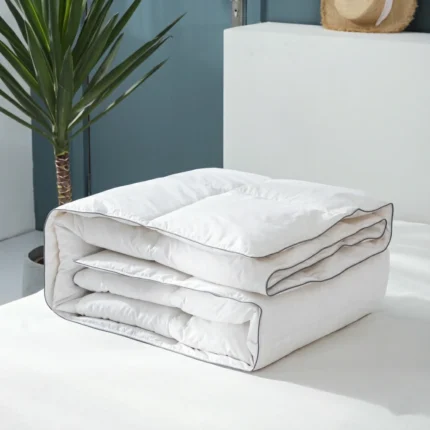
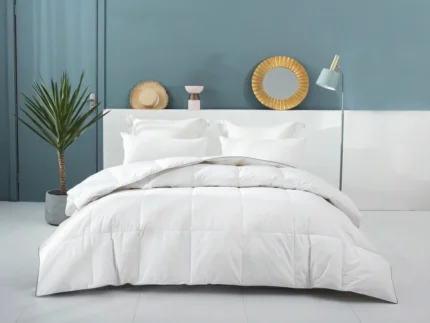
- The Combined Unit (Deep Winter): When snapped together along their perimeter borders, the two quilts combine to deliver a certified 13.5 Tog heavy winter insulation rating.
The Inter-Quilt Boundary Air Gap Effect
A critical scientific advantage of layered bedding is the microscopic boundary air gap formed between the two outer fabric shells:
Combined Thermal Resistance = Tog(Quilt A) + Tog(Quilt B) + Thermal Resistance of Trapped Boundary Air Layer
When Quilt A is snapped onto Quilt B, the air trapped between the two fabric faces creates an insulating barrier of completely stagnant air. This dead-air layer adds approximately 0.5 to 1.0 Tog of supplementary thermal resistance, allowing manufacturers to use slightly lower filling weights while still hitting certified 13.5 Tog laboratory benchmarks under BS 5335 testing.
100% Year-Round Asset Utilization
In traditional operations, when winter comforters are in use, summer duvets sit dormant in the warehouse, and vice versa. With a modular snapping system:
- During summer, Quilt A is in active circulation.
- During transition seasons, Quilt B is in active circulation while Quilt A undergoes scheduled deep sanitization.
- During winter, both units circulate together in guest rooms.
Every piece of textile inventory remains an active, revenue-supporting asset year-round, eliminating seasonal obsolescence.
2. Snap Hardware Engineering: Surviving the Commercial Laundry Tunnel
The primary failure point in consumer-grade dual duvets is the hardware. If a snap fastener breaks, rusts, or pulls out of the fabric casing during laundering, the entire unit becomes unusable.
For commercial hotel operations, fastener engineering is an exact science.
The Operational Hazards of Inferior Snaps
- Brittle Plastic Snaps: Cheap PVC or nylon snaps warp, crack, or melt when exposed to commercial tunnel dryer extraction temperatures exceeding 80°C.
- Corrosive Metal Studs: Standard metal press studs oxidize and rust when exposed to commercial alkaline detergents and chlorine-free oxidizers, permanently staining expensive white Egyptian cotton covers.
High-Tensile Polyacetal (POM) Resin vs. Enameled Brass
Commercial hospitality specifications mandate two approved hardware standards:
- Polyacetal (POM) Engineering Resin: An advanced industrial thermoplastic possessing high stiffness, low friction, and exceptional dimensional stability. POM resin snaps withstand continuous washing at temperatures up to 90°C and resist cracking under high-tonnage centrifugal water extraction presses.
- Corrosion-Proof Enameled Brass Studs: For luxury properties preferring a metallic click, heavy-gauge brass studs treated with nickel-free, lead-free electroplated enamel provide complete rust resistance across hundreds of commercial laundry cycles.
Webbing Tab Integration: Eliminating Fabric Punctures
A common manufacturing defect is riveting snap buttons directly through the outer cotton shell fabric. Under the violent pulling forces of commercial laundry extractors, the snap tears through the woven yarns, leaving a permanent hole that leaks filling.
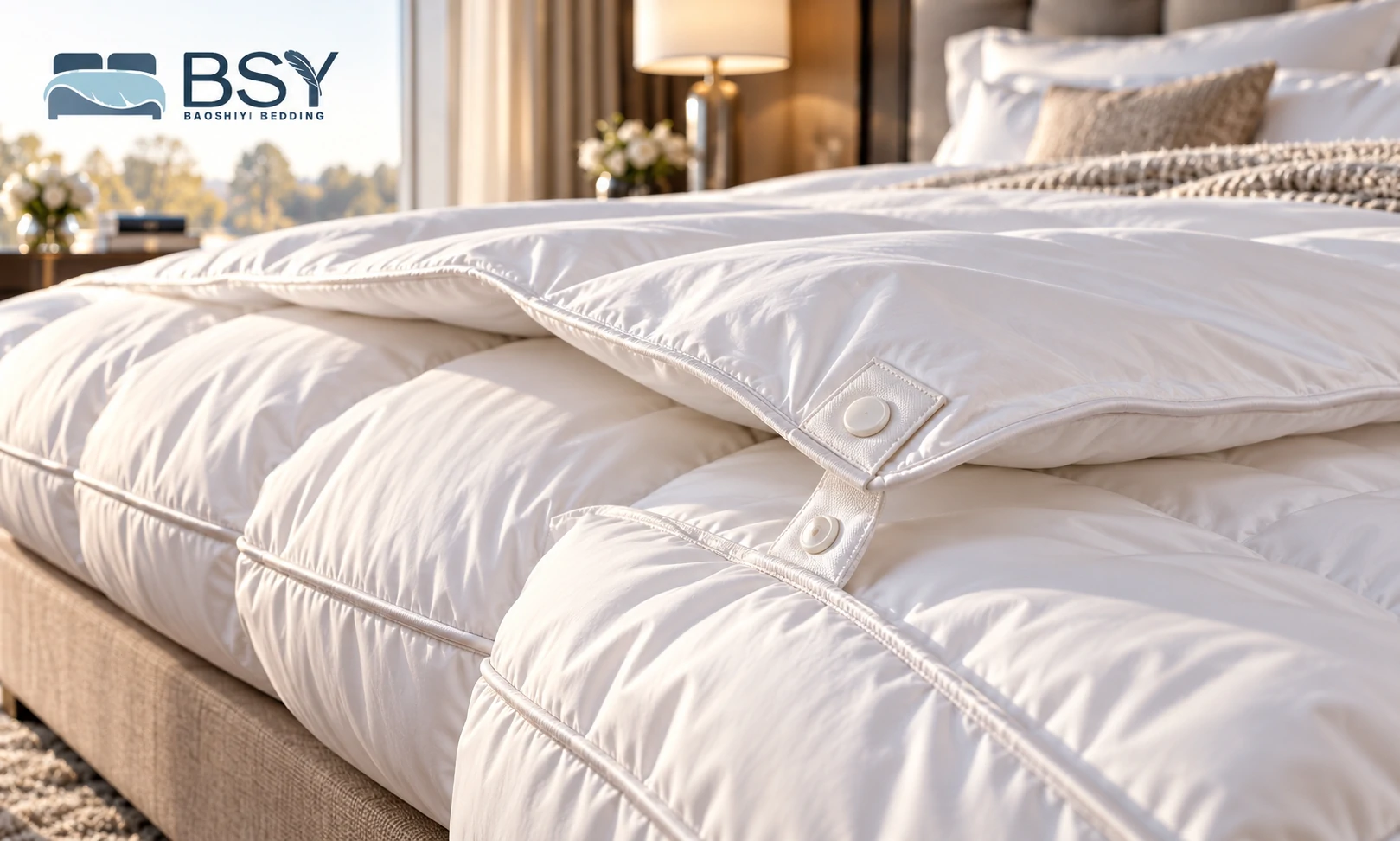
BSY manufacturing standards enforce Herringbone Twill Webbing Tabs:
- Snap hardware is riveted exclusively into heavy-duty, double-layer pure cotton herringbone twill tape (15 mm to 20 mm wide).
- This reinforced tape tab is folded and securely stitched directly into the perimeter corded piping seam assembly.
- The seam is reinforced with high-density bar-tack stitching, achieving a pull-off tensile strength exceeding 60 Newtons under ASTM D4846 testing.
3. Back-of-House Efficiency: Slashing Linen Footprint and Labor Costs
For hotel executive housekeepers and operations directors, the benefits of modular bedding extend far beyond guest comfort into measurable labor and space savings.
Reducing Linen Storage Footprint by 50%
Hotel real estate is expensive, and back-of-house linen closets on guest floors are notoriously cramped.
Storing thick, bulky 13.5 Tog winter comforters consumes immense shelf volume. With a modular system:
- Thin 4.5 Tog summer quilts fold down to a fraction of the size of a winter comforter.
- When stored during shoulder seasons, they occupy roughly half the shelving space of traditional winter bedding, freeing up room for backup towels, pillows, and room amenities.
PAR Level Optimization: Operating at 1.5 to 2.0 PAR
In standard dual-inventory setups, hotels often maintain:
- Summer Duvets: 2.0 PAR (200 units per 100 rooms)
- Winter Duvets: 2.0 PAR (200 units per 100 rooms)
- Total Inventory: 4.0 PAR (400 comforters per 100 rooms)
With a 3-in-1 modular system, the hotel maintains:
- Quilt A (4.5 Tog): 1.5 to 2.0 PAR
- Quilt B (9.0 Tog): 1.5 to 2.0 PAR
- Total Base Assets: 3.0 PAR, representing an immediate 25% reduction in total textile assets requiring tracking, storage, and replacement budgeting.
Seamless Seasonal In-Room Snapping
During seasonal transition weeks in autumn, switching an entire 300-room property from summer to winter bedding traditionally requires massive labor: moving thousands of heavy comforters from basement warehouses to upper guest floors via service elevators over multiple days.
With modular snapping duvets:
- Room attendants bring lightweight Quilt A bundles directly to the floors on standard housekeeping carts.
- The summer quilt is snapped onto the existing autumn quilt right on the bed in under 60 seconds.
- The seasonal transition is completed room-by-room without elevator congestion or centralized warehouse disruption.
4. Fill Material Options for Modular Comforter Sets
Procurement managers can specify modular duvets across multiple filling tiers depending on room class and target Average Daily Rate (ADR).
Pure White Goose Down Modular Sets (Five-Star Luxury Standard)
- Quilt A (4.5 Tog): Filled with 700+ FP white goose down (120 GSM) encased in a 300T cotton sateen shell with sewn-through box quilting to ensure maximum breathability during hot summer months.
- Quilt B (9.0 Tog): Filled with 700+ FP white goose down (220 GSM) encased in a matching 300T cotton shell with 2.5 cm internal 3D baffle-box walls.
- Combined Profile: When joined, the set delivers an ultra-luxurious, deeply lofted 13.5 Tog cloud-like winter bed that drapes with zero stiffness.
High-Resilience Microfiber Sets (Business Hotel Workhorse)
- Quilt A & B: Filled with a hybrid blend of 0.8D and 1.2D siliconized micro-denier polyester fibers encased in 233T cotton percale or brushed microfiber casings.
- Performance: Fully machine washable up to 60°C to 75°C, fast-drying, completely hypoallergenic, and highly resistant to commercial laundry friction. Ideal for high-turnover business hotels and extended-stay apartments.
The Strategic Hybrid Formulation: Synthetic Summer + Down Autumn
An innovative cost-saving formulation adopted by boutique properties:
- Quilt A (Summer): Sourced in durable, fast-drying blown microfiber (150 GSM) to withstand frequent summer washing.
- Quilt B (Autumn): Sourced in natural white duck down (240 GSM) to deliver authentic waterfowl loft and prestige.
- Combined Performance: When snapped together in winter, the down layer rests close to the body while the synthetic layer provides upper protection, delivering authentic down warmth at a 30% savings compared to an all-down set.
5. Preventing Shift and Friction Inside Commercial Duvet Covers
When two comforters are layered inside a single duvet cover, poor manufacturing will cause internal sliding, friction noise, and bunched corners. Precision factory engineering eliminates these defects.
Symmetrical Quilting Registration
If Quilt A features large 40 x 40 cm quilting squares while Quilt B features small 25 x 25 cm squares, the two quilts will pull against each other when folded or manipulated, causing internal bunching.
BSY engineering protocols require Identical Symmetrical Quilting Grids:
- The quilting grid lines of both quilts are programmed to match exactly (typically 30 x 30 cm squares).
- When snapped together, the quilting seams align in parallel, allowing both layers to flex and articulate as a unified, single comforter.
Dimensional Alignment Tolerances: Within ±1.0 cm
In high-speed production, cutting variances can cause one quilt to measure slightly wider than its counterpart. If Quilt A is 2 cm wider than Quilt B, the excess fabric will bubble and fold inside the duvet cover.
Computerized fabric spreading and automated CNC cutting tables ensure that both quilts maintain a strict dimensional matching tolerance of less than ±1.0 cm.
8-Point Perimeter Fastening with Duvet Cover Loops
To lock both quilts securely inside the exterior hotel duvet cover:
- The snapping tabs along the perimeter of the duvets are integrated with heavy-duty exterior corner and side loop ties.
- Housekeeping ties the ribbons of the outer hotel duvet cover directly through the aligned loops of both quilts, locking all three textile layers into a single, cohesive unit that never bunches or twists during guest sleep.
6. Sourcing Economics: Modular Sourcing vs. Dual Seasonal Buying
The financial justification for modular snapping systems becomes clear when comparing capital expenditure across property scales:
| Procurement Model | Initial Equipment Cost (300 Rooms / 2.0 PAR) | Back-of-House Storage Volume | Seasonal Transition Labor (Man-Hours) | Annual Asset Utilization Rate |
| Traditional Dual Buying (Independent 4.5 Tog + Independent 13.5 Tog) | 600 Summer Quilts (16,800)+600WinterDuvets(16,800)+600WinterDuvets(34,800) = $51,600 | High (~110 m³ required) | ~120 Hours (Warehouse to room cartage) | 50% (One set dormant per season) |
| Modular 3-in-1 System (Integrated 4.5 Tog + 9.0 Tog Snapping Sets) | 600 Modular Sets (Quilt A + Quilt B) = $38,400 | Low (~55 m³ required) | ~30 Hours (Direct in-room snapping) | 100% (Continuous active use) |
| Operational Variance | Direct Savings: $13,200 (25.5% CapEx Saved) | 50% Storage Footprint Freed | 75% Labor Time Saved | Zero Idle Working Capital |
Beyond direct purchase savings, shipping modular comforters in shared vacuum packaging significantly reduces international ocean container freight costs, as the lighter summer layer packs efficiently into the master carton alongside the autumn layer.
7. 5 Mandatory Quality Clauses for Modular Duvet Purchase Orders
When drafting an international Purchase Order (PO) for modular snapping duvets, include these technical specifications:
- Mandate Fastener Tensile Strength: Specify: All snap fasteners shall be constructed from non-corrosive polyacetal (POM) resin or enameled brass, riveted into reinforced twill tape and verified to withstand a minimum pull-off tensile force of 60 Newtons under ASTM D4846.
- Require Certified Multi-Configuration Tog Testing: Require: Supplier must provide certified laboratory test reports under BS 5335 / EN ISO 11092 verifying tested thermal resistance for Quilt A (4.5 Tog ±0.5), Quilt B (9.0 Tog ±0.5), and the combined snapped assembly (13.5 Tog ±0.8).
- Specify Dimensional Matching Tolerances: Mandate: Finished dimensions between Quilt A and Quilt B shall not deviate by more than ±1.0 cm along warp and weft directions.
- Enforce 8-Point Fastener Placement: Require: Snapping tabs shall be positioned at all four corners and at the exact center of each of the four perimeter sides, aligned with heavy-duty corner tie loops.
- Mandate High-Temperature Wash Compliance: State: All casing fabrics, internal fillings, and snap hardware must remain dimensionally stable (shrinkage under ±2.5%) and functional after commercial laundering at 60°C to 75°C.
8. Frequently Asked Questions (FAQ)
What makes a modular snapping duvet system more cost-effective than buying separate summer and winter duvets?
A modular system reduces initial procurement capital expenditure by 20% to 30% because hotels purchase one integrated system rather than two expensive independent comforter sets. Operationally, it cuts linen storage requirements by 50%, reduces seasonal bed-changing labor by 75%, and ensures that 100% of the hotel’s bedding assets are actively circulating year-round rather than sitting idle in storage closets.
Will hotel guests feel the snap buttons through the comforter and duvet cover?
No. High-standard commercial systems use low-profile, smooth-edged polyacetal (POM) resin snaps mounted on thin fabric tabs sewn directly into the perimeter piping seam. Because the snaps sit along the extreme outer edge of the comforter—inside the reinforced border of the duvet cover—they remain completely undetectable to sleepers resting in the center of the bed.
How do snap fasteners hold up under commercial laundry tunnel washers and ironers?
Industrial-grade POM resin snaps and enameled brass studs are specifically engineered for commercial laundry environments. They are rated to withstand water wash temperatures up to 90°C, high-pH detergents, and extraction press pressures without cracking, warping, or corroding. However, comforters should not be passed through flatwork ironers (mangles), as rolling pressure can crush internal down and damage hardware.
Can guests easily customize their own warmth level in the room?
Yes. Many upscale properties leave the summer layer snapped into the autumn layer during transition months and include a subtle guest room card explaining the modular system. Guests who sleep hot can easily unsnap the top layer to enjoy a lighter 4.5 Tog or 9.0 Tog quilt, giving them personal control over their sleep micro-climate and improving overall guest satisfaction scores.
Conclusion: Upgrading to Lean, Adaptive Hotel Bedding
In modern hospitality, operational efficiency and guest luxury must coexist. Traditional seasonal bedding strategies that require redundant inventories, wasted storage rooms, and high seasonal labor costs are rapidly giving way to smart, modular textile engineering.
By specifying 4.5 Tog + 9.0 Tog Modular Snapping Duvet Systems, hotel procurement directors achieve complete seasonal climate control, protect working capital, cut linen room footprints in half, and ensure that every guest room delivers customized, five-star sleep comfort.
Located in Xiaoshan, Hangzhou—China’s down processing and commercial textile manufacturing hub—BSY Bedding specializes in engineering commercial-grade modular snapping duvet systems for international hotel chains, serviced apartments, and retail brands. Equipped with automated precision cutting tables, high-tensile snap riveting machines, and in-house laboratory testing facilities, we manufacture certified, commercial-laundry-durable modular duvets tailored to your exact property specifications.