Understanding Thread Count: Choosing Between 233T, 300T, and 400T Down-Proof Cotton
September 16, 2026In commercial duvet manufacturing, the outer shell fabric plays a dual operational role: it must act as an impermeable physical fortress to keep down filaments and sharp feather quills locked inside, while simultaneously functioning as a breathable, vapor-permeable membrane that releases body humidity during sleep.
When a shell fabric fails, the entire duvet fails. Substandard casings leak feather dust, generate noisy paper-like rustling with every sleeper movement, or trap moisture like a plastic sheet, generating immediate customer returns and damaging hospitality brand equity.
Many international buyers operate under the oversimplified assumption that higher thread counts are universally superior. However, in technical down-proof textile engineering, yarn caliber, single-ply construction, and mechanical calendaring finishes matter just as much as thread numbers.
This sourcing guide breaks down the physical properties, air permeability metrics, commercial wash durability, and manufacturing economics of the three most specified commercial down-proof cotton shells: 233T, 300T, and 400T.
1. Deconstructing Thread Count: The Metrics That Actually Matter
Thread Count (often abbreviated as T or TC) indicates the total number of warp (vertical) and weft (horizontal) yarns woven into one square inch of fabric. However, evaluating a down-proof shell based solely on raw thread count creates significant supply chain blind spots.
Thread Count vs. Yarn Count (Ne)
The physical thickness of the woven yarn determines how many threads can fit into a square inch without congesting the weave:
- Yarn Count (English Number, Ne): Denotes yarn fineness. The higher the number (such as 40s, 60s, or 80s), the finer the individual yarn strand.
- Weaving Interlocking: Fine yarns (such as 80s) allow a dense weave (400T) that remains exceptionally lightweight. Coarser yarns (such as 40s) reach maximum density at lower thread counts (233T), producing a heavier, more rigid barrier fabric.
The Single-Ply vs. Multi-Ply Deception
Unscrupulous textile mills sometimes inflate thread counts by twisting two or three inferior, short-staple yarns together into a multi-ply thread, counting a 150T two-ply fabric as 300T.
Multi-ply yarns are coarse, heavy, and create loose micro-gaps between twisted filaments where down clusters can escape. High-standard commercial specifications must strictly mandate Single-Ply, Long-Staple Combed Cotton (Ring-Spun) to ensure uniform pore size and structural down containment.
Weave Structure: Plain Percale vs. Sateen
- Plain Weave (Percale): A classic one-over, one-under interlacing pattern. It produces a crisp, highly durable structure with small, uniform pore openings, offering the highest baseline resistance to feather quill penetration.
- Sateen Weave: A four-over, one-under interlacing pattern that floats yarns across the surface. It yields a lustrous, silky hand feel with virtually zero fabric rustle, but requires higher yarn density (60s/300T or finer) to prevent down leakage between the longer floating threads.
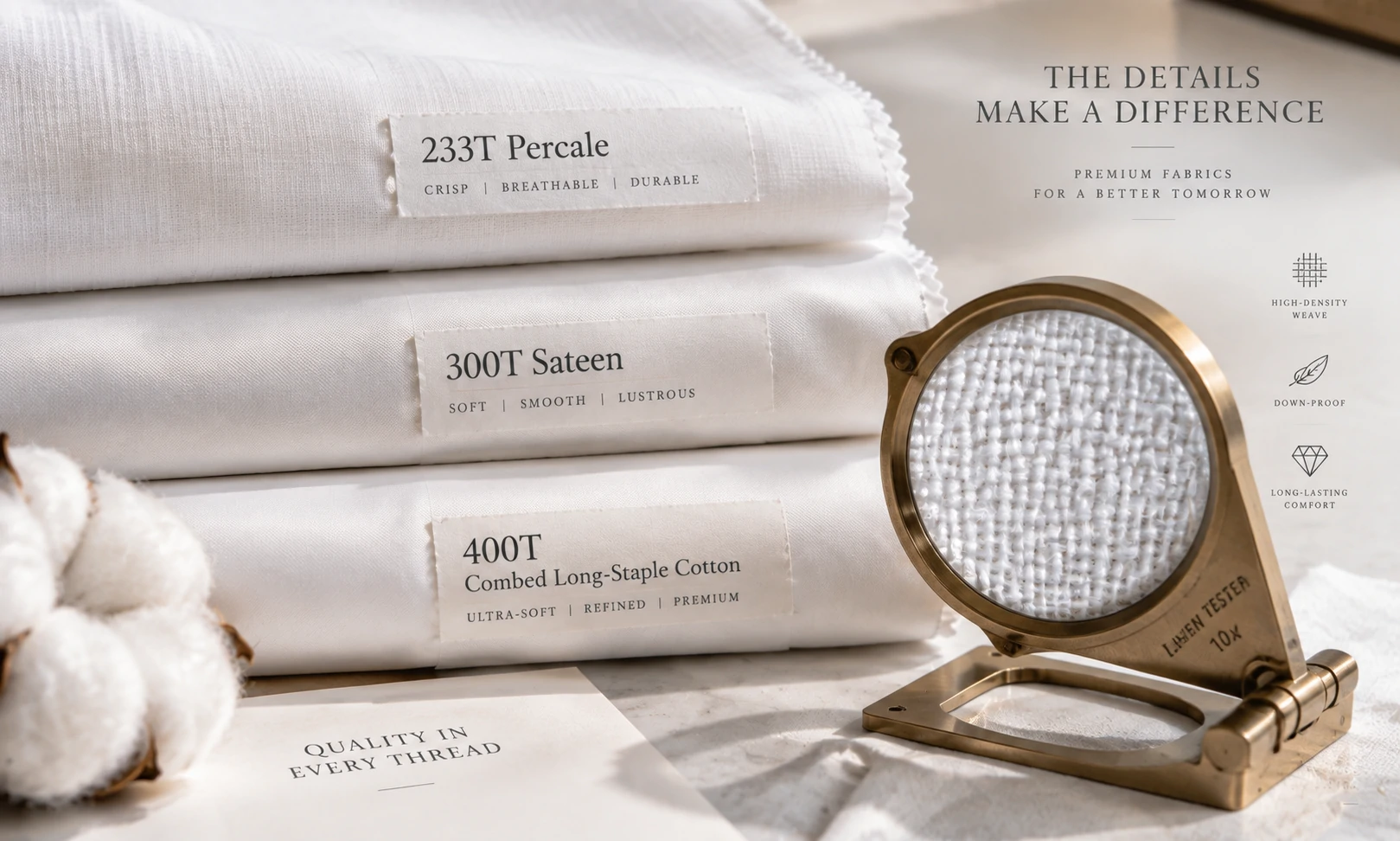
2. 233T 100% Cotton Percale: The Commercial Workhorse
Widely regarded as the global benchmark for institutional bedding, 233T cotton percale represents the most cost-effective and structurally resilient down-proof fabric available.
Construction Specifications
- Yarn Count: 40s combed cotton warp × 40s combed cotton weft (Ne 40/1 × 40/1)
- Thread Density: 133 warp yarns + 100 weft yarns per inch = 233 Threads (233T)
- Average Fabric Weight: 130 to 140 GSM
- Weave Type: Balanced Plain Percale
Operational Strengths
- Exceptional Tensile Strength: The sturdy 40s yarns withstand aggressive continuous tunnel washers, high-pH institutional detergents, and rapid extraction presses without bursting along seams.
- Superior Quill Resistance: The tight, balanced plain weave provides a dense mechanical shield that blocks stiff duck feather quills, making it the premier choice for feather/down blends (such as 15/85 or 30/70 mixes).
- Cost Efficiency: Economical raw greige material and high weaving efficiency keep FOB prices low, making it ideal for large-scale procurement programs.
Operational Trade-Offs
- Heavier Shell Weight: At approximately 135 GSM, the casing adds noticeable physical weight to the duvet, slightly dampening the loft of ultra-high fill power down (750+ FP).
- Audible Rustle (Crispness): Due to heavy mechanical calendaring on 40s yarns, fresh 233T fabric produces a distinct, paper-like rustle when manipulated. While this softens after commercial washing, it may not satisfy luxury five-star expectations.
Primary Sourcing Applications
- 3-star and 4-star business hotel chains.
- Institutional hospitality contracts, dormitories, and passenger cruise lines.
- Heavy winter duvets and commercial down/feather blended comforters.
3. 300T 100% Cotton Sateen & Percale: The Premium Hospitality Sweet Spot
For properties seeking to eliminate fabric rustle and elevate guest touchpoints without sacrificing operational durability, 300T cotton serves as the modern commercial standard.
Construction Specifications
- Yarn Count: 60s long-staple combed cotton warp × 60s long-staple combed cotton weft (Ne 60/1 × 60/1)
- Thread Density: 173 warp yarns + 127 weft yarns per inch = 300 Threads (300T)
- Average Fabric Weight: 110 to 120 GSM
- Weave Type: Sateen or Fine Percale
Operational Strengths
- Tactile Luxury and Drape: The use of finer 60s long-staple yarns creates a supple, soft casing that contours naturally around the human body, eliminating rigid tenting over the sleeper.
- Acoustic Silence: 300T sateen weaves significantly reduce internal friction noise, ensuring a quiet sleep environment critical for luxury hospitality ratings.
- Weight Reduction: Shaving 15% to 20% of shell weight compared to 233T allows natural down clusters (650 to 750 FP) to expand more freely inside the baffle boxes.
Operational Considerations
- Feather Content Limits: Because 60s yarns are thinner than 40s yarns, 300T casings are optimized for down-rich fillings (minimum 70% to 90% down cluster content). They should not be used with coarse waterfowl feathers with thick, rigid central shafts that could pierce the finer yarns over time.
Primary Sourcing Applications
- 4-star superior and 5-star boutique hotels.
- Premium direct-to-consumer (DTC) bedding brands and specialty department stores.
- All-season medium-weight duvets and high-end hotel pillow shells.
4. 400T Combed Long-Staple Cotton: The Ultra-Luxury High-Loft Standard
At the peak of luxury bedding engineering sits 400T down-proof cotton, crafted specifically for the finest white goose down in the world.
Construction Specifications
- Yarn Count: 80s extra-long staple combed cotton (Ne 80/1 × 80/1)
- Thread Density: 220 warp yarns + 180 weft yarns per inch = 400 Threads (400T)
- Average Fabric Weight: 95 to 105 GSM
- Weave Type: High-Density Percale or Micro-Sateen
Operational Strengths
- Zero Loft Suppression: Weighing under 105 GSM, 400T fabric is exceptionally light and gossamer-fine. When paired with high-fill-power goose down (750 to 850+ FP), the casing imposes virtually no physical downward pressure, allowing the fragile down clusters to achieve their maximum volumetric expansion.
- Exceptional Breathability: High-grade long-staple 80s cotton facilitates immediate body heat and moisture vapor transfer, establishing an optimal micro-climate under the covers.
- Sensory Appeal: Delivers a refined, silky texture suitable for top-of-bed luxury presentation without an exterior duvet cover if desired.
Operational Risks & Quality Controls
- Zero Tolerance for Feathers: 400T fabric must be paired strictly with 90% to 95% pure white goose down. Coarse feathers with intact quills will puncture the ultra-fine 80s yarn structure during commercial laundering extraction cycles.
- Laundering Delicacy: Demands calibrated commercial laundry parameters (mild detergents, controlled spin-cycle G-forces, and moderate tumble dry temperatures) to preserve long-term tensile strength.
Primary Sourcing Applications
- 5-star luxury flagships, presidential suites, and luxury wellness resorts.
- Heritage retail collections and bespoke private-label comforter lines retailing at $200+ FOB.
5. Beyond Thread Count: Mechanical Finishing & Down-Proof Treatments
A common misconception is that weaving density alone makes fabric down-proof. In reality, raw greige cotton fabric fresh off the loom will leak down regardless of thread count. The real barrier is created during the textile finishing process.
Mechanical Calendaring (The Only Acceptable Commercial Standard)
Mechanical calendaring passes the desized, bleached cotton fabric between heavy, heated steel rollers under extreme hydraulic pressure (frequently exceeding 30 to 50 tons) at temperatures around 150°C to 180°C.
This mechanical compression flattens the round cotton yarn profiles into ribbon-like ellipses, permanently sealing the microscopic gaps between the warp and weft intersections without compromising air permeability.
The Pitfall of Chemical Resin Coatings
Low-cost suppliers sometimes use inferior, loose-weave greige fabric and spray it with a chemical polyurethane or polyacrylate resin backing to pass basic down-proof tests.
Commercial buyers must avoid chemical resin coatings:
- Chemical coatings wash out after 3 to 5 commercial laundering cycles, causing sudden down leakage.
- Resin treatments destroy breathability, turning the duvet into a clammy, sweat-trapping enclosure.
- Coatings can release chemical odors under commercial tumble-drying heat, failing OEKO-TEX screening.
Contract specifications must explicitly state: Mechanical Calendaring Only; No Chemical Resin Coatings.
6. Laboratory Testing & Quality Verification Standards
To verify down-proof integrity prior to approving mass container shipments, commercial purchase orders should mandate accredited laboratory testing under international standards.
EN 12132-1: The Rotating Box Down-Proofness Test
The primary European and global standard for casing integrity is EN 12132-1. A sewn pillow sample of the fabric filled with standardized down and feather material is tumbled inside a rotating mechanical box containing hard silicone balls for a specified cycle count (typically 2,700 revolutions).
The test measures how many down filaments, plumules, and feather quills penetrate or pass through the fabric casing:
- Pass Threshold: Fewer than 50 total penetrated particles. Premium hotel contracts often mandate fewer than 20 particles.
Air Permeability Testing (ISO 9237)
Air permeability measures the velocity of airflow passing perpendicularly through a defined area of fabric under a 100 Pa pressure differential:
- The Sourcing Sweet Spot: Between 5.0 and 15.0 L/m²/s (liters per square meter per second).
- Risk of High Permeability (>20 L/m²/s): Down filaments will migrate through the yarn pores, resulting in feather leaks.
- Risk of Low Permeability (<3 L/m²/s): The fabric acts like a windbreaker jacket, trapping air inside the duvet during bed-making (ballooning) and preventing sweat evaporation during sleep.
7. Technical Sourcing Comparison & Purchase Order Guidelines
| Technical Parameter | 233T Cotton Percale | 300T Cotton Sateen / Percale | 400T Combed Cotton |
| Yarn Count (Ne) | 40s / 1 × 40s / 1 | 60s / 1 × 60s / 1 | 80s / 1 × 80s / 1 |
| Yarn Quality | Carded / Combed Cotton | Long-Staple Combed Cotton | Extra-Long Staple Combed |
| Fabric Weight (GSM) | 130 – 140 GSM | 110 – 120 GSM | 95 – 105 GSM |
| Fabric Weave | Plain Percale | Sateen or Percale | High-Density Percale |
| Air Permeability | 8.0 – 14.0 L/m²/s | 6.0 – 12.0 L/m²/s | 5.0 – 10.0 L/m²/s |
| Acoustic Noise Level | Moderate rustle (crisp) | Silent (minimal friction) | Ultra-quiet & silky |
| Optimal Down Pairing | Duck Down & Feathers (550–650 FP) | Goose & Duck Down (650–750 FP) | Luxury Goose Down (750–850+ FP) |
| Industrial Wash Life | 50+ commercial wash cycles | 35 to 45 commercial wash cycles | 25 to 35 gentle wash cycles |
| Relative Greige Cost | Baseline | + 20% to 30% | + 50% to 70% |
5 Sourcing Clauses to Protect Your Purchase Orders
- Mandate Single-Ply Yarns: Explicitly specify single-ply combed ring-spun cotton (e.g., 60s/1, not 30s/2).
- Specify Finishing Method: Require double-sided mechanical calendaring with zero chemical sealing agents.
- Lock Air Permeability Tolerances: Include a contractual acceptance threshold of 5.0 to 15.0 L/m²/s tested under ISO 9237.
- Demand Shrinkage Limits: Mandate maximum residual shrinkage after laundering not to exceed ±3.0% warp and weft under ISO 6330.
- Certify Chemical Safety: Require valid OEKO-TEX Standard 100 Class I transaction certificates for every dyed or bleached fabric lot.
8. Frequently Asked Questions (FAQ)
Does a higher thread count always mean a better down-proof fabric?
No. An inferior 600T fabric constructed from cheap multi-ply yarns or treated with temporary chemical coatings will leak down far faster than a dense, single-ply 233T plain percale shell with proper mechanical calendaring. Fabric density, yarn quality, and calendaring execution are far more critical than raw thread count numbers.
Why does 233T cotton percale make a rustling noise, and can it be eliminated?
The crisp, paper-like rustling sound in new 233T down-proof cotton is the physical result of passing sturdy 40s yarns through heavy, high-pressure calendaring rollers to flatten the weave and close pore gaps. While the sound softens naturally after two or three commercial laundering cycles, buyers seeking complete acoustic silence should specify 300T sateen weave instead.
Can 400T cotton fabric be used for duvets filled with feather blends?
No. Sourcing teams should never pair 400T cotton casing with fillings containing coarse waterfowl feathers (such as 15/85 or 30/70 down/feather blends). The ultra-fine 80s yarns are designed for soft down clusters; rigid, sharp feather quills will pierce and tear the fine yarns during compression and industrial spin-drying cycles.
What is the standard air permeability range for certified down-proof fabric?
The industry standard air permeability for commercial down-proof fabric is between 5.0 and 15.0 L/m²/s tested at 100 Pa pressure under ISO 9237. Fabric testing above 15.0 L/m²/s risks down fiber leakage, while fabric testing below 5.0 L/m²/s acts like a vapor barrier, trapping moisture and body heat.
Conclusion: Selecting the Ideal Casing for Your Product Program
Down-proof shell selection is an engineering balancing act. There is no single universal fabric for every application:
- Specify 233T Cotton Percale when building durable, cost-effective institutional comforters, high-turnover hotel duvets, or products containing duck feather blends where physical puncture resistance is paramount.
- Specify 300T Cotton Sateen or Percale when sourcing premium hospitality bedding, boutique hotel lines, or retail collections that demand silent acoustic comfort, elegant drape, and reliable long-term durability.
- Specify 400T Combed Long-Staple Cotton exclusively for flagship luxury collections and high-fill-power white goose down (750+ FP), giving expansive down clusters the lightweight freedom to achieve maximum volumetric loft.
As an established home textile manufacturer located in Xiaoshan, Hangzhou, BSY Bedding operates dedicated fabric testing laboratories to evaluate air permeability, tensile strength, and down-proofness under EN 12132 standards. We supply custom-calendered 233T, 300T, and 400T cotton shells tailored to global retail and hospitality specifications.