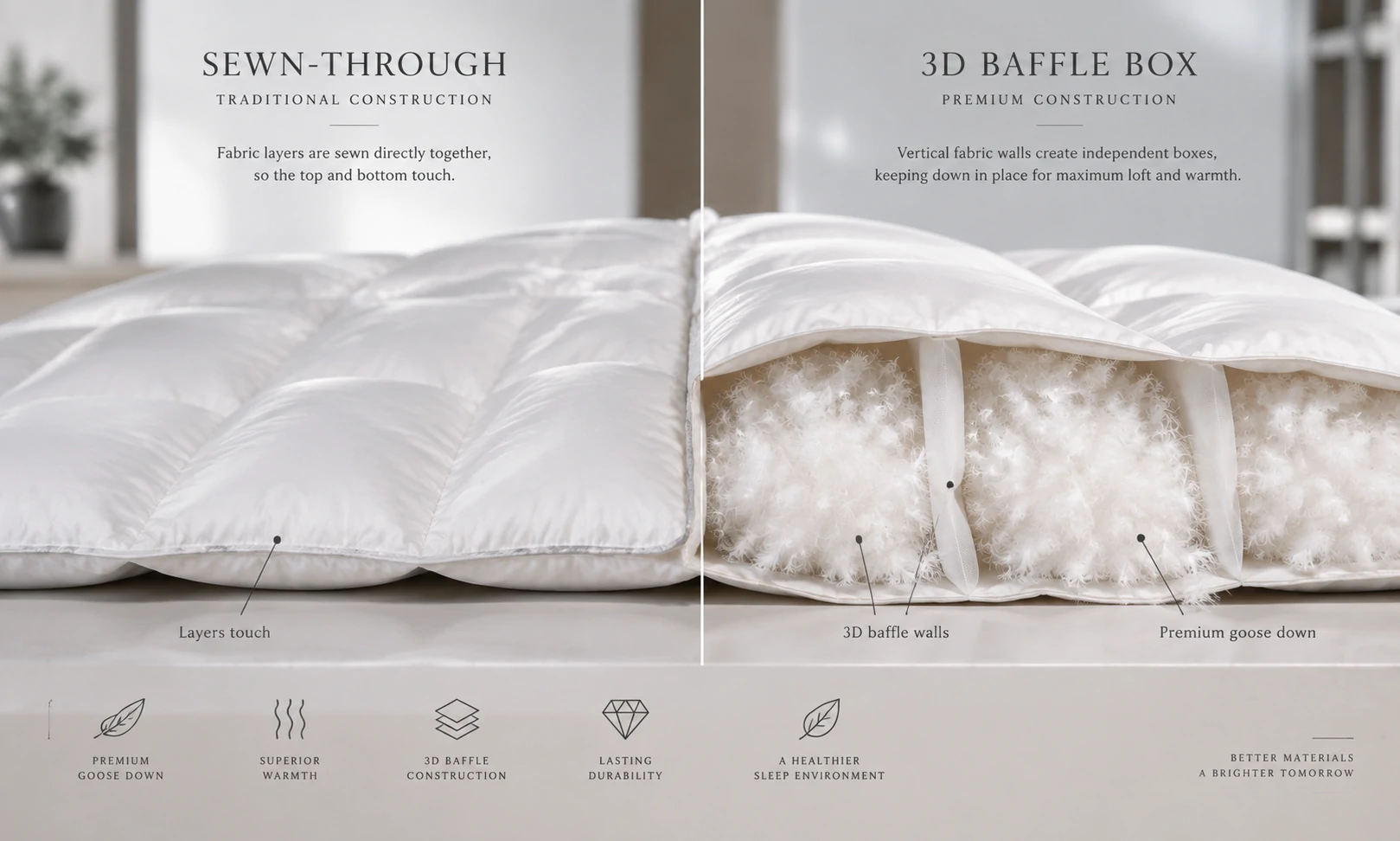
Baffle Box vs. Sewn-Through Stitching: Which Duvet Construction Prevents Cold Spots?
September 16, 2026When sourcing commercial duvets, procurement managers and retail product developers often scrutinize fill power ratings, raw down percentages, and outer shell thread counts. However, two duvets built with identical 750 fill power white goose down and identical 300T cotton casings can perform completely differently under real-world guest use.
One comforter delivers consistent, cloud-like insulation across the entire bed, while the other develops freezing cold lanes along its seam lines and allows down clusters to clump into corners after minimal laundering.
The root cause of this performance discrepancy lies in the hidden internal architecture: Sewn-Through Stitching versus 3D Baffle Box Construction.
Selecting the wrong internal construction can undermine premium raw down materials, generate customer complaints regarding cold spots, and complicate commercial laundering cycles. This engineering guide examines the thermal physics, labor economics, and structural durability of both quilting methods to help commercial buyers specify the ideal construction for their product programs.
1. The Thermodynamics of Duvet Construction: How Cold Spots Occur
To understand why quilting geometry matters, procurement teams must evaluate the mechanism of heat retention in bedding. Down does not generate warmth; rather, microscopic down barbules trap stagnant air, forming a thermal barrier that slows the conduction of body heat into cooler room ambient air.
The Conductive Cold Bridge Mechanism
In any textile insulation system, heat follows the path of least resistance:
Thermal Heat Loss = Surface Area × Temperature Differential / Thermal Resistance (R-Value)
When a sewing machine needle pierces directly through both the top and bottom fabrics to form an enclosed box, the fabric layers are compressed completely flat along the stitch line. At these seam intersections, the down thickness is reduced to zero millimeters.
These flattened seam lines act as conductive cold bridges. Body heat rapidly dissipates through these uninsulated channels, creating localized cold strips—commonly known as cold spots—across the sleeper’s body.
Down Shifting and Volumetric Compression
Flat, sewn-through pockets lack vertical wall depth. As a sleeper moves, bodily friction pushes down clusters away from the center of the pocket toward the seam edges. Because the pocket tapers down to zero height at the perimeter, down clusters become compressed, losing their volumetric expansion and leaving the center of each box depleted of insulation.
The Relationship Between Loft and Insulation
Fourier’s Law of Thermal Conduction demonstrates that heat flux is inversely proportional to barrier thickness. A duvet that maintains an unbroken 3.5 cm loft across its entire surface area provides consistent thermal insulation. Conversely, a duvet featuring deep valleys along every seam line suffers an overall thermal efficiency loss of 25% to 35%, regardless of raw down fill power.
2. Sewn-Through Construction: Mechanics, Advantages, and Sourcing Limits
Sewn-through construction (frequently referred to as Box Stitch or Channel Stitch) represents the traditional, high-throughput manufacturing standard in bedding production.
Direct Fabric-to-Fabric Stitching Geometry
The manufacturing process is straightforward: the top shell fabric, internal filling, and bottom shell fabric are layered together. A multi-needle computerized quilting machine then drives continuous thread lines through all layers simultaneously, locking the fabric faces directly together into square grids or vertical channels.
Production Speed and Cost Advantages
Because sewn-through duvets do not require internal partitions, they offer significant manufacturing advantages:
- High-Speed Automation: Multi-needle commercial quilting machines can stitch a complete Queen-size duvet shell in 3 to 5 minutes.
- Low Labor Intensity: Does not require specialized manual operators to stitch vertical mesh walls or individually blow down into compartmentalized chambers.
- Lower Unit FOB Cost: Produces a factory price savings of $3.50 to $6.00 per unit compared to equivalent baffle-box designs.
Ideal Commercial Applications: Summer Quilts (<200 GSM) and Promotional Lines
Sewn-through stitching is not inherently flawed; rather, it is designed for specific seasonal profiles:
- Summer Lightweight Duvets (3.0 to 4.5 Tog / 120 to 180 GSM): In warm climates or air-conditioned guest rooms, high insulation is undesirable. The uninsulated seam lines function as deliberate ventilation channels, allowing excess body heat to escape and preventing nocturnal sweating.
- Promotional Retail & Institutional Programs: For high-turnover budget motels, student housing, and promotional supermarket lines, sewn-through construction provides an economical way to deliver clean aesthetics at volume price points.
The Failure Point in Heavy Winter Comforters
The commercial failure of sewn-through construction occurs when buyers attempt to use it for medium or heavy winter duvets (exceeding 250 GSM). Stuffing dense volumes of down into flat-sewn pockets crushes the natural down clusters, while deep seam valleys allow cold drafts to penetrate, leading to high consumer return rates in cold markets.
3. 3D Baffle Box Construction: The Gold Standard for Commercial Loft
To eliminate the cold bridge defect, textile engineers developed the Three-Dimensional Baffle Box (3D Baffle Wall).
Anatomy of the Baffle Wall: Breathable Internal Mesh Spacers
In a true baffle-box duvet, the top and bottom fabric shells never touch. Instead, they are separated by thin, vertical strips of breathable, lightweight fabric—known as baffle walls or internal mesh spacers.
These vertical spacers transform what would be flat pockets into three-dimensional cubic chambers. The down clusters have vertical space to expand, creating an unbroken layer of insulation across the entire width and length of the bed.
Calibrating Baffle Wall Height (2.5 cm to 5.0 cm)
Baffle wall heights must be calibrated to match the target fill power and GSM of the filling material:
- 2.0 cm to 2.5 cm Baffle Walls: Optimized for 600 to 650 FP duck down in all-season weights (220 to 280 GSM).
- 3.0 cm to 3.5 cm Baffle Walls: The hospitality standard for 700 to 750 FP white goose down (280 to 350 GSM).
- 4.0 cm to 5.0 cm Baffle Walls: Engineered for heavy-winter duvets (13.5 to 15.0 Tog / 400+ GSM) and high-fill-power luxury down (800+ FP), allowing expansive plumes to achieve maximum volumetric loft.
Eradicating Cold Bridges: Creating Uniform Thermal Resistance
Because the vertical baffle walls hold down clusters directly over and beneath the seam intersections, thermal conduction lines are eliminated. A thermal imaging camera reveals that a properly constructed baffle-box duvet maintains a uniform surface temperature across both the center of the boxes and the seam boundaries.
Manufacturing Complexity: Baffle Assembly and Chamber Filling
Producing a 3D baffle-box duvet requires high operational precision:
- A skilled machine operator stitches individual vertical mesh strips along the inner face of the top shell.
- The bottom shell is aligned, and the opposite edges of the mesh strips are sewn into place, creating an internal honeycomb lattice with small blowing openings left open.
- Automated quantitative blowing injectors enter each chamber individually, injecting a calibrated weight of down (accurate to within 0.5% tolerance) before the opening is permanently sealed.
4. Technical & Sourcing Cost Breakdown: Baffle Box vs. Sewn-Through
Choosing between these constructions directly impacts production lead times, minimum order quantities (MOQs), and unit purchase pricing.
| Specification Parameter | Sewn-Through Construction | 3D Baffle Box Construction | Commercial Engineering Significance |
| Internal Architecture | Top & bottom shells sewn directly flat | Vertical breathable mesh partitions (2.5-4cm) | Baffle box creates continuous 3D loft |
| Thermal Cold Spots | Present along every stitch line | Completely eliminated | Baffle box delivers uniform insulation |
| Down Fill Weight Capability | Best for low weights (100–200 GSM) | Optimized for medium-heavy (220–500+ GSM) | Sewn-through crushes high-fill-power down |
| Target Seasonal Tier | Summer (3.0 – 4.5 Tog) | All-Season & Winter (9.0 – 15.0 Tog) | Matches regional seasonal requirements |
| Manufacturing Method | Automated multi-needle continuous line | Manual baffle assembly + chamber blowing | Baffle box requires 3x higher labor time |
| Unit FOB Price Variance | Baseline Cost | + $3.50 to $6.00 per unit | Reflects mesh material and injection labor |
| Commercial Wash Lifespan | 25 to 35 industrial wash cycles | 45 to 60 industrial wash cycles | Baffles reduce seam strain during washing |
| Ideal Target Buyer | Budget hotels, summer lines, promos | 4/5-star hotels, luxury retail, DTC brands | Aligns with brand value and room rates |
5. Quilting Patterns and Grid Dimension Optimization
In addition to wall construction, the dimensions of the individual quilting squares influence product longevity.
Square Baffle Grid Sizing (25×25 cm vs. 35×35 cm vs. 45×45 cm)
- Small Boxes (25 x 25 cm): Restricts down movement, ensuring high uniformity. However, the high density of internal baffle walls adds physical weight and increases manufacturing labor costs.
- Large Boxes (45 x 45 cm): Lower manufacturing cost, but allows too much down migration within each chamber, leading to clumping after laundering.
- The Commercial Golden Ratio (30 x 30 cm to 35 x 35 cm): Standard specification for luxury hotel bedding. Provides optimal down cluster containment while allowing natural volumetric expansion without adding excess internal mesh weight.
Edge Gussets vs. Flat Piped Borders
To complement an internal baffle box, premium comforters frequently incorporate a perimeter side gusset (walled border) measuring 2.5 cm to 5.0 cm in height.
While a flat piped edge pinches the perimeter boxes down along the mattress edges, a boxed perimeter gusset ensures the duvet maintains full loft all the way to the edge of the mattress, preventing cold drafts from entering along the sides of the bed.
6. Perimeter Sewing & Sealing Standards: Preventing Down Leaks
Down clusters are microscopic and will migrate through standard needle holes if seams are not engineered correctly. Factory specifications must mandate:
Double-Needle Topstitching Spacing (4 mm to 6 mm)
All perimeter borders must be secured with two parallel rows of lockstitching spaced 4 mm to 6 mm apart. If an exterior thread ruptures during commercial laundry extraction, the secondary interior stitch line maintains structural containment, preventing catastrophic down blowouts.
German Piping (Corded Trim)
A pre-shrunk cotton cord wrapped in high-density bias-cut fabric must be inserted into the perimeter seam. This cord reinforces stress points, provides structural rigidity to maintain square corners inside duvet covers, and forms an extra physical barrier against down fiber migration.
Needle Heat Control on Automated Production Lines
High-speed automated sewing machines generate needle friction heat exceeding 180°C, which can melt synthetic thread or burn microscopic puncture holes in dense cotton casing. High-standard factories utilize micro-fine titanium-coated needles (Size 70/10 to 80/12) paired with pneumatic needle coolers to maintain casing integrity.
7. Sourcing Decision Matrix: Matching Construction to Market Channels
To optimize your product portfolio, align duvet construction with target distribution channels:
Mandate 3D Baffle Box Construction When:
- Sourcing all-season or winter comforters with target ratings of 9.0 Tog, 10.5 Tog, 13.5 Tog, or 15.0 Tog.
- Supplying four-star, five-star, and luxury boutique hotel properties where guest sleep complaints directly impact contracts.
- Developing premium retail lines retailing above $80.00 to $100.00 FOB.
- Utilizing high-fill-power white goose down (700+ FP) that requires vertical expansion space.
Select Sewn-Through Construction When:
- Designing dedicated summer comforters (3.0 to 4.5 Tog / 120 to 180 GSM) where seam breathability prevents overheating.
- Equipping short-stay budget hotels, student accommodations, or cruise line crew quarters where low unit replacement cost is paramount.
- Developing high-volume promotional merchandise for discount supermarket chains.
8. Frequently Asked Questions (FAQ)
What is the minimum fill weight (GSM) that justifies switching from sewn-through to baffle box construction?
As an industry standard, comforters filled with natural down exceeding 220 GSM should utilize 3D baffle-box construction. Below 200 GSM, down volume is low enough that sewn-through stitching provides adequate loft without significant cold spot penalties; above 220 GSM, sewn-through stitching begins crushing down clusters, leading to severe thermal cold bridges.
Can guests visually see the internal baffle walls from the outside of a finished duvet?
No. Baffle walls are completely internal, sewn between the inner faces of the top and bottom shells. Externally, a baffle-box duvet displays a smooth grid of stitched depressions that appear slightly puffier and more three-dimensional than flat, compressed sewn-through seams.
How does baffle box construction affect the commercial laundry cycle and drying time?
Baffle-box duvets require slightly longer commercial drying times (approximately 15% to 20% longer than sewn-through quilts) because natural down clusters achieve greater volume and density within each chamber. However, baffle-box duvets withstand industrial washing better because internal mesh walls distribute hydraulic stress, reducing tension on exterior surface threads.
What is the typical factory price difference per unit between sewn-through and baffle box comforters?
Holding outer shell fabric and raw down filling constant, a 3D baffle-box duvet typically carries an FOB price premium of $3.50 to $6.00 per unit over a sewn-through duvet. This price delta covers the internal mesh fabric material, specialized cutting, manual baffle wall pre-stitching, and individual chamber injection labor.
Conclusion: Specifying the Right Interior Architecture
A down duvet’s outer fabric and raw down certification are only as effective as the internal engineering that binds them together.
While sewn-through stitching serves a practical, cost-effective purpose for lightweight summer lines, 3D Baffle Box Construction remains the non-negotiable benchmark for all-season, winter, and luxury commercial bedding. By investing in vertical internal walls, commercial buyers ensure their bedding programs deliver uniform warmth, withstand rigorous laundering, and eliminate cold spot returns.
As a high-capacity home textile manufacturer located in Xiaoshan, Hangzhou, BSY Bedding operates automated Jack sewing lines, computerized multi-needle quilters, and multi-chamber quantitative filling systems. We engineer precision-tailored sewn-through and 3D baffle-box duvets to meet exact international hospitality and retail specifications.