How to Select the Right Tog Rating for Wholesale Comforters (UK & European Market)
September 10, 2026For international home textile buyers, expanding into the United Kingdom and continental Europe presents unique regulatory and technical specifications. In North America and many Asian markets, comforters are marketed under broad consumer descriptions such as lightweight, medium warmth, or extra warmth.
In the UK and European retail ecosystems, however, warmth is an exact, measurable physical quantity: The Tog Rating.
Duvets lacking certified Tog specifications face legal compliance hurdles on European retail shelves, customer confusion, and elevated product return rates. Furthermore, importing incorrect Tog ratings can leave retailers with warehouses of unsellable stock during unseasonable weather shifts.
This B2B procurement guide details the thermodynamics of the Tog system, maps out the necessary grams per square meter (GSM) across natural down and synthetic hollowfibers, and provides regional sourcing recommendations across the UK, DACH, and Nordic territories.
1. The Engineering Behind Tog: Measuring Thermal Resistance
Originally developed by the Shirley Institute in Manchester during the 1940s, the term Tog is derived from the British slang word for clothing. Scientifically, it serves as a standardized measure of thermal resistance across textile products.
Scientific Definition and Test Mechanisms
Technically, 1 Tog equals 0.1 square meter Kelvin per Watt (0.1 m²K/W). It quantifies the temperature difference across a textile specimen divided by the heat flux passing through it:
Thermal Resistance (Tog) = 10 × (Surface Temperature Difference / Heat Flux Density)
The higher the Tog rating, the greater the thermal insulation provided by the enclosed air pockets within the duvet filling, preventing body heat from escaping into the surrounding room.
Laboratory Testing Methods (BS 5335 & Two-Plate Apparatus)
Under British Standard BS 5335 and European testing norm EN ISO 11092, duvets are tested in specialized climatic chambers maintained at 20°C and 65% relative humidity.
The comforter is placed between a heated metal plate (calibrated to human skin temperature at 33°C to 35°C) and an upper cooling plate. Precision sensors measure the electrical energy required to maintain steady plate temperatures, generating an exact, certified Tog calculation. Commercial buyers must verify that their manufacturing partner operates calibrated thermal testing equipment or partners with accredited testing institutes like IDFB or Shirley Technologies.
Tog vs. Clo vs. R-Value: Converting International Metrics
Commercial procurement teams managing multi-regional catalogs often encounter different thermal units. The mathematical conversions are exact:
- 1 Tog = 0.645 Clo (Apparel thermal unit)
- 1 Tog = 0.568 R-Value (Imperial insulation unit)
- 1 Clo = 1.55 Tog
- 1 R-Value (US) = 1.76 Tog
2. Commercial European Tog Tiers: Seasonal Positioning and Market Demand
The European market is segmented into four primary Tog tiers. Understanding commercial demand across these categories ensures optimal inventory turnover.
3.0 to 4.5 Tog (Summer Lightweight)
- Physical Characteristics: Ultra-lightweight, low profile, typically engineered with sewn-through box quilting to prevent heat buildup.
- Target Application: High-summer retail collections, Mediterranean climates (Spain, Italy, Southern France), and modern hotel rooms equipped with central air conditioning.
- Procurement Share: Accounts for approximately 15% to 20% of annual European retail sales.
7.5 to 9.0 Tog (Spring & Autumn / Transition Seasons)
- Physical Characteristics: Balanced loft with moderate thermal retention. Usually manufactured in small baffle-box or channel quilt patterns.
- Target Application: Spring and autumn shoulder seasons, energy-efficient modern residential developments, and boutique hotels maintaining controlled 21°C room environments year-round.
- Procurement Share: Represents roughly 15% of annual wholesale orders.
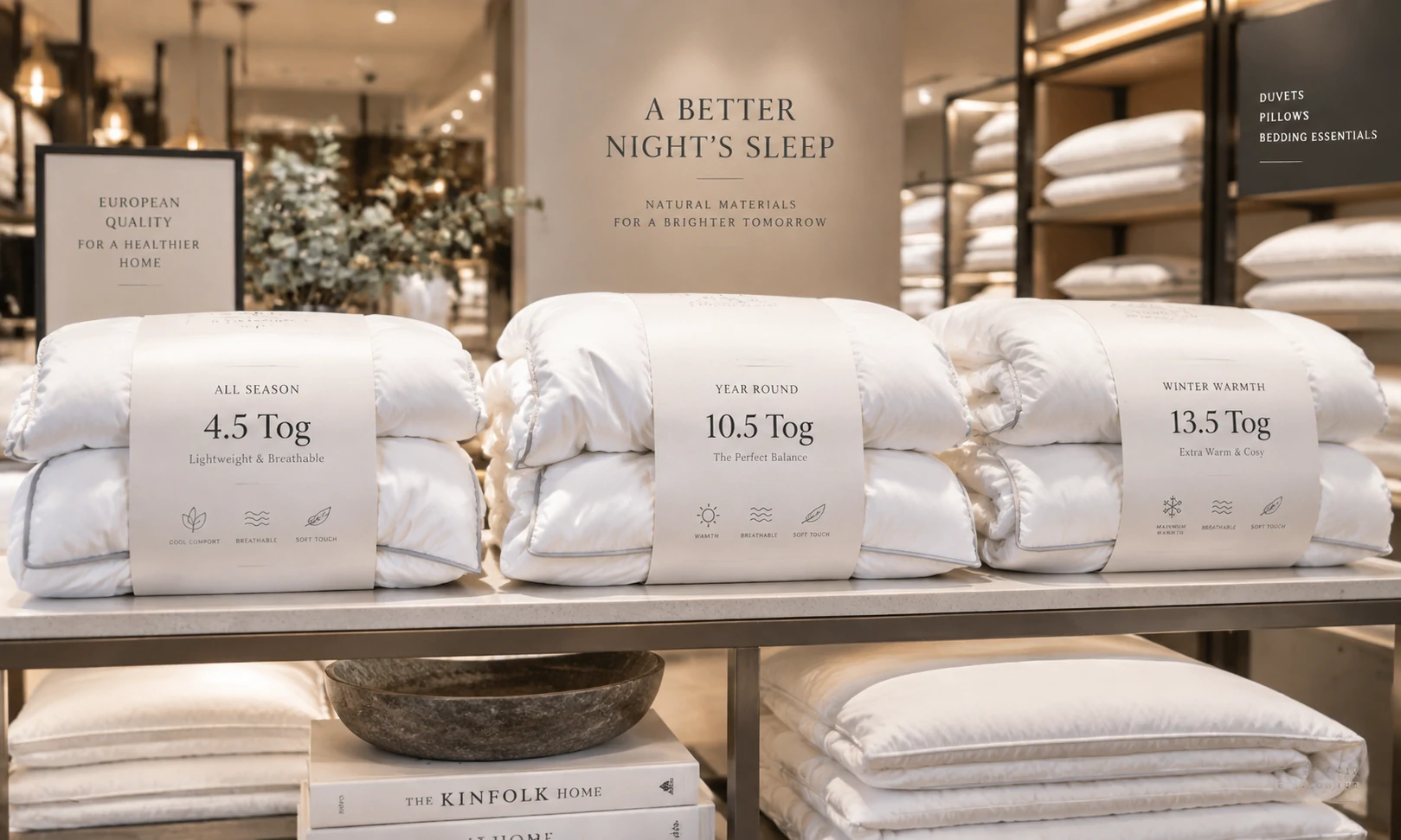
10.5 Tog (The Core Commercial Workhorse: The UK All-Year Standard)
- Physical Characteristics: Substantial loft, medium-to-heavy drape, constructed with 2.5 cm to 3.5 cm internal baffle-box walls.
- Target Application: The undisputed volume driver for UK department stores, supermarkets, and hotel groups. Considered the default all-year-round duvet for temperate climates.
- Procurement Share: Commands over 50% to 55% of total duvet production volume in British commercial contracts.
13.5 to 15.0 Tog (Heavy Winter / Cold Northern & Eastern Europe)
- Physical Characteristics: High-volume, deep loft, manufactured exclusively with deep 3D baffle-box structures to eradicate cold spots along seam lines.
- Target Application: Traditional, drafty domestic residences in the UK and Ireland, rural cottages, and unheated winter bedrooms across Northern and Eastern Europe.
- Procurement Share: Represents 15% to 20% of wholesale volume, surging heavily between September and December.
3. Calibrating Fill Weight (GSM) to Match Tog Targets
A fundamental rule in duvet engineering is that Tog measures thermal resistance, not physical weight. Sourcing directors must match the specific fill power or denier of the filling material to the target Tog rating.
The Density Discrepancy: Natural Down vs. Synthetic Hollowfiber
Because high-fill-power down clusters trap significantly more air per gram than solid or hollow synthetic polymers, a down comforter requires nearly half the physical weight of a synthetic comforter to achieve an identical 10.5 Tog rating.
- 750 FP White Goose Down: Achieves a 10.5 Tog rating with only 220 to 250 GSM of filling, creating an ultra-light, cloud-like drape.
- Standard Siliconized Hollowfiber (6D-7D): Demands 400 to 450 GSM to trap equivalent static air, resulting in a substantially heavier, denser comforter.
Complete B2B Tog vs. GSM Technical Sourcing Matrix
The following factory specification chart outlines target fill weights across standard filling categories to achieve certified European Tog ratings:
| Target Warmth Rating | White Goose Down (750 FP) | White Duck Down (650 FP) | Ultra-Fine Microfiber (0.8D) | Standard Hollowfiber (7D) | Construction Style |
| 3.0 – 4.5 Tog | 120 – 150 GSM | 150 – 180 GSM | 180 – 220 GSM | 250 – 300 GSM | Sewn-Through Diamond / Box |
| 7.5 – 9.0 Tog | 180 – 210 GSM | 220 – 260 GSM | 260 – 300 GSM | 330 – 380 GSM | Low Baffle Box (2.0 cm) |
| 10.5 Tog | 220 – 250 GSM | 280 – 320 GSM | 330 – 380 GSM | 420 – 480 GSM | 3D Baffle Box (3.0 cm) |
| 13.5 Tog | 300 – 350 GSM | 380 – 420 GSM | 450 – 500 GSM | 550 – 620 GSM | Deep Baffle Box (4.0 cm) |
| 15.0 Tog | 360 – 420 GSM | 440 – 500 GSM | 520 – 580 GSM | 650 – 750 GSM | Extra Deep Baffle (4.5 cm) |
4. The Inventory Optimization Playbook: Modular Snapping Quilts (4.5 + 9.0 = 13.5 Tog)
One of the most successful product formats in the European retail sector is the All-Seasons Dual Comforter Set.
One SKU, Three Configurations: Reducing Retail Overstock
Instead of manufacturing and warehousing three distinct SKUs for summer, autumn, and winter, procurement teams source a dual-quilt modular unit:
- Quilt A (Summer): Rated at 4.5 Tog (Lightweight, sewn-through construction).
- Quilt B (Spring / Autumn): Rated at 9.0 Tog (Medium baffle-box construction).
- Combined Unit (Deep Winter): Snapped together, the trapped air barrier between the two casings creates a certified 13.5 Tog winter system.
For retail merchandisers, this configuration simplifies supply chain forecasting, cuts shelf footprint by 50%, and provides consumers with a complete year-round sleep solution in a single retail package.
Snap Fastener Engineering: Industrial Durability
Commercial failure in dual comforters occurs almost exclusively at the fastening points. BSY manufacturing standards mandate:
- Reinforced Twill Edge Tabs: Snaps must be riveted into heavy-duty herringbone twill tape double-stitched into the perimeter piping, never directly into the outer cotton shell fabric.
- Rust-Proof, Nickel-Free Hardware: Fasteners must utilize high-tensile polyacetal resin snaps or corrosion-proof enameled brass studs that withstand repeated commercial washing up to 60°C without oxidizing or unseating.
5. Market-Specific Nuances Across Europe: UK vs. DACH vs. Nordic
Consumer sleeping habits and architectural heating standards vary significantly across European sub-regions. A uniform product line will struggle without localized adaptation.
The United Kingdom and Ireland
- Consumer Climate: Draftier legacy housing, widespread reliance on radiator heating systems that shut down overnight, and high consumer awareness of Tog numbers.
- Sourcing Focus: High-volume demand for 10.5 Tog and 13.5 Tog.
- Standard Dimensions: Single (135 x 200 cm), Double (200 x 200 cm), King (230 x 220 cm), Super King (260 x 220 cm).
The DACH Region (Germany, Austria, Switzerland)
- Consumer Climate: Highly insulated homes, triple-glazed windows, and strong emphasis on individual temperature control.
- The Dual-Single Culture: Married couples in Germany predominantly sleep under two individual Single duvets rather than one shared King duvet. Retail buyers should focus on individual dimensions: 135 x 200 cm and extended 155 x 220 cm (Komfortgröße).
- Warmth Classes: Rather than explicit Tog numbers, DACH consumers navigate by Wärmeklassen (Warmth Classes 1 to 5). Sourcing contracts must map tested Tog ratings directly to these DIN standards: Class 1 (Summer, up to 4.5 Tog) through Class 5 (Extra Warm, 13.5+ Tog).
The Nordic Region (Sweden, Norway, Denmark, Finland)
- Consumer Climate: Exceptionally energy-efficient, well-insulated homes with consistent indoor climate control.
- Sourcing Focus: Despite sub-zero outdoor temperatures, Nordic consumers sleep in warm bedrooms and strongly prefer breathable, lightweight 7.5 to 10.5 Tog duvets. Sourcing heavy 15 Tog quilts in Scandinavia leads to high consumer return rates due to overheating.
- Standard Dimensions: 140 x 200 cm (Standard Single) and 140 x 220 cm (Extra Length).
6. Standards, Labeling, and Compliance in the UK and European Union
To pass customs clearance and retailer quality audits, exported duvets must comply with strict statutory testing and labeling frameworks.
British Standards (BS 5335) and European Norms (EN ISO 11092)
Export documentation should reference laboratory certification confirming tested Tog values under BS 5335:1991 or thermal resistance testing (
RctRct) under EN ISO 11092:2014. Contract specifications should establish an allowable commercial tolerance margin of ± 0.5 Tog from the stated packaging claim.
Mandatory Textile Labeling Under Regulation (EU) No 1007/2011
In the European Union, the composition of textile products must be clearly labeled in the official language of the destination country. For down-filled bedding:
- Down and feather percentages must be stated precisely (such as 90% Duck Down / 10% Duck Feather).
- Generic claims like “Down Rich” or “100% Down” must meet strict statutory thresholds (minimum 90% down cluster content under European standard EN 12934).
Contract Hospitality Flammability: BS 7175
For contract hospitality, commercial duvets exported to the UK and Ireland must comply with BS 7175 (Methods of test for the ignitability of bedcovers and pillows by smouldering and flaming ignition sources).
Depending on the property risk tier, fabrics and fillings must pass Source 0 (Cigarette test), Source 1 (Match test), or Crib 5 (Wood crib flame test) to satisfy municipal fire regulations.
7. Frequently Asked Questions (FAQ)
What is the most popular all-season duvet Tog rating in the UK market?
The 10.5 Tog rating is the undisputed market leader in the UK, accounting for more than 50% of commercial wholesale orders. It provides a balanced level of insulation suitable for year-round use in centrally heated British homes and hotel properties.
How does down fill power impact the required GSM to reach a specific Tog rating?
Higher fill power down traps more insulating air per unit of weight. Consequently, achieving a 10.5 Tog rating requires only 220 to 250 GSM of 750 FP goose down, compared to roughly 300 GSM of 650 FP duck down, or over 420 GSM of synthetic hollowfiber.
Can a synthetic microfiber duvet achieve the same Tog rating as a goose down duvet?
Yes. Thermal resistance (Tog) measures heat retention regardless of the filling medium. A 450 GSM microfiber duvet can deliver the exact same 10.5 Tog insulation as a 230 GSM down duvet; however, the synthetic comforter will be significantly heavier and denser in physical drape.
What is the acceptable laboratory tolerance margin for commercial Tog rating certifications?
Under British and European manufacturing standards, the standard commercial tolerance is ± 0.5 Tog for ratings up to 10.5 Tog, and ± 1.0 Tog for heavy winter ratings between 12.0 and 15.0 Tog. Laboratory certifications should test multiple production batch samples to verify conformity within this margin.
Conclusion: Building an Optimized European Duvet Line
Successfully navigating the European and UK duvet markets requires combining thermodynamic calculations with localized consumer insight. By establishing exact Tog rating targets, matching appropriate GSM weights across filling types, and ensuring verified laboratory compliance with BS 5335 and EN ISO 11092, wholesale buyers can build profitable, low-return bedding collections.
As a certified home textile manufacturer based in Xiaoshan, Hangzhou, BSY Bedding engineers custom-calibrated down and synthetic duvets tailored to European Tog standards, backed by full RDS traceability, OEKO-TEX Standard 100 compliance, and accredited thermal lab testing.