The B2B Buyer’s Guide to Down Duvet Sourcing: Fill Power, GSM, and Fabric Shells
September 10, 2026Sourcing down duvets in bulk is one of the highest-value yet operationally complex procurement categories in the home textile sector. Whether you are outfitting a portfolio of luxury hotel suites, developing a premium private-label comforter line for a department store, or scaling an e-commerce brand, down comforters present distinct engineering challenges.
Unlike synthetic alternatives, natural down bedding involves volatile raw material commodities, complex international testing protocols, and precise manufacturing tolerances. A slight discrepancy in fabric air permeability can cause down leakage across thousands of units, while inflated fill power ratings can result in substandard thermal insulation and customer returns.
This comprehensive technical guide outlines the core physical metrics of down duvet production: Fill Power (FP), Grams per Square Meter (GSM), and Fabric Shell Construction. By mastering these parameters, procurement directors and commercial buyers can eliminate guesswork, protect their supply chains, and negotiate directly with manufacturing facilities on measurable physical criteria.
1. Demystifying Down Fill Power (FP): The Engine of Insulation
Fill power represents the definitive commercial benchmark for down quality. In technical terms, fill power measures the volume in cubic inches that one ounce of down occupies under controlled laboratory conditions, evaluated according to International Down and Feather Bureau (IDFB) testing protocols:
Fill Power (FP) = Volume (Cubic Inches) / Weight (1 Ounce of Down)
Higher fill power indicates larger, more mature down clusters. These expansive clusters trap more air pockets relative to their weight, producing superior thermal retention without adding physical heaviness.
Commercial Fill Power Tiers in B2B Procurement
- 550 to 600 FP (Standard Commercial / High Volume Retail): Derived primarily from younger duck down or mixed feather blends. Suitable for economy hotel chains, seasonal promotional lines, and budget retail programs. Provides adequate warmth but requires higher filling weights, yielding a heavier comforter drape.
- 650 to 700 FP (Premium Hospitality / Mid-to-High Retail): The commercial standard for 4-star and 5-star business hotels, boutique rental portfolios, and premium DTC bedding collections. Sourced from mature duck or white goose down. Delivers an optimal balance of plushness, loft longevity, and production cost efficiency.
- 750 to 800+ FP (Luxury Hospitality / High-End Department Stores): Sourced from mature white goose down across cold climate regions. Used exclusively for presidential suites, luxury residential collections, and prestige private-label offerings. Delivers cloud-like lightness, immediate loft recovery, and exceptional breathability across broad ambient temperature ranges.
Goose Down vs. Duck Down: What the Data Shows
While goose down typically reaches higher maximum fill power thresholds (800+ FP) due to larger avian cluster maturity, premium duck down at 650 to 700 FP delivers comparable thermal insulation at a more competitive cost basis.
For commercial buyers, the critical differentiator is washing, de-dusting, and sterilization. Duck down contains higher natural fat and oil content, demanding rigorous industrial scouring to ensure turbidity ratings exceed 1,000 mm and oxygen consumption numbers stay below 10 mg/100g, eliminating persistent odors under humid operational conditions.
2. Fill Weight (GSM) and Seasonal Warmth Calibration
A widespread misconception in consumer bedding is that heavier comforters are inherently warmer. In down engineering, warmth is governed by the volume of trapped dead air (fill power), while total fill weight (GSM) determines the seasonal performance envelope.
Deploying excessive filling into a tight baffle box compresses down clusters, restricting their expansion and decreasing thermal performance. Sourcing teams must calibrate fill weight based on destination climate, commercial heating systems, and regional warmth scales such as the UK Tog rating system.
B2B Seasonal Warmth & Specification Matrix
| Market Classification | European Tog Rating | Recommended Fill Power | Target Fill Weight (GSM) | Primary Application / Climate |
| Summer Light | 3.0 – 4.5 Tog | 650 – 750 FP | 120 – 180 GSM | Tropical climates, air-conditioned hotel rooms, summer retail collections |
| All-Season Medium | 9.0 – 10.5 Tog | 650 – 750 FP | 220 – 300 GSM | Temperate zones, year-round climate-controlled hospitality suites |
| Heavy Winter | 13.5 – 15.0 Tog | 600 – 700 FP | 350 – 450+ GSM | Cold northern climates, low-heating domestic residences |
| Dual Modular (Snapping) | 4.5 + 9.0 = 13.5 Tog | 700 – 800 FP | 150 GSM + 250 GSM | Modular dual-quilt sets joined by snap buttons for all-year retail versatility |
For retail procurement teams, All-Season modular snapping duvets offer an efficient inventory strategy. By joining a 4.5 Tog summer quilt to a 9.0 Tog autumn quilt via reinforced edge snap buttons, retailers provide three distinct warmth configurations from a single SKU, reducing inventory risk while offering customers year-round flexibility.
3. Fabric Shell Engineering: Zero Leakage with Maximum Breathability
The fabric shell serves as the primary barrier preventing down and feather quills from escaping into the guest room, while allowing moisture vapor to transfer away from the body. An inferior shell compromises the highest-grade down within days of commercial laundering.
Thread Count (TC) and Fabric Construction
Thread count indicates the number of horizontal and vertical yarns per square inch. However, thread count alone does not guarantee a down-proof barrier; yarn count (such as 40s, 60s, 80s) and weave density are equally vital.
- 233T 100% Cotton Percale (40s Yarn): The baseline commercial workhorse. Features a plain weave treated with mechanical calendaring. Highly durable, withstands industrial washing, and offers an economical down-proof barrier suitable for institutional contracts.
- 300T 100% Cotton Sateen / Percale (60s Yarn): Delivers a softer, quieter hand feel. Widely selected for high-end boutique hospitality and domestic retail brands where low fabric rustling noise is prioritized.
- 400T Combed Long-Staple Cotton (80s Yarn): Ultra-fine, lightweight shell fabric. Essential for high-fill-power down (750+ FP), allowing fragile down clusters to expand without being weighed down by a heavy outer casing.
Down-Proof Verification: The EN 12132 Testing Protocol
Commercial contracts should specify compliance with EN 12132 (Determination of the down-proof properties of fabrics). This standard utilizes a rotating mechanical tumble box packed with synthetic silicone balls to simulate rigorous commercial use.
Fabric shells that pass this testing prevent down migration while maintaining balanced air permeability, ideally between 5 to 15 liters per square meter per second. Fabric with excessively low air permeability acts like a plastic film, trapping body perspiration and causing uncomfortable heat buildup.
Mechanical Finishing: Calendaring vs. Chemical Coatings
To make woven fabric down-proof, mills apply calendaring—passing raw cotton between heated, high-pressure rollers to flatten yarn intersections and close microscopic gaps.
Buyers should verify that the factory relies on mechanical calendaring rather than heavy polyurethane chemical sprays. Chemical resin coatings wash out after repeated commercial laundering cycles, leading to sudden down leakage down the line.
4. Quilting Architecture & Structural Integrity
How down is contained within the shell directly influences insulation consistency and washing resilience.
Baffle Box vs. Sewn-Through Stitching
- Sewn-Through Stitching: The top and bottom fabrics are sewn directly together, forming enclosed pockets. While cost-effective, the stitch lines have zero filling, creating structural cold bridges where heat escapes. This construction is appropriate only for lightweight summer duvets under 200 GSM.
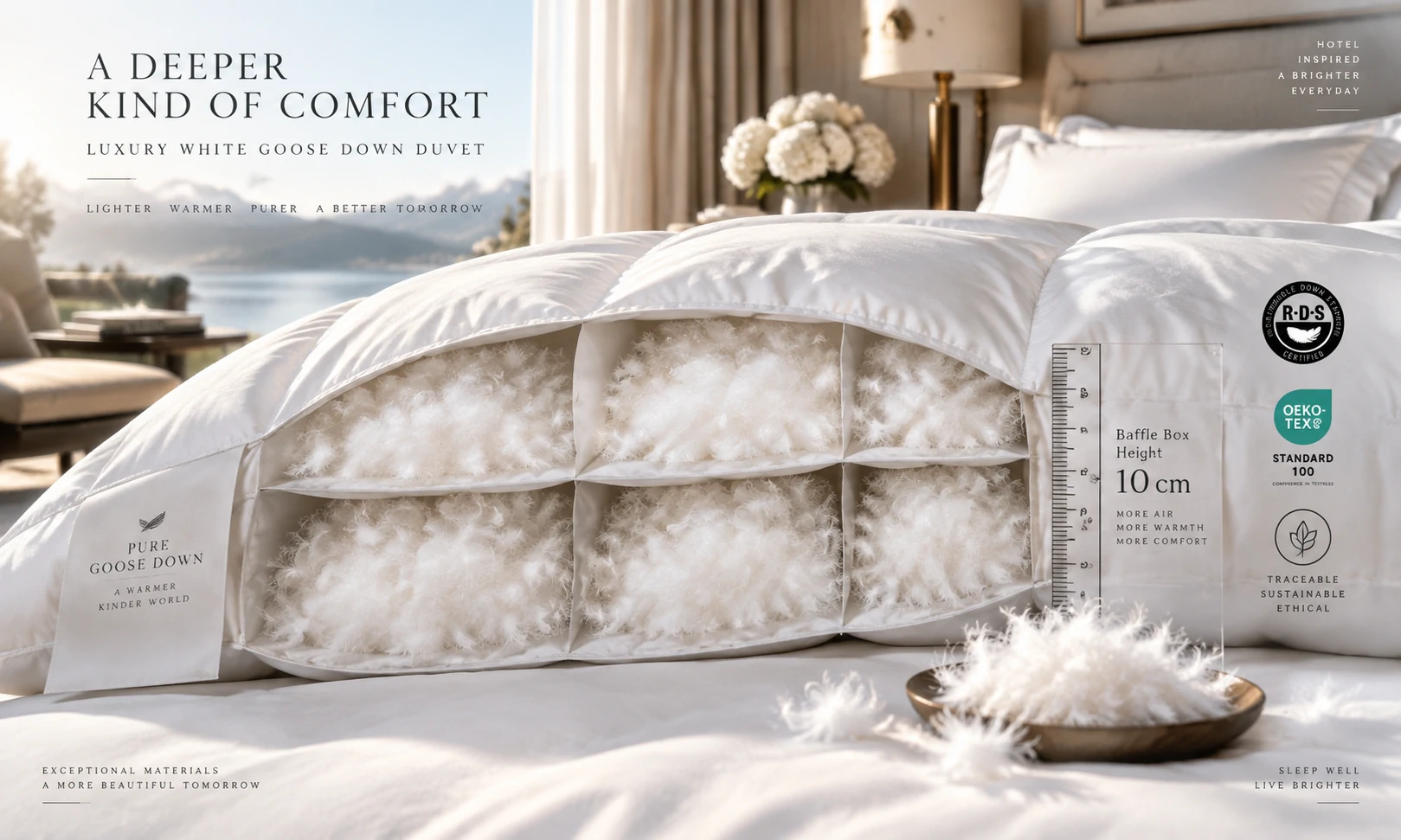
- 3D Baffle Box Construction: The top and bottom shells are joined by vertical internal fabric mesh walls, typically 2.5 cm to 4 cm in height. This box profile allows down clusters to expand to their full volumetric loft across the entire duvet surface, eliminating cold spots. Baffle-box construction is mandatory for premium hospitality and winter-weight bedding.
Perimeter Seams and Piping Durability
Down leakage most commonly occurs along perimeter seams. Commercial-grade specifications require:
- Double-Needle Topstitching: Two parallel rows of stitching spaced 4 mm to 6 mm apart, providing redundant barrier protection against burst seams.
- Piped Edging (German Piping): A structural cord wrapped in fabric strip sewn securely along the outer border, which reinforces stress points and maintains a clean, squared silhouette inside duvet covers.
5. Ethical Compliance, Chemical Safety, and Testing Protocols
Global regulatory environments require rigorous documentation for animal welfare and chemical safety. Sourcing teams cannot afford supply chain disruptions driven by customs rejections or negative ESG audits.
The standard traceability chain follows a direct sequence:
Certified Farm Supply → RDS or Downpass Chain of Custody Audit → In-House Laboratory Inspection → OEKO-TEX Standard 100 Chemical Screening → Finished Commercial Export.
Responsible Down Standard (RDS) & Downpass
All bulk natural down procurement should require verified chain-of-custody documentation, such as the Responsible Down Standard (RDS) or Downpass. These certifications guarantee that down and feathers originate from ducks and geese that have not been subjected to live-plucking or force-feeding, tracing the supply chain from raw agricultural farms to the finished export packaging.
Chemical Safety: OEKO-TEX Standard 100 Class I
Duvet shells and internal fillings must maintain OEKO-TEX Standard 100 certification, preferably Class I, approved for direct skin contact and infant use. This certification validates that the product is free from hazardous levels of formaldehyde, heavy metals, chlorinated phenols, and harmful azo dyes.
Key Laboratory Cleanliness Benchmarks
Before accepting finished down batches, require certified laboratory test reports confirming:
- Turbidity (Cleanliness): Equal to or greater than 1,000 mm. Confirms complete removal of natural organic dust and debris via light transmittance testing.
- Oxygen Number: Equal to or less than 10 mg per 100 grams. Measures remaining oxidizable organic matter; values above 10 signal insufficient washing and potential for microbial growth and odor.
- Moisture Content: Maintained strictly between 9% and 13% to prevent bacterial formation during prolonged ocean freight transport.
6. Packaging Architecture and Container Logistics
For international buyers, maritime shipping costs directly influence landed unit pricing. Down is naturally resilient and highly compressible, allowing significant cubic meter (CBM) optimization when managed correctly.
Vacuum Compression: Limits and Loft Recovery
Advanced vacuum-packing equipment can compress down bedding volume by up to 60% to 70%, substantially increasing master carton capacity inside 40-foot High Cube (40HQ) containers.
However, excessive hydraulic compression or prolonged warehouse storage past six months can fracture down feathers and damage cluster hooks.
- Best Practice: Use calibrated mechanical compression with internal polyethylene waterproof sealing. High-fill-power goose down (700+ FP) will regain 95% to 100% of its uncompressed loft volume within 24 to 48 hours of unpacking and gentle shaking.
Port Logistics
Partnering with production plants situated within proximity to key deep-water ports—such as Shanghai Port or Ningbo-Zhoushan Port in the Zhejiang textile corridor—reduces domestic trucking lead times, lowers inland container handling surcharges, and ensures reliable departure scheduling during peak pre-holiday shipping quarters.
7. The 5-Point Sourcing Checklist Before Issuing a Production PO
Before signing an international purchase contract for bulk down comforters, ensure your supplier satisfies these technical and operational criteria:
- Verify Raw Material Testing Reports: Request current IDFB, RDS, or third-party down cleanliness testing reports specifically tied to your current production batch.
- Review Fabric Permeability Specs: Confirm that down-proof fabric shells have passed EN 12132 testing and verify that calendaring is mechanical rather than a wash-away chemical finish.
- Inspect Seam and Corner Details: Check for double-needle perimeter stitching, robust interior corner loop ties for fastening inside duvet covers, and uniform baffle box heights.
- Audit Metal Detection Protocols: Ensure the production line uses multi-frequency needle detection scanners for every single finished comforter prior to vacuum packaging.
- Establish Clear Tolerance Thresholds: Contractually establish standard commercial tolerances for fill weight within plus or minus 3%, finished dimensions within plus or minus 2 cm, and moisture content at or below 12%.
Conclusion: Building a Defensible Bedding Program
Procuring down duvets at scale requires balancing technical metrics with operational realities. By establishing precise parameters for fill power, calibrating GSM targets to actual seasonal heating requirements, and demanding lab-tested down-proof casing materials, commercial buyers can confidently build resilient, high-margin bedding collections.
As a manufacturer located in China’s down processing hub of Xiaoshan, Hangzhou, BSY Bedding partners with global brands, department store groups, and hospitality supply companies to engineer fully certified, custom-manufactured down comforters built to exacting international standards.